low price 2 function manual patient nursing beds with wheels Company - Bulk Supply and Specification Guide
Scope of Supply and Physical Form
| Finish | Colour Options | Typical Use | Lead Time (weeks) |
|---|---|---|---|
| Epoxy powder coat | White, Light Grey, Soft Blue | General ward, long‑term care | 4‑6 |
| Chrome plated | Bright Chrome | High‑visibility areas, infection control | 6‑8 |
| Anti‑microbial powder coat | White, Pale Green | ICU, isolation rooms | 5‑7 |
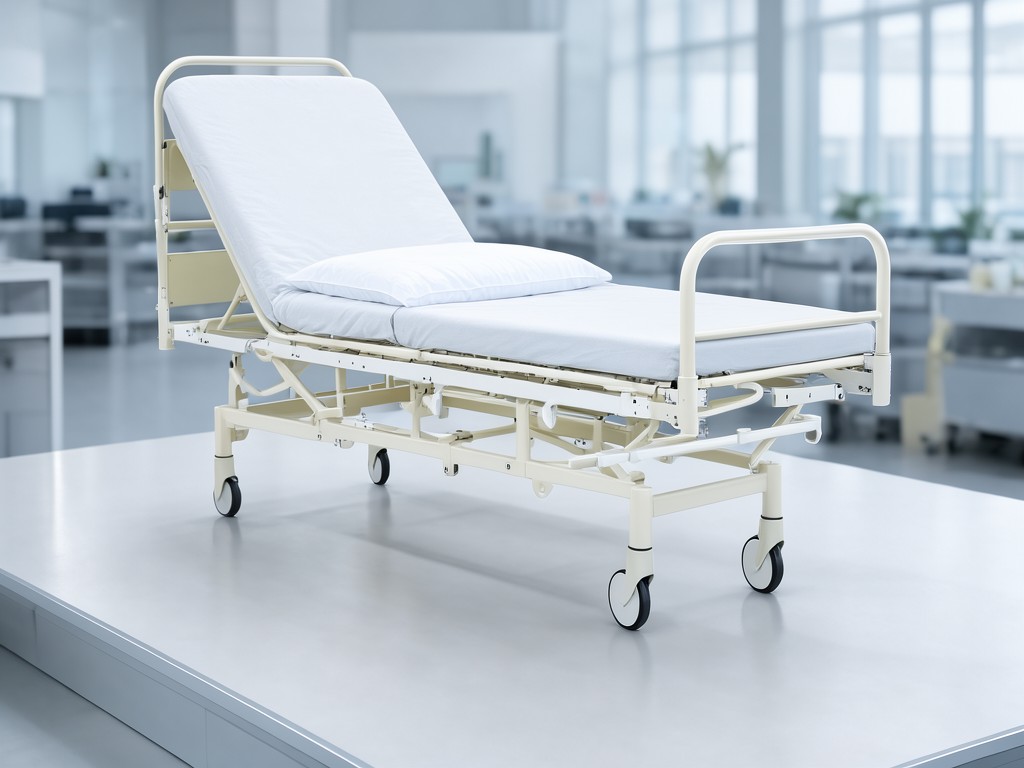
Each unit ships as a fully assembled frame with two manual crank functions (back‑rest elevation and knee‑break) and four 100 mm locking casters. The frame is built from 1.8 mm cold‑rolled steel tube, welded at 6 mm fillet radius to meet a 180 kg static load rating. Dimensional tolerance on overall length is ±5 mm, width ±3 mm, height ±4 mm — agreed on the production drawing before first article inspection.
The mattress platform uses a 30 mm high‑density polyurethane core (35 kg/m³) with a removable, washable cover. Crank cycles are rated to 10 000 operations per function; torque required at the handle stays below 12 Nm across the full travel range. Wheels are double‑ball‑bearing, non‑marking polyurethane, lockable with a single foot pedal.
The Problem Buyers Keep Paying For
Total cost of ownership shifts once returns are counted. Beds that leave the factory with a 0.5 mm weld mis‑alignment develop a squeak after 2 000 crank cycles, forcing a warranty claim that costs three times the unit price in logistics and re‑work. Cheaper stock options fail at the worst point in the season — when a ward is at full occupancy and a single immobile bed blocks a discharge pathway.
Replacement rate, not unit price, drives the budget. A 2 % early‑failure rate on a 500‑bed order adds ten extra units, extra freight, and a week of delayed ward commissioning. The specification that prevents this is a 100 % first‑article dimensional check plus a 500‑cycle crank endurance test on every batch before release.
Materials and Construction Trade-offs
Specification Agreement Checkpoint
Before any steel is cut, the buyer signs off on a 2‑page drawing set: frame geometry, crank lever geometry, caster mounting pattern, and finish code. A physical pre‑production sample (one bed) is shipped for tactile approval — crank feel, wheel lock engagement, and surface gloss. Only after written sign‑off does the line move to volume.
Cold‑Rolled Steel (1.8 mm)
Higher stiffness, 180 kg load rating, 10 000 crank cycles with <0.2 mm play. Cost per frame ≈ $42. Weight 28 kg. Preferred for high‑turnover wards where durability outweighs handling effort.
Aluminium Alloy 6063‑T5 (2.0 mm)
30 % lighter (≈ 20 kg), same load rating if wall thickness increased to 2.0 mm. Crank torque rises to 14 Nm due to lower torsional rigidity. Cost per frame ≈ $55. Chosen for mobile‑unit deployments where staff lift beds daily.
Powder‑coat adhesion is verified by cross‑hatch test (ISO 2409) after a 200 h salt‑spray exposure; failure triggers a re‑coat batch. Chrome plating adds 0.15 mm thickness, improves cleanability but adds 2 weeks to lead time and raises unit cost by ≈ $8.
Customisation Options and Their Limits
Branding is limited to a laser‑etched logo on the headboard (max 120 mm × 40 mm) and a colour‑matched label on the crank handle. Artwork must be supplied as vector AI/EPS at 300 dpi; any raster file triggers a 3‑day artwork correction loop. Custom mattress cover fabrics (e.g., PVC‑coated polyester, 180 gsm) are available in 5 standard hues; non‑standard Pantone matches require a minimum 200‑unit run and add 2 weeks.
Artwork Approval Flow
1) Buyer uploads vector file → 2) Factory returns a digital proof with placement overlay → 3) Buyer signs off via email → 4) First‑article sample produced → 5) Physical sign‑off on sample → 6) Volume release. Each step is timestamped; any revision after step 3 adds 5 working days.
Caster options: standard 100 mm lockable polyurethane (included), optional 125 mm anti‑static casters for MRI suites (adds $3/unit, 1 week lead). Side‑rail kits (fold‑down, 2‑piece) are a separate line item; they mount to pre‑drilled 8 mm holes on the frame and do not affect crank clearance.
Questions Buyers Ask Before Ordering
- What is the minimum order quantity for a custom colour? 200 units; below that the setup cost for the powder‑coat line makes the per‑unit price exceed the standard catalogue price by >15 %.
- Can the crank handle be swapped for a lever‑type actuator? Yes, but the lever adds 15 mm to the overall width and requires a revised drawing sign‑off; lead time extends by 3 weeks.
- How are the beds packaged for sea freight? Each bed is shrink‑wrapped, placed on a fumigated wooden pallet (1200 × 800 mm), strapped with two polyester bands. Stack height limited to 2 units per pallet to keep centre of gravity below 1.2 m.
- What warranty coverage applies to the crank mechanism? 24 months or 10 000 cycles, whichever occurs first, covering parts and labour. Wear items (crank bearings, wheel locks) are excluded after 12 months.
- Is there a fast‑track sample programme? A pre‑production sample can be shipped within 10 working days after drawing approval; the buyer covers express freight. The sample is invoiced at 1.2× unit price and credited on the first bulk order.
Ready to Validate the Spec?
Request a physical sample and receive the full drawing pack for sign‑off before you commit to volume.
Request a Sample