factory direct one function manual hospital beds with mattress factory: Specification, Ordering and Quality Notes
What This Product Is and Where It Fits
| Parameter | Standard Configuration | Heavy-Duty Configuration | Unit | Typical Test Method |
|---|---|---|---|---|
| Safe Working Load (SWL) | 170 | 250 | kg | Static load test, 1.5× SWL for 5 min |
| Backrest Angle Range | 0–75 | 0–80 | ° | Digital inclinometer at full crank |
| Mattress Core Density | 32–35 | 40–45 | kg/m³ | ISO 845 indentation load deflection (ILD) 25% compression |
| Crank Cycle Life | 15,000 | 30,000 | cycles | Automated cyclic test at rated load |
| Frame Coating Thickness | 60–80 | 80–100 | µm | Magnetic gauge, 5 points per bed |
A one-function manual bed targets facilities that need reliable backrest adjustment without the cost of electric actuators. The crank mechanism uses a worm gear with a self-locking nut; the standard configuration runs a 12 mm diameter screw, while the heavy-duty version steps up to 16 mm to handle the higher SWL. Mattress selection is baked into the SKU — foam density and ILD are matched to the frame’s deflection profile so the sleeping surface stays flat when the backrest is raised. Buyers should note that the heavy-duty frame adds roughly 8 kg per unit, which impacts container loading and freight class.
Customisation Options and Their Limits
Epoxy Powder Coat (Standard)
60–80 µm dry film thickness, textured finish. Passes 500 h neutral salt spray (ISO 9227) with < 2 mm creep from scribe. Scratch resistance: 2H pencil hardness. Colour matching to RAL or Pantone within ΔE ≤ 1.5.
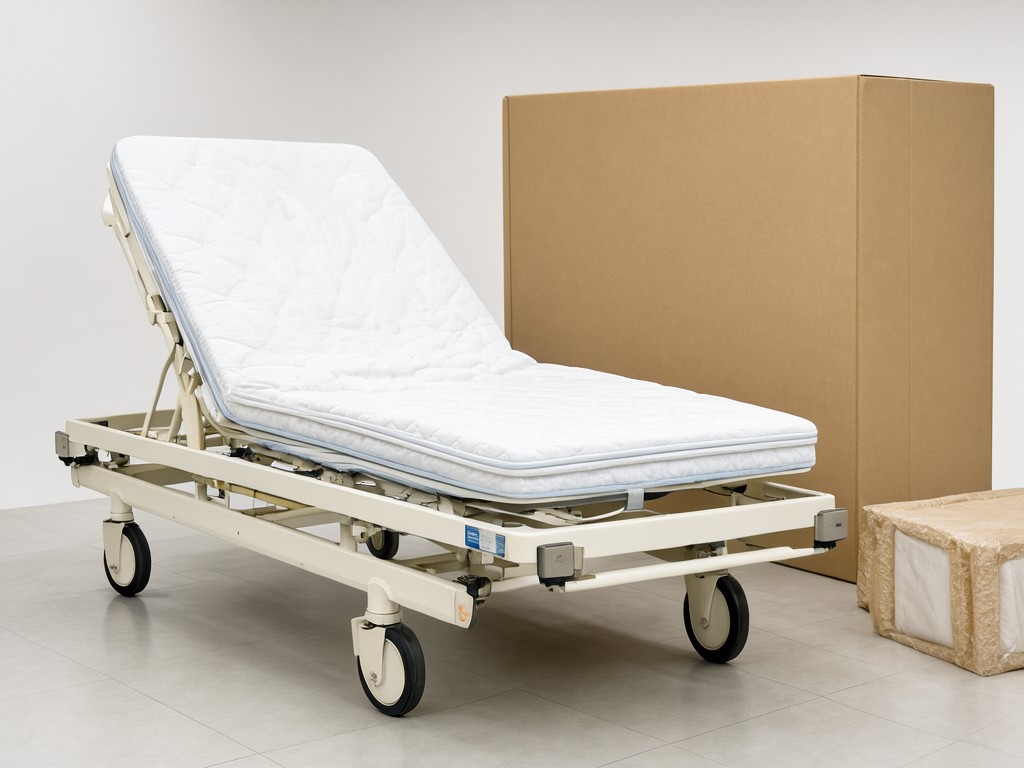
Limitation: chips at sharp edges if beds are stacked without corner protectors during sea freight. Touch-up paint available in 500 ml tins matched to batch.
Chrome Plating (Optional)
20 µm nickel + 0.3 µm chromium. Passes 1000 h salt spray with no red rust. Surface hardness 900 HV. Adds 1.2 kg per bed. Required for markets where disinfectant fogging uses quaternary ammonium compounds that attack epoxy.
Limitation: 3-week longer lead time for plating slot; minimum order 50 units per colour. Not compatible with custom powder-coat logos.
Mattress cover material is another decision point. PVC-coated polyester (180 gsm) offers weldable seams and low cost but stiffens below 10 °C. PU-coated nylon (150 gsm) stays supple to -20 °C and breathes better, yet costs 18–22% more and requires high-frequency welding equipment that not all lines carry. We freeze the cover spec at sample approval; changing later forces a new tooling review and a minimum 500-piece re-run.
Side rails come in two styles: full-length split (two halves) or half-length fixed. Split rails add 1.5 kg and two extra pivot points — each pivot is a potential squeak source after 5,000 cycles. We grease pivots with food-grade PTFE paste at assembly; buyers specifying rail-less configurations for pediatric wards should confirm local regulations allow it.
Requirements by Buyer Segment
Specification Agreement Protocol
Before any production run, we require a signed-off technical data package (TDP) that includes: 2D drawings with ±1 mm tolerances on critical dimensions (overall length, width, mattress platform height), a bill of materials with supplier part numbers for foam, cover, casters and crank assembly, and a colour master for powder coat or chrome. Private-label buyers must also supply artwork files (AI or PDF/X-1a, 300 dpi, CMYK) for headboard/footboard logos at least 10 working days before first article inspection.
First article inspection (FAI) covers dimensional check, crank torque measurement (target 1.8–2.2 Nm at no load), mattress ILD verification, and coating adhesion cross-hatch test (ISO 2409, rating ≥ 4B). FAI report is the gate to mass production; any deviation triggers a corrective action record and a re-sample if the deviation is on a critical-to-quality characteristic.
Distributors typically lock in the standard configuration with a single mattress SKU to simplify inventory. They care about knock-down packaging efficiency — our standard pack fits 12 beds per 40 ft HC container when frames are nested and mattresses rolled. Brand product managers often request the heavy-duty frame with PU cover and split rails to differentiate on comfort and infection control; they also ask for serialized QR codes on the frame for asset tracking, which adds a laser-marking station and 0.3 minutes per unit cycle time.
Procurement officers for public tenders focus on total cost of ownership: they want crank cycle life data, spare parts availability for 7 years, and a warranty that covers frame welds for 5 years and mattress foam for 3. We provide a spare parts list with unit prices at quotation stage so they can model maintenance budgets.
Quality Control and Batch Consistency
Each production batch (typically 200–500 units) follows a controlled plan: incoming steel coil certified to EN 10130 DC01, foam blocks sampled for density and ILD at 1 per 50 blocks, cover fabric roll-tested for tensile strength and colour fastness to light (ISO 105-B02, grade ≥ 4). Welding parameters (current, voltage, travel speed) are logged per shift; a destructive macro-section is done on the first and last frame of each shift to verify penetration ≥ 80% of plate thickness.
Crank assemblies are 100% torque-tested on a calibrated rig; any unit exceeding 2.5 Nm no-load torque is quarantined for gear meshing inspection. Mattress foam blocks are cut from the same bun to minimise density drift; we track ILD per batch and flag any shift > 5% from the approved mean. Coating thickness is measured at five fixed points per bed; the batch passes if the average is within spec and no single reading falls below 50 µm.
Traceability: every bed gets a laser-etched serial number on the frame side rail linking to the batch record, coil heat number, foam lot, and cover roll. This enables targeted recalls if a material defect surfaces post-delivery — something we’ve executed twice in eight years, both times limited to < 0.3% of a batch.
What Gets Checked Before Shipment
Final inspection is a 12-point checklist performed on a statistical sample (AQL 1.5, level II per ISO 2859-1) plus 100% visual on all units. The checklist includes: frame dimensions, crank operation through full range, mattress cover seam integrity (no open welds), caster swivel and brake function, side rail latch engagement force (15–25 N), label legibility, packaging completeness (instruction manual, warranty card, assembly tools), and carton drop test (one corner, three edges, six faces from 60 cm). Failed units are reworked or scrapped; the batch ships only when the sample passes and the rework rate is < 2%.
We photograph each container load — showing pallet configuration, stretch wrap tension, and desiccant placement — and upload the images to the shared drive before the truck leaves the dock. Buyers receive the packing list, FAI report, and a certificate of conformity (CoC) referencing the agreed TDP revision. No third-party test certificates are issued unless specifically contracted; we can arrange SGS or Intertek witness testing at buyer’s expense.
Questions Buyers Ask Before Ordering
- What is the minimum order quantity for custom colours? 50 units for powder coat, 100 units for chrome. Below that, we apply a setup surcharge of $350 per colour.
- Can we supply our own mattress foam? Yes, but it must meet our density and ILD spec and pass our incoming inspection. We charge a handling fee of $2 per mattress for receiving, inspection, and line integration.
- How do you handle warranty claims on the crank mechanism? We ship a replacement crank assembly (pre-assembled with gear and handle) within 5 working days of claim validation. The faulty unit is returned freight-collect for root-cause analysis.
- What are the packaging options for air freight? We offer a reinforced export carton (double-wall, 500 gsm) with foam corner protectors and vacuum-sealed mattress roll. This adds $18 per bed but reduces volumetric weight by 12%.
- Do you support private-label serialization with our own numbering scheme? Yes, provide a CSV with the serial range; we laser-etch during final assembly. Minimum batch 200 units for laser setup.
- What is the typical lead time from TDP sign-off to first container? 45–55 calendar days for standard configuration; add 10 days for chrome plating or custom mattress cover welding fixtures.
Ready to Review Tooling and Sample Plan?
Send us your technical data package or a marked-up spec sheet. We’ll return a detailed tooling review — including crank gear material options, foam bun yield calculations, and packaging optimisation — within 3 business days. No commitment required.
Start a Tooling Review