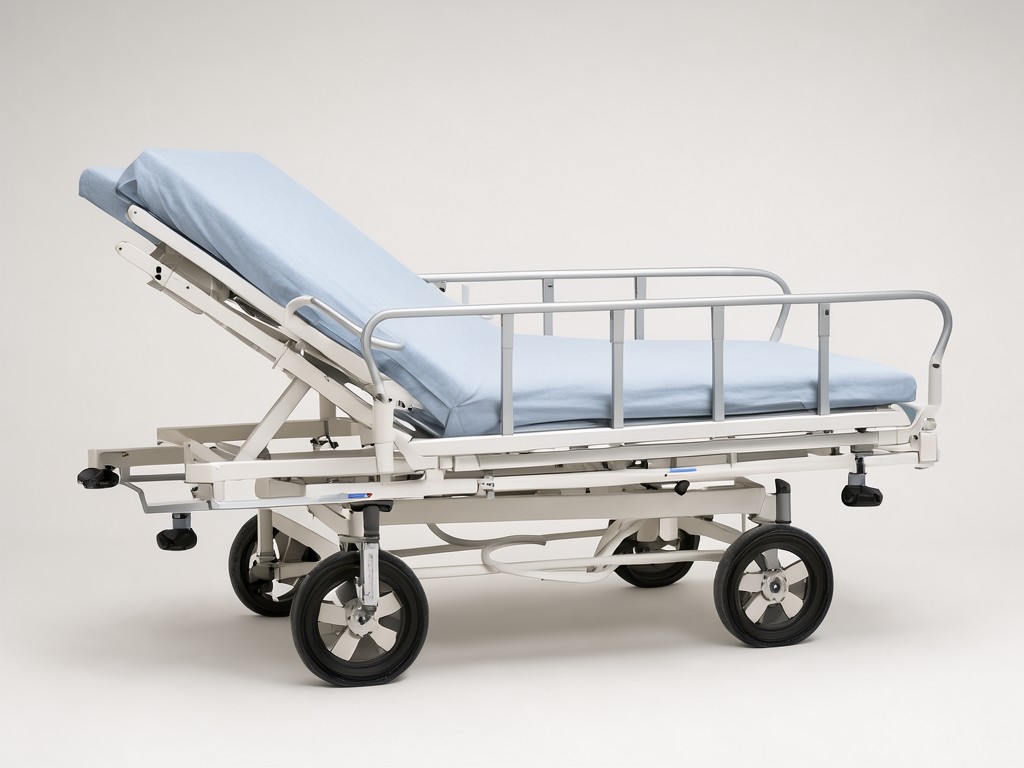
Specifying factory direct movable manual medical bed for patients exporter for Wholesale and OEM Orders
What Actually Determines Performance
Load rating, caster cycle life, and frame weld integrity drive the real‑world performance of a manual medical bed.
- Static load capacity tested to 250 kg per bed, verified by a 1.5× safety factor.
- Caster brake engagement force measured at 12 N; wheels rated for 100 000 lock‑unlock cycles.
- Frame welds inspected by ultrasonic scan; acceptance threshold 0.2 mm maximum discontinuity.
How It Is Built and What That Changes
The build method decides the durability ceiling. Each bed starts as a 40 mm × 40 mm square steel tube, cold‑formed and robotically welded at 1200 °C. After welding, the frame undergoes a 12‑stage phosphate conversion coating before a 80‑µm epoxy‑polyester powder coat is cured at 200 °C.
Critical spec rule: any deviation greater than ±0.5 mm in the head‑foot rail spacing triggers a re‑run of the welding fixture. This tolerance directly prevents the most common field complaint — misaligned side‑rail brackets that bind during patient transfer.
Mattress support uses a 30 mm high‑density polyurethane core (45 kg/m³) bonded to a breathable PVC‑coated fabric. The bond is validated by a 90° peel test requiring ≥ 5 N/mm.
Customisation Options and Their Limits
Two finish families cover the majority of private‑label requests.
Standard Powder Coat
Colour palette limited to RAL 9003 (white), RAL 7035 (light grey), and RAL 5010 (hospital blue). Minimum order 200 units per colour.
Coating thickness 80 µm ± 10 µm; salt‑spray resistance 500 h per ASTM B117.
Anti‑Microbial Topcoat
Adds a silver‑ion infused clear layer (15 µm) over the base coat. Extends microbial reduction to > 99.9 % after 24 h contact (ISO 22196).
Available only on the three standard colours; MOQ rises to 500 units because the topcoat requires a dedicated curing line.
Who Uses It and Where It Matters
Primary buyers fall into three groups, each with a distinct service environment.
- Public‑hospital procurement teams — beds must survive daily high‑turnover patient flows and aggressive cleaning chemicals.
- Private‑clinic chains — emphasis on aesthetic consistency across sites; colour match tolerance ± ΔE 1.5.
- Medical‑equipment distributors exporting to regions with 40 °C ambient temperatures — caster lubricants rated to –20 °C to +60 °C.
Working as a Production Partner, Not a Catalogue Supplier
First‑article tooling determines the entire production trajectory. Before any steel is cut, we lock a 3‑D CAD model, a 2‑D drawing pack with GD&T, and a signed-off sample. The sample approval checklist covers:
- Dimensional verification of all critical lengths (± 0.3 mm).
- Caster brake torque measured with a calibrated torque wrench.
- Coating adhesion cross‑hatch test (ISO 2409) rating ≥ 4B.
Only after the sample passes does the production BOM freeze. Any later change triggers a new first‑article run and a revised lead‑time quote. For a fast track, use the specification review form to upload your drawings and receive a feasibility report within 48 hours.
Quality Control and Batch Consistency
Every production lot undergoes a three‑gate inspection.
| Usage Condition | Typical Complaint | Preventive Specification |
|---|---|---|
| High‑frequency patient turnover (≥ 30 moves/day) | Caster brake wear leading to unintended roll | Brake torque ≥ 12 N; 100 000 cycle rating |
| Aggressive disinfectant cleaning (chlorine‑based, 5000 ppm) | Powder‑coat chipping at weld seams | Phosphate conversion + 80 µm epoxy‑polyester; adhesion 4B |
| Hot‑climate storage (40 °C, 80 % RH) | Mattress core sag > 15 mm after 6 months | 45 kg/m³ PU core; compression set ≤ 5 % at 70 °C/22 h |
Stock Availability and Reorder Planning
Standard‑finish beds (white, light grey, hospital blue) are held in a rotating buffer of 150 units per colour at the Shenzhen warehouse. Anti‑microbial topcoat variants are built to order.
- Reorder point set at 30 units; automatic PO generated when stock dips below threshold.
- Lead time for buffer replenishment: 18 calendar days from PO confirmation.
- Custom colour or topcoat orders: 35 calendar days plus first‑article approval.
Ordering, Tooling and Lead‑Time Questions
- What is the minimum order quantity for a new private‑label colour? 200 units for standard powder coat; 500 units if the anti‑microbial topcoat is required.
- How long does first‑article tooling take? Typically 12 working days from approved drawings to a test‑ready sample.
- Can we supply our own mattress fabric? Yes, provided the fabric meets the 5 N/mm peel strength and passes the ISO 10993‑5 cytotoxicity screen.
- What documentation accompanies each shipment? Packing list, certificate of conformity (load test, caster cycle, coating adhesion), and a batch traceability sheet linking each bed to its welding fixture ID.
- Is there a warranty on the caster brake mechanism? 24 months or 100 000 cycles, whichever occurs first, provided the bed is operated within the specified load envelope.
Ready to Align Specifications?
Submit your drawings, colour targets, and volume forecast through the specification review form. Our engineering team returns a feasibility matrix, unit cost breakdown, and a firm lead‑time quote within two business days.
Open Specification Review Form