Custom manual 3 crank medical bed top Factory: Specification, Ordering and Quality Notes
What This Product Is and Where It Fits
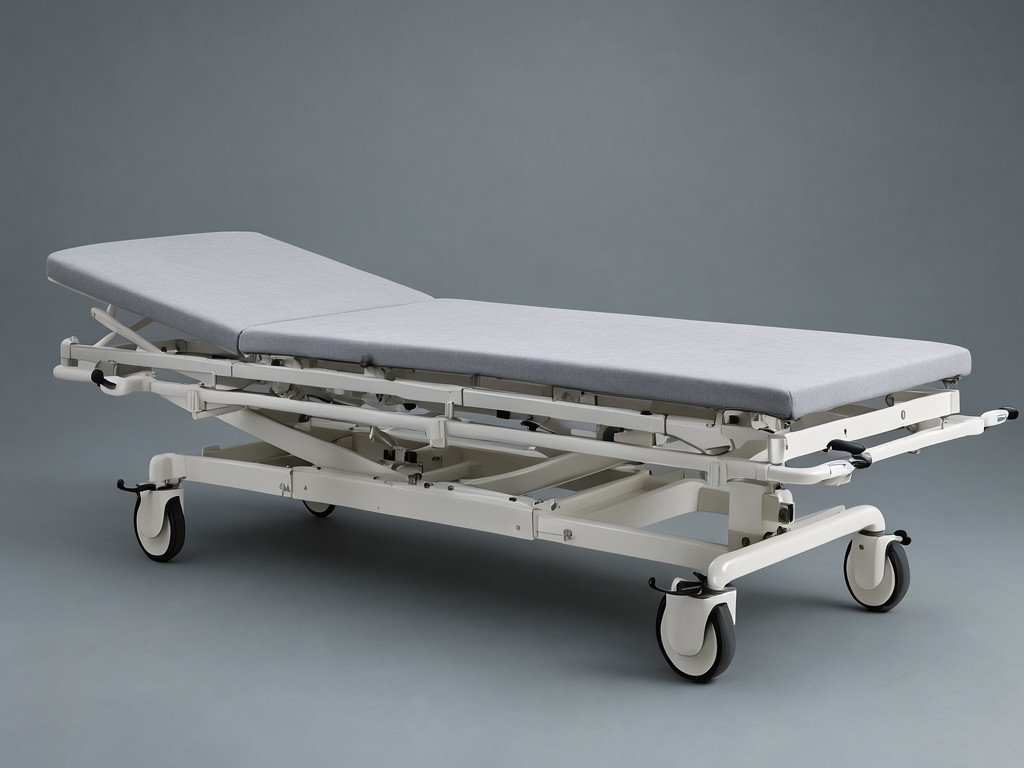
Fatigue appears at the stress concentration where the backrest pivot meets the main frame, not in the crank handle or the screw drive. A manual three-crank bed top — backrest, knee-break, and height or Trendelenburg — lives in wards where nurses adjust positions twenty times a shift, and cleaning crews hit every surface with quaternary ammonium or hypochlorite solutions daily. The mattress platform is not a passive shelf; it is a moving structure that must hold 250 kg static load plus dynamic impact without permanent set, while the epoxy coating survives 5,000 wipe-downs without chalking.
Buyers specifying private-label programs usually start with a competitor's catalogue page and ask for "the same thing." The same external dimensions hide different steel grades, wall thicknesses, and pivot-bush materials that change service life by a factor of three. This page documents the specification levers that actually move the needle on durability and consistency, so the next purchase order locks in the performance the ward expects.
Design Constraints Behind the Specification
The limiting factor is rarely the headline specification. A 250 kg safe working load sounds identical across suppliers until you ask how it was derived — static centre-point load on a fully flat deck, or distributed load with backrest at 70° and knee-break at 30°? The latter produces 40% higher bending moment at the backrest pivot tube. If the tube is 40 × 40 × 2 mm Q235 instead of 40 × 40 × 2.5 mm Q345, the safety factor drops from 3.2 to 1.8. That difference does not show up in a catalogue; it shows up as a cracked weld after eighteen months.
Crank torque is the other hidden variable. A 12 mm diameter Acme screw with a 3 mm pitch needs roughly 18 Nm at full load. If the supplier substitutes a 10 mm screw to save material, torque climbs to 28 Nm — above what a 5th-percentile female nurse can apply comfortably. The spec card below captures the parameters that separate a bed top that lasts seven years from one that gets warranty-claimed in two.
Frame Steel
Q345B, 2.5 mm min wall at pivots; Q235 acceptable for non-load ribs
Screw Drive
Tr12×3 Acme, case-hardened 45# steel, trapezoidal nut in POM or bronze
Pivot Bush
Oil-impregnated bronze ID 20 mm, flanged; no plastic at primary articulation
Deck Boards
ABS 4 mm or PP 5 mm, ventilated, snap-in; must pass 80°C/24h flatness test
Coating
Epoxy-polyester powder, 80–100 µm, salt spray 500 h, cross-hatch 0
Articulation Angles
Backrest 0–75°, knee-break 0–40°, height 400–700 mm or Trend ±12°
How It Is Built and What That Changes
Weight and stiffness trade off against each other. The frame is robot-welded on a fixture that locates pivot holes to ±0.15 mm. Manual welding introduces heat distortion that misaligns the backrest pivot by 0.5–0.8 mm — enough to accelerate bush wear and create a measurable "clunk" at 30° elevation. After welding, every frame enters a shot-blast booth (Sa 2.5) before powder coating; skipping the blast to save cycle time leaves mill scale that blooms rust within six months in coastal hospitals.
The screw-nut assembly is the only part that sees metal-to-metal sliding under load. We press the bronze nut into a reinforced nylon housing that absorbs misalignment; a direct steel-on-steel nut seizes after 2,000 cycles if lubrication is missed during maintenance. Crank handles are die-cast zinc alloy with a soft-touch TPE overmould — cheaper ABS handles crack at the knurl when dropped on tile.
Deck boards snap into extruded aluminium channels riveted to the frame. Rivet pitch is 150 mm; stretching to 200 mm saves six rivets per bed but lets the board drum under a 120 kg patient, accelerating fatigue at the rivet holes. The channels are anodised 15 µm clear; bare aluminium oxidises and stains sheets within a year.
Buying Mistakes That Lead to Returns
The most expensive mistake is specifying by overall dimensions only. A 900 × 2000 mm bed top can weigh 38 kg or 52 kg depending on tube selection. The lighter version ships cheaper but fails the 250 kg dynamic test at the knee-break pivot. Distributors who order the light version to win a tender on price usually reorder the heavy version within twelve months after the first ward complaint.
- Assuming all "3-crank" tops share the same crank geometry — some use a single screw for height and Trendelenburg, requiring a changeover lever that jams under load.
- Accepting plastic pivot bushes (PA66 GF30) to save $0.80 per joint; they creep at 60°C under constant load, causing backrest drift.
- Skipping the salt-spray requirement because "the bed stays indoors" — cleaning fluid residue creates a chloride film equivalent to 200 h salt spray per month.
- Ordering deck boards without the ventilation pattern; trapped moisture rots the mattress cover and voids the mattress warranty.
- Not confirming crank handle orientation — left-hand vs right-hand thread changes the nursing workflow and cannot be swapped post-assembly.
Usage Scenarios and Buyer Segments
General ward fleets in public health systems need the 250 kg SWL, 500 h salt spray, and bronze bushes — anything less generates a corrective-action request from the biomedical engineering department. Private clinics buying 20–30 units often accept Q235 frame ribs and POM nuts to hit a lower unit cost, provided the pivot tubes remain Q345B. Emergency department stretchers that double as beds need the Trendelenburg option (±12°) and a reinforced foot-end cross member to handle lateral transfer loads.
Home-care distributors order the 900 mm width with split side-rail brackets pre-welded; they cannot retrofit brackets later without disturbing the coating. Paediatric units specify 800 mm width with 60° max backrest angle to prevent sliding — a separate fixture on the production line. Every segment gets the same weld fixture and coating line; only the BOM changes.
Inspection Items and Test Methods
Every batch passes through three gates before release. First article inspection checks pivot-hole true position (±0.15 mm), screw lead error (±0.05 mm/300 mm), and coating thickness (80–100 µm at eight points). In-process, every 50th frame gets a 300 kg static deflection test at the backrest centre — deflection must not exceed 8 mm and must fully recover. Final inspection runs each bed top through 50 full articulation cycles under 120 kg distributed load; crank torque must stay below 20 Nm at all angles.
Accelerated life test: one unit per 500 runs 10,000 cycles (backrest 0–70°–0, knee-break 0–35°–0) with 150 kg load. Post-test pivot bush wear must be <0.15 mm diametral; screw flank wear <0.08 mm. Salt-spray coupons from the same powder batch run 500 h; no red rust, blister density <2 (S2). Deck boards bake at 80°C for 24 h; flatness deviation <3 mm over 1 m.
Critical Acceptance Rule
If crank torque exceeds 22 Nm at any angle during the 50-cycle final test, the entire batch is held for screw-nut lapping or replacement. No deviation waiver — this is the single measurement that predicts field seizures.
Keeping Repeat Orders Supplied
Tooling ownership determines lead time. The weld fixture, screw-nut gauges, and powder-coat hangers are dedicated per SKU. A new private-label SKU adds four weeks for fixture qualification and first-article approval. Once qualified, standard 900 × 2000 mm tops run at 120 units/week; 800 mm paediatric tops share the same fixture with a changeover plate, adding one day per changeover.
We hold safety stock of Q345B tube (40×40×2.5, 30×30×2) and Tr12×3 screw blanks — long-lead items at 8 weeks from mill. Bronze bushes and POM nuts are kanban-replenished at two-week cycles. Deck boards are extruded to order; minimum extrusion run is 500 kg (≈1,200 beds). If a repeat order changes only the coating colour, lead time stays at three weeks. If it changes tube wall or screw pitch, treat it as a new SKU.
| Parameter | Standard Range | Custom Range (MOQ 50) | Weight Impact |
|---|---|---|---|
| Overall size (W × L) | 900 × 2000 mm | 800–1000 × 1900–2100 mm | ±3 kg per 100 mm |
| Frame tube (pivot zones) | 40×40×2.5 mm Q345B | 40×40×3 mm or 50×50×2.5 mm | +4 to +7 kg |
| Deck board material | ABS 4 mm ventilated | PP 5 mm, X-ray translucent composite | ±1.5 kg |
| Height range | 400–700 mm | 350–750 mm or fixed 500 mm | ±2 kg |
| Crank configuration | 3 independent cranks | 2-crank (height+backrest linked), fold-away handles | −1.5 kg |
| Finished unit weight | 48–52 kg | 42–60 kg | — |
Next Step: Request a Sample Top
A single production-representative unit — same fixture, same coating line, same inspection gate — tells you more than any catalogue. We ship samples in a reusable crate with the first-article report attached. If the torque, deflection, and coating data match your specification, the purchase order locks in the BOM for the next production window.
Request a sample bed top and first-article report — include your target SWL, width, and crank configuration so we pull the correct fixture.