custom 5 function manual hospital beds with mattress and wheels factory - Bulk Supply and Specification Guide
What This Product Is and Where It Fits
Consistency is set at the forming stage when the cold-rolled steel profile is cut, bent, and welded into a frame that must hold 250 kg static load without permanent deflection.
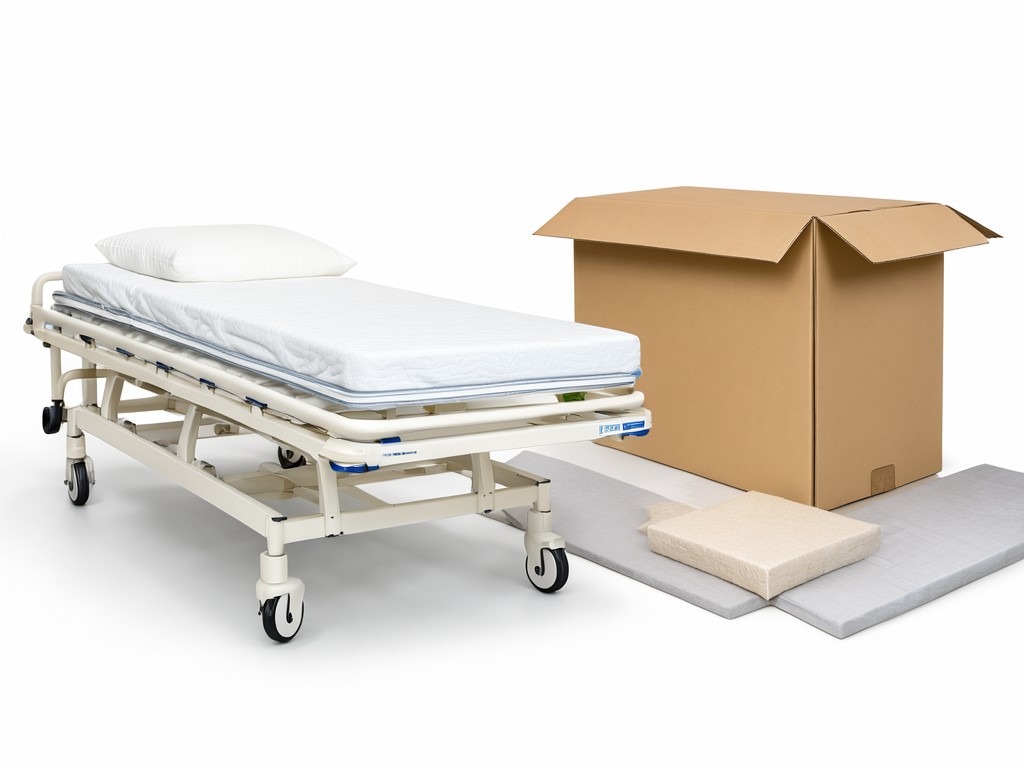
A 5-function manual bed delivers backrest, knee-break, height, Trendelenburg, and reverse Trendelenburg adjustment through a single crank shaft and gearbox assembly. The mattress ships as a matched component: high-density polyurethane foam core (35-40 kg/m³) wrapped in a welded-seam PVC cover that passes ISO 10993-5 cytotoxicity and resists sodium hypochlorite wiping. Wheels are 125 mm twin casters with central-locking via a foot pedal; two are directional, two are braked. Buyers in public procurement, private clinic chains, and export distributors specify this configuration when they need a bed that can be serviced by in-house biomedical engineers without proprietary tools.
The Problem Buyers Keep Paying For
Process choice shows up later as cracked welds at the head-end cross member after 18 months of daily height cycling, or as powder-coat delamination where alkaline cleaners pool under the mattress deck.
The most common complaint pattern: crank handles develop play because the gearbox housing is stamped from 1.2 mm sheet instead of die-cast zinc, allowing the shaft to walk under load. Wheel locks fail when the pedal pivot uses a plain bushing rather than a sealed ball bearing; corrosion locks the mechanism in the "free" position within six months in humid wards. Mattress covers split at the high-frequency weld seams because the PVC plasticizer migrates out under constant heat from patient-warming blankets. Each failure mode adds a service call that costs more than the unit price difference between a spec-compliant build and a corner-cut one.
Construction Method and Its Effect on Consistency
The build method decides whether the bed stays in tolerance after 10,000 crank cycles. Our line uses robotic MIG welding on a fixtured jig that holds the frame within ±0.5 mm diagonal squareness; post-weld stress relief is a 200 °C oven pass, not a manual grind. Gearbox housings are die-cast Zamak 5, CNC-machined for shaft bore concentricity, then assembled with a pre-loaded thrust washer that eliminates end-play. Powder coating is a two-coat system: epoxy primer (60 µm) plus polyester topcoat (80 µm) cured at 190 °C, tested to 500 h neutral salt spray per ASTM B117 before shipment.
| Parameter | Standard Range | Custom Option | Test Method |
|---|---|---|---|
| Safe working load | 250 kg | 300 kg (reinforced frame) | Static load hold 10 min + cyclic 50k cycles |
| Backrest angle | 0-75° | 0-85° (gas-assist) | Digital inclinometer ±0.5° |
| Knee-break angle | 0-40° | 0-45° | Same as backrest |
| Height range | 450-750 mm | 400-800 mm (extended screw) | CMM measurement at four corners |
| Trendelenburg / Reverse | ±12° | ±15° (reinforced pivot) | Load cell at 250 kg, 5k cycles |
| Crank torque | ≤15 Nm at max load | ≤10 Nm (ball-screw upgrade) | Torque wrench at 90° increments |
| Mattress foam density | 35 kg/m³ | 40-50 kg/m³ (viscoelastic topper) | IFD 25% deflection per ASTM D3574 |
| Caster wheel diameter | 125 mm twin | 150 mm single (low push force) | Push force ≤25 N on vinyl tile |
Cold-rolled steel + epoxy/polyester
Base specification for general wards. 500 h salt spray, impact resistance 50 kg·cm. Touch-up paint matches RAL 9016. Lowest unit cost; requires dry storage before assembly.
Best for: high-volume tenders where budget per bed drives award criteria.
304 stainless frame + electropolish
No coating to chip; passes 1000 h salt spray. Weight increases 12 kg per bed. Cleanroom compatible. Unit cost +35% but eliminates refinishing labor over a 10-year service life.
Best for: ICU, burns units, coastal hospitals, and export markets requiring ISO 13485 traceability.
Segment-Specific Requirements
Public procurement tenders often mandate a minimum 3-year warranty on the frame and 1-year on the mattress cover, with spare-part availability guaranteed for 7 years. Private clinic chains prioritize bed-end aesthetics — coloured ABS panels, integrated nurse-call buttons, and a mattress cover that matches their brand palette. Export distributors need knock-down packaging that fits 40 beds per 40-ft HC container without exceeding 2,800 kg payload. Each segment forces a different combination of frame reinforcement, cover material, and crate design.
| Segment | Packaging Configuration | Beds per 40-ft HC | Gross Weight (kg) | Labeling Requirement |
|---|---|---|---|---|
| Public tender (flat-pack) | Frame + mattress separate, steel crate | 40 | 2,650 | Batch QR code, CE mark, country of origin |
| Private clinic (assembled) | Fully assembled, shrink-wrapped on pallet | 24 | 2,100 | Brand hang-tag, serial barcode, warranty card |
| Export distributor (semi-KD) | Frame assembled, mattress & wheels in carton | 36 | 2,780 | Multilingual warning labels, HS code, fumigation cert |
Ordering, Tooling and Lead-Time Questions
- What is the minimum order quantity for a custom mattress cover colour? 50 units per colour; the PVC calendering run requires a 500 m minimum roll.
- Do you hold tooling for the 300 kg reinforced frame? Yes, the fixture is maintained in-house; no tooling charge for repeat orders above 100 units/year.
- Can the crank handle be changed to a fold-away design after first article approval? Only if the gearbox output shaft diameter matches; otherwise a new die-cast housing is needed (6-week lead, $3,200 tooling).
- What is the standard lead time from PO to first container? 45 calendar days for standard spec; 60 days if stainless frame or custom mattress foam density is specified.
- How are warranty claims handled for beds shipped outside the factory region? We ship a spare-part kit (gearbox, caster set, cover patches) with each container; claims are settled via photo evidence and serial traceability within 14 business days.
Quotation review: Send your tender specification or volume forecast to /contactus. We return a line-item cost model showing unit price, tooling amortization, freight configuration, and spare-part provisioning so you can compare total cost of ownership across the contract period.