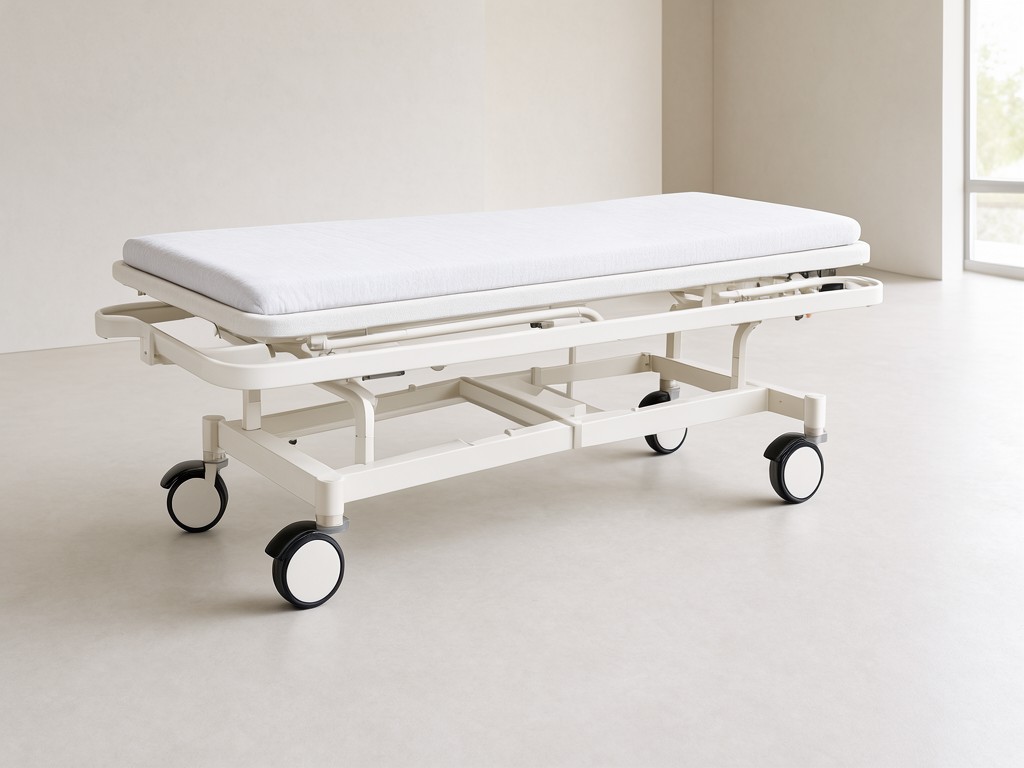
custom 1 function manual medical nursing beds with wheels Company: Specification, Ordering and Quality Notes
Design Constraints Behind the Specification
Before comparing quotations, the procurement team needs to separate structural decisions that drive warranty exposure from cosmetic choices that do not. A single-function manual bed lives or dies on the crank mechanism and the frame joints that carry the backrest load cycle after cycle.
Two suppliers quoting the same specification often diverge on tube wall thickness at the head-end upright. One mills 1.5 mm cold-drawn steel; the other stamps 1.2 mm and relies on a gusset plate. The thinner wall saves 0.8 kg per bed but increases deflection at the crank pivot by roughly 15 % under a 120 kg patient. That deflection accelerates wear on the worm gear and is the root cause of the "crank binds after six months" complaint that drives returns.
Unit price settles the question only after the buyer quantifies the cost of a field service visit versus the per-unit upcharge for the heavier tube. In our experience, the heavier tube pays back inside the first 18 months of a three-year warranty window.
Construction Method and Its Effect on Consistency
The frame is robot-welded on a dedicated fixture that locates the head-end upright, foot-end upright, and both side rails in a single clamping sequence. This eliminates the cumulative tolerance stack that appears when sub-assemblies are welded separately and then bolted together.
Crank housings are die-cast zinc alloy (Zamak 5) rather than stamped steel. The casting holds the worm gear centre distance to ±0.05 mm without secondary machining. Stamped housings typically show ±0.15 mm variation, which translates directly into uneven crank torque and premature gear tooth wear.
Process rule: Every bed leaving the line receives a 50-cycle crank test under 80 kg simulated load. Torque must remain within 1.8–2.4 Nm across all cycles. Beds outside this window are segregated for gear-lash adjustment before packaging.
Casters are pressed into the frame legs with a 22 mm socket interference fit, then secured by a secondary M10 bolt. This dual retention prevents the caster stem from working loose when the bed is pushed over threshold strips — a common failure mode in facilities with frequent room transfers.
Requirements by Buyer Segment
Public Hospital Tender
Mandatory central-locking caster system (single pedal locks all four wheels). Frame must pass IEC 60601-2-52 impact test at 50 J. Powder coat: epoxy-polyester hybrid, minimum 80 µm, salt-spray 500 h.
Documentation package: EN 10204 3.1 material certs for frame tube, full traceability to heat number.
Private Clinic / Nursing Home
Individual brake casters acceptable. Aesthetic priority: RAL 9016 or custom colour match, orange-peel texture to hide handling scratches. Mattress platform: four-section ABS panels with integrated CPR release.
Shorter lead time preferred; willing to accept standard component colours to avoid powder-coat setup charges.
Distributor / Private Label
Neutral packaging, laser-etched logo on headboard (no stickers). Crank handle fold-flat design for container density. Spare parts kit (2 casters, 1 crank handle, 4 M10 bolts) included per 50 units.
MOQ flexibility: 20 units per SKU if using standard grey frame and black casters.
Volume Planning and Lead Time
Tooling amortisation drives the step-function in unit cost. The crank housing die costs USD 4,200; the robotic weld fixture adds USD 2,800. At 50 units these tools add USD 140 per bed. At 500 units the adder drops to USD 14.
Standard lead time assumes powder-coat line runs in RAL 9016 or 7035. Custom colour adds 7–10 working days for lab match, panel approval, and line changeover. If the order exceeds 200 units, we stock the custom powder in our feed hopper for repeat orders, eliminating the setup delay on subsequent POs.
| Parameter | Standard Range | Custom Option | Notes |
|---|---|---|---|
| Overall Length (mm) | 2120 ± 5 | 2050–2200 | Longer frames require centre support leg |
| Overall Width (mm) | 965 ± 3 | 910–1020 | Width > 1000 mm needs wider caster stance |
| Height to Mattress Deck (mm) | 520 (fixed) | 480–560 | Adjustable leg inserts add USD 12/unit |
| Backrest Angle Range | 0°–75° | 0°–80° | Requires longer gas spring assist |
| Safe Working Load (kg) | 180 | 220 / 250 | 250 kg needs 2.0 mm tube + reinforced deck |
| Unit Weight (kg) | 42 ± 1.5 | 38–55 | Depends on deck material and caster spec |
| Caster Diameter (mm) | 125 (central lock) / 150 (individual) | 100–200 | ≥150 mm recommended for carpeted wards |
Export Packaging and Handling Protection
Beds ship partially assembled: frame welded, casters fitted, crank handle and mattress deck flat-packed in the same carton. This reduces container volume by 35 % versus fully assembled shipment and eliminates the freight damage claims that occur when upright beds shift under braking.
Each unit sits in a five-layer corrugated carton (ECT 48) with die-cut EPS corner blocks at the head and foot uprights. The crank handle is secured in a dedicated recess moulded into the top EPS block — no loose hardware bags to lose during unloading.
For sea freight to high-humidity regions, we add a VCI-treated inner bag and desiccant sachets (2 units per carton). Powder-coat blistering at the weld toes after 60-day transits was the single largest cosmetic claim until this packaging revision.
Care, Storage and Service Life
Crank mechanism lubrication interval: every 12 months with NLGI grade 2 lithium complex grease. Apply via the grease nipple on the worm housing; 3 g per bed. Over-greasing attracts dust and accelerates gear wear.
Caster bearings are sealed for life (2RS). Do not pressure-wash the base frame; water ingress past the seals causes brinelling within 30 cycles. Wipe casters with damp cloth only.
Powder coat touch-up: use the supplied 15 ml aerosol (matched to order colour). Sand chip to bare metal, prime with epoxy etch primer, then topcoat. Chips larger than 10 mm diameter should be referred to our service team for spot-repair procedure — field welding voids the frame warranty.
Expected service life under typical hospital utilisation (8 adjustments/day, 365 days/year): 10 years for frame, 7 years for crank gear set, 5 years for casters. Mattress deck panels (ABS) show surface crazing after 6–8 years under UV exposure near windows; rotate beds annually to equalise.
Ordering, Tooling and Lead-Time Questions
- What is the minimum order quantity for a custom frame colour? 50 units if the colour matches an existing RAL in our powder library. Non-RAL colours require 100 units to justify the lab match and line purge.
- Can we mix central-lock and individual-brake casters in the same container? Yes, but each variant needs its own carton label and packing list line. Mixed pallets are not permitted due to warehouse picking errors.
- How does the crank handle fold-flat option affect container loading? Fold-flat handles allow 2-high stacking of cartons in a 40 ft HQ container, increasing load factor from 180 to 240 units. The handle adds USD 3.50 per unit.
- What documentation ships with a first article inspection (FAI) lot? Dimensional report (15 critical dimensions), material certs for frame tube and caster stems, crank torque curve across 50 cycles, salt-spray test certificate for powder coat (if custom colour).
- Is there a tooling deposit, and when is it refunded? 50 % of die/fixture cost invoiced with PO; balance at FAI approval. Full refund after 1,000 cumulative units shipped against the same tooling.
- How are spare parts managed for private-label distributors? We hold a dedicated SKU for each distributor's spare kit. Replenishment lead time: 10 working days ex-works. No minimum reorder quantity for spares once the initial kit is established.
Request a Quotation Review
Send your specification sheet, target annual volume, and delivery postcode. We return a line-item cost model showing tooling amortisation, per-unit price at three volume tiers, and lead-time scenarios — all within two working days.
Start Quotation Review