China two crank manual hospital bed with casters supplier: Specification, Ordering and Quality Notes
Scope of Supply and Physical Form
Replacement rate, not unit price, drives the real cost of a two‑crank manual bed program. A bed that drifts 5 mm in overall length across lots forces a re‑work of mattress fit and adds freight claims. The specification below locks the critical envelope so the buyer can price total cost of ownership before the first container ships.
2150×900×550 mm
250 kg
4 turns (≈30 mm)
125 mm twin‑wheel, central brake
1900×850 mm, removable
Powder‑coated steel, 80 µm epoxy
Design Constraints Behind the Specification
The two‑crank layout is chosen because a single crank would require 50 % more operator force at the same height increment, pushing the effort beyond the 150 N ergonomic limit for nursing staff. Caster lock engagement must withstand a 200 N lateral push without disengaging, otherwise the bed migrates during patient transfer. Frame welds are spaced at 250 mm centers to keep deflection under 2 mm under full load, and the powder coat thickness is controlled to 80 ±10 µm to avoid chipping at the crank mounting points.
Single Crank
Peak handle torque 22 Nm; 8 turns for full height range; fewer moving parts; lower BOM cost.
Double Crank
Peak handle torque 12 Nm; 4 turns per crank for full range; balanced force; +3 % BOM cost.
The double‑crank architecture adds two extra bearing housings, which increases the bill of materials by roughly 3 % but reduces the peak handle torque from 22 Nm to 12 Nm, a trade‑off that pays back in reduced staff fatigue over a 5‑year service horizon.
| Material | Yield Strength (MPa) | Weight per Unit (kg) | Corrosion Resistance (hrs salt spray) | Serviceability (ease of part replacement) | Unit Cost Index (relative) |
|---|---|---|---|---|---|
| Powder‑coated steel (Q235) | 235 | 42 | 500 | High – bolted joints | 1.0 |
| Stainless steel 304 | 215 | 48 | 1000 | Medium – welded joints | 1.6 |
Assumptions Buyers Should Stop Making
Buyers often assume that all casters from the same supplier share identical swivel torque, yet a 0.5 Nm drift between lots changes the push force needed to move a loaded bed by 15 %. Another assumption is that the crank handle length is fixed; in practice a 10 mm variation alters the mechanical advantage enough to shift the torque curve. Finish colour is also treated as a cosmetic detail, but a 2 ΔE shift between batches triggers rejection in private‑label programs that require visual consistency across wards.
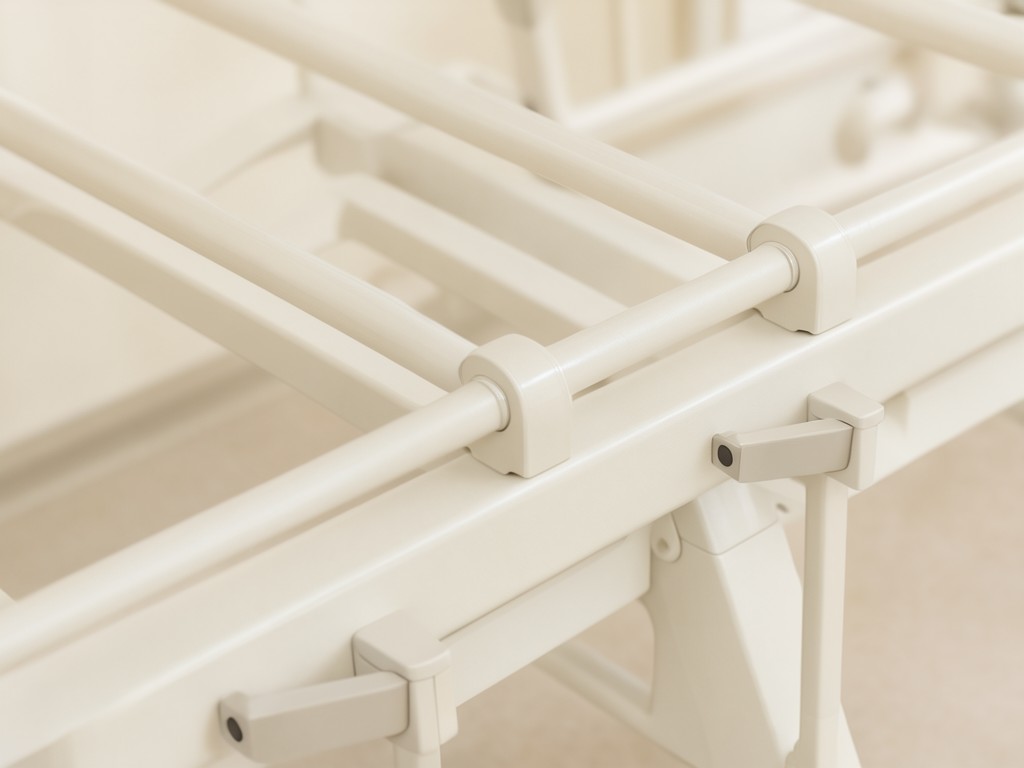
- Caster swivel torque is not guaranteed across production runs.
- Crank handle length can vary ±10 mm unless a dedicated fixture is specified.
- Powder‑coat hue drifts up to 2 ΔE without a colour‑master agreement.
- Bed frame length tolerance of ±3 mm may not match mattress spec of ±2 mm.
What Gets Checked Before Shipment
Every lot passes a fixed inspection sequence before the container is sealed. The table summarises the test, the acceptance window, and the consequence of a fail.
| Test | Acceptance Criteria | Fail Action |
|---|---|---|
| Overall Length / Width / Height | ±3 mm per dimension | Rework or scrap |
| Crank Torque (peak) | 10–14 Nm | Adjust bearing preload or reject |
| Caster Swivel Force | 25–35 N | Replace caster lot |
| Static Load 250 kg for 10,000 cycles | No permanent deformation >1 mm | Reject lot |
| Coating Adhesion (cross‑hatch) | 5B minimum | Strip and recoat |
| Caster Brake Holding Force | ≥200 N lateral | Replace brake assembly |
Stock Availability and Reorder Planning
Lot‑to‑lot consistency is the single biggest driver of reorder friction. A 2 mm shift in frame length across two consecutive productions forces the buyer to re‑qualify mattress suppliers and update warehouse slotting. The factory holds a rolling buffer of 200 units for the standard 2150 mm length, but custom lengths require a 30‑day tooling lead time and a minimum order of 50 units.
Specification Callout: Length tolerance is ±3 mm. If your mattress spec calls for ±2 mm, request a dedicated fixture before placing a repeat order. Drift beyond ±3 mm adds a 15 % surcharge for re‑inspection and potential air‑freight expedite.
Reorder cycles of 8 weeks are typical when the buffer is intact; extend to 12 weeks if a new fixture is needed. Plan safety stock at 1.5× the monthly consumption to absorb the variability.