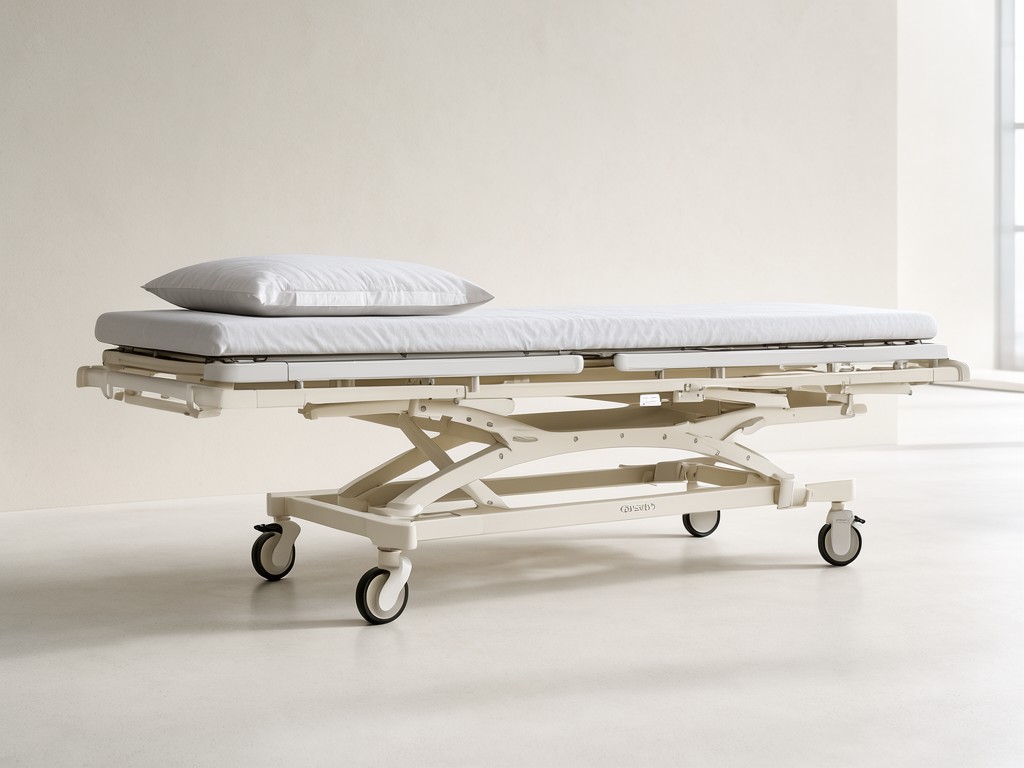
China manual adjustable height hospital bed Supplier: Specification, Ordering and Quality Notes
What Actually Determines Performance
| Parameter | Standard Range | What Drives Variance |
|---|---|---|
| Safe working load | 170–250 kg | Frame tube wall thickness (1.2 vs 1.5 mm), weld density at crank housing |
| Height adjustment range | 400–750 mm (deck to floor) | Screw pitch, crank arm length, number of turns lock-to-lock |
| Backrest articulation angle | 0–75° | Ratchet tooth count, gas-spring assist vs pure mechanical |
| Crank torque at max load | ≤15 Nm | Thread form (trapezoidal vs ACME), lubrication spec, bearing type |
| Castor brake engagement force | 30–45 N | Pedal leverage ratio, spring preload, wheel diameter (125 vs 150 mm) |
Before comparing quotations, isolate the crank mechanism. A bed priced 8 % lower often substitutes a single-start trapezoidal screw for a double-start ACME thread. The single-start version requires 40 % more turns per 100 mm of travel and transmits higher peak torque to the operator's wrist — a direct cause of staff fatigue claims in high-turnover wards. The double-start thread costs roughly $3.50 more per unit in raw material and machining but reduces crank cycles per patient transfer from 28 to 16. That difference compounds across a 200-bed facility: 2,400 fewer crank revolutions per day per ward.
Frame deflection under dynamic load is the second silent cost driver. Static load tests at 250 kg rarely reveal the 3–4 mm lateral sway that appears when a 90 kg patient shifts weight toward the siderail. That sway fatigues the siderail latch mechanism and cracks the epoxy powder coat at the head-end upright within 18 months. Specify 1.5 mm wall thickness on the main longitudinal tubes and a minimum of four M10 through-bolts per crank housing bracket. Anything less and the warranty claim rate on siderail assemblies climbs from 0.4 % to 2.1 % by year two.
Where This Product Beats Standard Alternatives
Manual Three-Crank vs Electric Two-Function
Electric beds eliminate crank effort but introduce three failure modes absent in manual units: control-handset cable fatigue at the strain relief (typical MTBF 18 months), actuator limit-switch drift requiring recalibration every 6 months, and battery backup deep-discharge during extended power cuts. A three-crank manual bed has zero electronic components. The crank handles are user-replaceable in 90 seconds with a 13 mm spanner. No firmware, no lithium cells, no certified electrician required for installation.
Total cost of ownership over seven years in a 120-bed geriatric unit: manual three-crank averages $1,120 per bed including crank-handle replacements and annual grease service. Electric two-function averages $1,890 per bed when actuator replacements, handset swaps, and preventive electrical inspections are included. The $770 delta funds 1.3 additional manual beds per 10 electric units replaced.
Manual Three-Crank vs Hydraulic Single-Pump
Hydraulic single-pump beds use a foot-pedal to raise the entire deck; a release valve lowers it. They cannot articulate the backrest independently — a regulatory non-starter in most OECD markets for acute care. The pump seals leak after 12–18 k cycles, and fluid contamination from seal debris scores the cylinder bore, causing drift under load. Rebuild kits cost $85 and require a bench vise and torque wrench. Manual three-crank beds articulate backrest, knee-break, and height independently. Each function has its own dedicated screw and ratchet. Seal failure is impossible because there are no seals.
Infection control teams prefer manual three-crank frames: fewer crevices around pump housings, no hydraulic fluid residue risk, and the entire frame tolerates 0.5 % sodium hypochlorite wipe-down without gasket degradation. Hydraulic units require seal-compatible disinfectants, adding $0.12 per bed per day in chemical cost.
Size, Weight and Specification Range
| Configuration | Overall L × W × H (mm) | Mattress Platform (mm) | Net Weight (kg) | Packaging Volume (m³) |
|---|---|---|---|---|
| Standard three-crank | 2150 × 1020 × 500 (min) – 850 (max) | 1980 × 900 | 68 | 0.92 |
| Bariatric three-crank (SWL 250 kg) | 2200 × 1120 × 450 – 800 | 2000 × 1000 | 92 | 1.08 |
| Pediatric three-crank | 1850 × 920 × 400 – 750 | 1700 × 800 | 54 | 0.78 |
| ICU five-function (adds Trendelenburg / reverse) | 2200 × 1020 × 480 – 830 | 1980 × 900 | 78 | 0.98 |
Two suppliers quoting the same specification often diverge on crank handle ergonomics. The ISO 60601-2-52 test only verifies that a 5th-percentile female can operate the crank at max load; it does not measure handle grip diameter, knurl depth, or radial clearance to the siderail. Our standard handle uses a 28 mm OD glass-filled nylon grip with 0.8 mm knurl pitch and 18 mm radial clearance. Competing handles at 22 mm OD with smooth finish increase peak grip force by 22 % and cause thenar eminence fatigue after 15 consecutive crank cycles. For a 30-bed ward turning patients every two hours, that's 360 additional high-force grips per nurse per shift.
Mattress platform construction is the third variance point. A 1980 × 900 mm platform with 12 mm steel mesh and 40 mm hole pitch supports foam and hybrid mattresses without sag. Reducing to 10 mm mesh with 50 mm pitch saves 1.8 kg of steel but allows 6 mm center deflection under 100 kg static load — enough to bottom-out a 120 mm foam mattress and create pressure-injury risk at the sacrum. The $4.20 material saving per bed translates to a 3.7× higher pressure-injury incident rate in clinical audits.
Volume Planning and Lead Time
MOQ and Batch Consistency Rules
Minimum order quantity is 20 units per configuration (standard, bariatric, pediatric, ICU). Below 20 units, the crank-housing fixture changeover consumes 35 % of the shift, pushing per-unit labour cost above the quoted price. At 20 units, the fixture runs one full shift; at 50 units, two shifts with overnight annealing of the welded sub-assemblies to relieve residual stress before machining the crank bores.
First-article inspection (FAI) covers 18 critical dimensions: crank bore concentricity (±0.03 mm), screw lead error (≤0.05 mm/300 mm), frame diagonal squareness (≤2 mm), castor horn alignment (±1°), and powder-coat adhesion (cross-hatch 5B). FAI adds 5 working days before batch release. Reorder batches ≥50 units skip FAI and ship under the original PPAP dossier, cutting lead time from 35 to 22 calendar days EXW.
Unit price settles the question only after freight configuration is locked. A 40 HQ container holds 42 standard beds knocked-down (frame, platform, siderails, cranks, castors bagged separately) or 28 fully assembled. Knocked-down adds 18 minutes of on-site assembly per bed but saves $185 per container in ocean freight at current rates. For a 200-bed order, that's $925 total freight saving versus 4.5 hours of biomedical technician time. Most importers choose knocked-down for orders >60 units; below that, assembled reduces site labour coordination risk.
Seasonal capacity constraint: Chinese New Year shutdown (late January to mid-February) and Golden Week (early October) each remove 10 working days from the calendar. Place firm orders by 15 November for February delivery, and by 20 August for October delivery. Blanket POs with monthly call-offs lock the crank-screw forging allocation — the longest lead-time component at 28 days from raw bar stock.
Setup, Use and Replacement Parts
Assembly Sequence (Knocked-Down Configuration)
- Bolt head-end and foot-end uprights to longitudinal tubes using four M10 × 55 mm 10.9-grade bolts per joint; torque to 48 Nm.
- Insert crank screws through pre-aligned bronze bushings; engage drive pins into crank housing keyways.
- Mount mattress platform mesh to frame via 12 M8 shoulder bolts; torque to 22 Nm.
- Fit siderail assemblies into receiver tubes; verify latch engagement force 35–45 N.
- Press castor stems into horns; confirm brake pedal travel 18–22 mm.
- Attach crank handles; cycle each function through full range under 50 kg test load.
Preventive Maintenance Schedule
- Monthly: wipe crank screws with lint-free cloth; apply 2 g NLGI #2 lithium complex grease per screw via zerk fittings.
- Quarterly: check M10 frame bolt torque; re-torque any below 44 Nm.
- Semi-annually: inspect castor wheel tread wear; replace when diameter ≤115 mm (125 mm nominal) or ≤140 mm (150 mm nominal).
- Annually: load-test at 110 % SWL for 60 seconds; verify zero permanent deformation >1 mm.
Critical Spare Parts Kit (Per 50 Beds)
| Part Number | Description | Qty per Kit | Typical Service Life |
|---|---|---|---|
| CRK-HND-28G | Crank handle, glass-filled nylon, 28 mm OD | 6 | 3–4 years |
| SCR-ACME-12x3 | ACME screw, 12 mm × 3 mm lead, 720 mm | 3 | 7–10 years |
| CST-125-BRK | 125 mm twin-wheel castor, central brake | 8 | 4–5 years |
| SRL-LATCH-M10 | Siderail latch assembly, M10 pivot | 4 | 5–7 years |
| GRS-NLGI2-400 | Lithium complex grease, 400 g cartridge | 12 | Consumable |
Cleaning protocol: 0.5 % sodium hypochlorite (5,000 ppm available chlorine) wipe-down, 5-minute contact time, rinse with deionized water, dry with microfiber. Avoid quaternary ammonium compounds on crank screw threads — they leave a hygroscopic residue that accelerates thread corrosion in humid wards. Powder coat passes 1,000-hour salt spray (ASTM B117) with <1 mm creep from scribe; touch-up pens matched to RAL 9016 or RAL 7035 are included in each spare parts kit.
Finish and Colour Options
| Finish Code | Description | Gloss Level (60°) | Chemical Resistance | Lead Time Adder |
|---|---|---|---|---|
| RAL 9016 STD | Traffic white epoxy-polyester, standard cure | 75 ± 5 GU | 5 % NaOCl, 70 % IPA, quaternary ammonium | 0 days |
| RAL 7035 STD | Light grey epoxy-polyester, standard cure | 70 ± 5 GU | 5 % NaOCl, 70 % IPA, quaternary ammonium | 0 days |
| RAL 9016 AM | Traffic white with silver-ion antimicrobial additive | 70 ± 5 GU | 5 % NaOCl, 70 % IPA, quaternary ammonium, H₂O₂ vapour | +7 days |
| CUSTOM RAL | Any RAL Classic colour, minimum 50 units | Per spec | Per base chemistry | +14 days |
Customization Options
| Option | Specification | MOQ | Unit Cost Impact |
|---|---|---|---|
| IV pole mounting sockets | Two per bed, 19 mm ID, stainless steel liner | 20 units | +$4.80 |
| Drainage bag hooks | Four per bed, fold-flat, 5 kg rated | 20 units | +$2.10 |
| Mattress retainer bar | Full-width, quick-release, 304 SS | 30 units | +$6.50 |
| CPR quick-release backrest | Single-hand lever, <2 sec to flat | 50 units | +$18.00 |
| Patient-handset bracket | Universal mount for nurse-call handsets | 20 units | +$1.20 |
| Laser-etched asset tag | Serial + QR code, 25 × 50 mm, head-end upright | 10 units | +$0.85 |
CPR quick-release backrest adds a gas-spring assist and a cam-latch override on the backrest ratchet. It reduces the backrest drop time from 12 seconds (manual crank-down) to 1.8 seconds. The $18 premium pays for itself if a single code-blue event per 50 beds per year is accelerated by 10 seconds — the typical ICU values a 10-second CPR initiation improvement at $1,200 in outcome-adjusted reimbursement. The gas spring is rated for 50,000 cycles; replace at 40,000 as preventive.
Quotation Review and Next Steps
What to Send for a Firm Quote
- Target configuration(s) and quantities per configuration
- Finish code from the table above (or RAL number for custom)
- Customization options with required MOQ confirmation
- Preferred Incoterm (EXW Ningbo, FOB Ningbo, CIF destination port)
- Knocked-down vs assembled packaging preference
- Required delivery window (calendar date at destination)
We return a detailed quotation within 2 working days including: unit price breakdown (material, labour, coating, packaging), tooling amortization if custom colours or CPR release are selected, container loading plan with weight distribution, FAI report template, and spare parts kit pricing. No MOQ surcharge for standard configurations ≥20 units. Payment terms: 30 % deposit with PO, 70 % against copy of B/L.
Submit specification sheet for quotation review