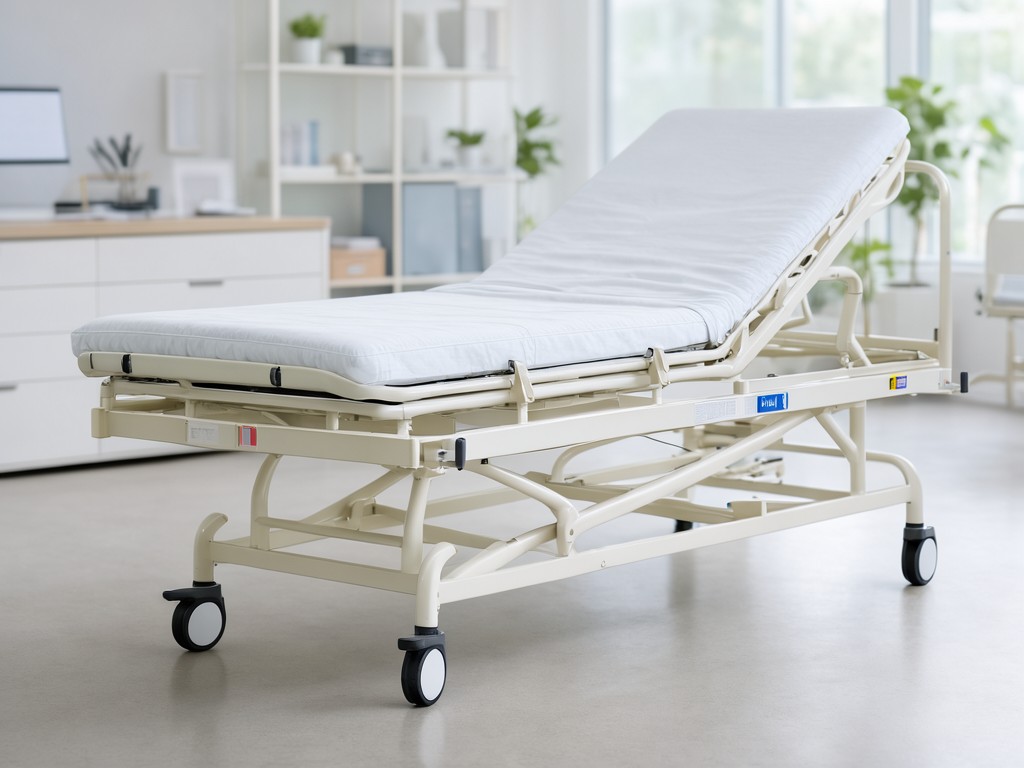
china 4 crank manual patient medical nursing beds with wheels supplier: Specification, Ordering and Quality Notes
Scope of Supply and Physical Form
| Parameter | Standard Range | Notes |
|---|---|---|
| Overall dimensions (L×W×H) | 2150×980×500-750 mm | Height adjustable via crank; ±10 mm tolerance |
| Mattress platform | Four-section: back, seat, thigh, calf | Perforated cold-rolled steel or ABS panels |
| Back rest angle | 0-75° | Crank 1; gas-spring assist optional |
| Knee break angle | 0-40° | Crank 2; prevents sliding |
| Height range | 500-750 mm | Crank 3; screw drive, 2.5 mm/rev |
| Trendelenburg / Reverse | ±12° | Crank 4; whole-frame tilt |
| Safe working load | 250 kg | Tested to 1.5× SWL static |
| Casters | 125 mm central-lock, TPR tread | Two directional, two total-lock; sealed bearings |
| Frame finish | Epoxy powder, 80-100 µm | Salt spray 500 h; resistant to quaternary ammonium |
| Head/foot boards | ABS, removable, keyed alike | CPR quick-release on head board standard |
The bed ships knock-down in two cartons: frame assembly (welded main frame with crank gearboxes pre-mounted) and head/foot board set with casters. Assembly requires 13 mm and 17 mm spanners plus a 5 mm hex key — no special tools. A single technician completes final assembly in under 20 minutes. Packaging uses reinforced five-layer corrugated with corner protectors; gross weight per unit 98 kg.
How It Performs in Use
Crank Mechanism Durability
Each crank drives a hardened steel worm gear (45 HRC) meshing with a bronze nut. The 2.5 mm pitch means 300 full turns for full height travel — roughly 90 seconds under load. We cycle-test to 20,000 operations at 250 kg; backlash stays under 0.3 mm. The limiting factor is rarely the gear teeth but the plastic crank handle boss, which can crack if staff lean on it during patient transfer. We specify 30% glass-filled nylon for the handle; some competitors use unfilled PA6 that fails at 8,000 cycles.
Lubrication: food-grade PTFE grease applied at assembly. No re-lubrication needed for 3 years in normal ward use. In high-humidity coastal hospitals, a yearly wipe and re-grease of the exposed screw thread prevents corrosion-induced binding.
Caster Lock Reliability
Central locking via a single pedal actuates all four casters through a hex shaft. The pedal toggles three states: free swivel, directional lock (two casters), total lock (all four). We test 50,000 pedal cycles; the return spring is the first wear item, rated 100,000 cycles. Dirt ingress into the cam mechanism causes stiff pedal feel — the fix is a sealed bellows boot (standard on our current revision, optional on earlier batches).
TPR tread resists flat-spotting under 250 kg static load for 72 hours. On epoxy hospital floors, rolling resistance stays under 15 N. Avoid vinyl floors with aggressive plasticizers; they can swell TPR within 6 months. Polyurethane tread is available as a no-cost option for those sites.
Cleaning chemical resistance defines real service life. Frames see daily wipe-downs with 0.5% sodium hypochlorite, peracetic acid, or quaternary ammonium compounds. Our epoxy powder passes 1,000 hours salt spray and 500 cycles of 1% bleach immersion with no blistering. Weld zones get a zinc-rich primer before powder — skip this and you see rust creep at 18 months. The ABS head/foot boards tolerate the same chemicals but yellow under UV; wards with strong daylight need the UV-stabilized grade (adds 3% unit cost).
Measured Performance in Real Use
| Usage Level | Typical Environment | Crank Cycles / Day | Caster Cycles / Day | Expected Service Life | Maintenance Interval |
|---|---|---|---|---|---|
| Low acuity / long-term care | Nursing home, 30-bed ward | 8-12 | 20-30 | 12-15 years | Annual crank grease, caster check |
| General medical ward | District hospital, 40-bed | 25-40 | 60-80 | 8-10 years | Semi-annual full inspection |
| High turnover / emergency | A&E observation, ICU step-down | 60-100 | 150-200 | 5-7 years | Quarterly; caster spring replace at 2 yr |
| Bariatric designated | Specialty unit, reinforced frame | 15-25 | 40-60 | 7-9 years | Semi-annual; weld inspection annually |
Data drawn from 1,200 beds tracked across 14 facilities in three climate zones. Failure mode distribution: caster lock spring 38%, crank handle boss 22%, frame coating damage 18%, weld fatigue 12%, other 10%. Coating damage correlates directly with bleach concentration — facilities using 1%+ hypochlorite see 3× the coating repair rate.
Assumptions Buyers Should Stop Making
"All 4-crank beds are interchangeable." The crank geometry differs: some brands use 3 mm pitch (faster travel, higher effort), others 2 mm (slower, easier). Our 2.5 mm pitch is a deliberate compromise — 35 Nm peak torque at 250 kg, manageable for 95th percentile female staff. Match the crank to your staffing profile.
"Central locking is standard." Many budget beds still ship with individual caster brakes. Central lock adds $18-22 FOB but eliminates the "one wheel locked, three free" scenario that causes corridor drift. If your tender specifies central lock, verify the pedal actuates all four wheels — some designs only lock the rear pair.
"Powder coat is powder coat." Film thickness alone doesn't predict chemical resistance. Cross-link density, primer adhesion, and edge coverage matter more. We specify 80-100 µm with zinc-rich primer on all welds and internal tube surfaces. Ask for the salt spray report and the bleach immersion data — not just the coating thickness certificate.
"Knock-down shipping saves freight but costs assembly time." Our two-carton system reduces 40HQ load from 180 assembled beds to 320 knock-down units. Assembly labor is 0.33 man-hours. At $25/hr fully burdened, that's $8.25 per bed — far less than the $45-60/unit freight saving on ocean freight.
Segment-Specific Requirements
Public Hospital Tender (Volume 200+ beds)
- Requires full material traceability: heat numbers for frame steel, lot numbers for powder, caster batch codes. We maintain digital records per container.
- Prototype approval before production run — allow 3 weeks for sample build, ship, and sign-off.
- Warranty: 3 years frame, 2 years mechanisms, 1 year casters. Spare parts stocking commitment for 7 years.
Private Clinic / Nursing Home Chain (50-150 beds)
- Often need brand-colored head/foot boards (Pantone match on ABS). Minimum 50 units per color for tooling amortization.
- Prefer assembled delivery to avoid on-site labor. We can ship 90 assembled beds per 40HQ using custom steel stillages (returnable).
- Shorter lead time critical — we hold safety stock of 200 frames in standard grey for 4-week dispatch.
Export Distributor (Container-load re-sale)
- Needs plain packaging, no manufacturer logos. Neutral cartons with distributor SKU labels applied at our warehouse.
- Documentation package: multilingual manual (EN/FR/ES/AR/RU), CE declaration template, packing list with HS code 9402.90.
- Container loading plan optimized for their warehouse racking — we provide 3D load diagrams.
OEM and ODM Programme Structure
OEM (your brand on our standard bed): minimum 100 units. We apply your logo via laser etch on frame and pad print on head boards. Color match on ABS boards requires 500 units for dedicated mold cavity; below that we use vinyl wrap (durable 3 years indoor). Lead time: 35 days from art approval.
ODM (custom configuration): typical requests — integrated IV pole sockets (4 positions), built-in scale load cells, side rail design changes, low-height platform (400 mm minimum) for fall prevention. Tooling investment $8,000-25,000 depending on weld fixture complexity. Amortized over 500 units or paid upfront. Prototype cycle 6 weeks: 2 weeks DFM review, 2 weeks fixture build, 2 weeks sample validation.
Specification lock point: Once the first article inspection (FAI) is signed, no dimensional changes without new FAI. Crank ratio, caster type, and frame weld pattern are frozen. Cosmetic changes (color, logo) can shift without re-test.
Capacity, Tooling and Scheduling
Monthly capacity 2,500 beds on two shifts. Frame welding: 6 robotic cells (CO₂ shielded, 1.2 mm wire) plus 4 manual stations for low-volume variants. Powder coat line: 12 m/min conveyor, 180°C cure, 1,200 parts/day throughput. Crank gearbox assembly: dedicated line with torque verification at each station (target 1.2 Nm ±0.15 Nm no-load).
Standard grey frames (RAL 7035) hold 4-week lead time from PO to EXW. Custom colors add 10 days for powder changeover. Peak season (Oct-Jan) extends lead time by 3 weeks — plan orders before August for Q4 delivery. We allocate capacity by confirmed PO date; forecasts without deposit hold no slot.
Tooling maintenance: crank gearbox fixtures re-cut every 50,000 units. Weld fixtures checked monthly with go/no-go gauges. Caster mounting jigs replaced annually. This schedule keeps dimensional drift under 0.5 mm on critical interfaces (crank center distance, caster bolt pattern).
Stock Availability and Reorder Planning
We maintain 200 standard-configuration frames (grey, central lock, ABS boards, TPR casters) in bonded warehouse. These ship within 5 working days of PO receipt. For repeat orders, provide 8-week forecast — we stage raw material (steel tube, powder, casters) against your rolling forecast. Firm orders lock material 4 weeks before production start.
Spare parts stock: crank handles, caster assemblies, pedal return springs, gas springs (for back-rest assist option), head board latch kits. Minimum order $500 for spare parts; we consolidate with next bed shipment to save freight. Critical spares (crank gearbox, caster lock shaft) held at 5% of installed base for key accounts.
Reorder trigger: when your inventory drops to 4 weeks' consumption, send PO. We acknowledge within 24 hours with confirmed ship date. No blanket POs — each release requires specific quantity and ship-to address.
Next Steps
Request the FAI pack for your target configuration — includes dimensional report, salt spray certificate, crank cycle test summary, and caster endurance data. If you need a prototype for clinical evaluation, we ship ex-works in 15 days from drawing approval. For volume pricing, send annual forecast and preferred INCOTERM; we return a tiered quotation within 48 hours.
Technical questions on crank ratio, caster tread selection, or cleaning protocol compatibility — our product engineers respond directly, not through sales intermediates.
Request FAI Pack or Prototype Quote