Specifying china 1 crank manual hospital beds with casters and mattress supplier for Wholesale and OEM Orders
Design Constraints Behind the Specification
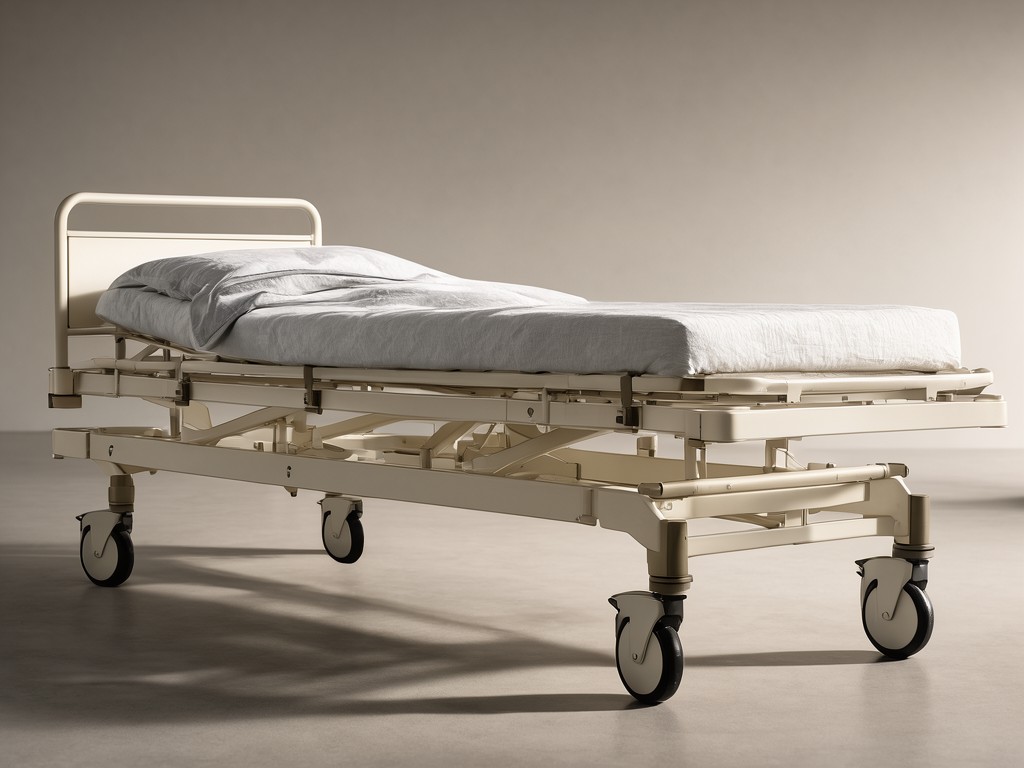
Weight and stiffness trade off against each other in a single-crank frame. The crank only drives the backrest, so the knee-break stays fixed — this simplifies the mechanism but shifts more load into the head-end casting when a patient sits up.
Buyers specifying private-label beds often push for thinner tube walls to hit a freight-friendly weight. Below 1.2 mm wall on the main longitudinals, the frame deflects enough to bind the crank worm gear after 500 cycles. The sweet spot for consistent torque feel is 1.4–1.6 mm cold-drawn rectangular tube, 50 × 25 mm profile.
If your spec calls for a 180 kg safe working load, the crank handle must clear the side rail when folded. We see returns when the handle fouls a universal half-rail — the fix is a 15 mm offset crank boss, not a longer handle.
What Actually Determines Performance
Repeat loading drives the failure at three points: crank thrust bearing, caster stem weld, and mattress cover zipper. The crank sees 40–60 N·m each articulation; a sintered bronze thrust washer outlasts a plastic one by 3× in salt-spray accelerated ageing.
Caster stem welds crack when the bed is pushed over thresholds loaded. A 125 mm twin-wheel with a 32 mm stem and double-ball race survives 200 km of corridor travel; 100 mm singles start wobbling at 80 km. Spec central-locking only if the ward layout justifies the extra 1.2 kg per bed.
| Parameter | Standard Range | Consistency Target |
|---|---|---|
| Crank torque (no load) | 8–12 N·m | ±1.5 N·m lot-to-lot |
| Backrest angle range | 0–75° | ±2° at end stops |
| Caster brake holding force | ≥150 N per wheel | ±10 N |
| Mattress foam density | 30–35 kg/m³ | ±2 kg/m³ |
| Cover zipper cycles to failure | ≥5,000 | ≥4,500 minimum |
Construction Method and Its Effect on Consistency
Frames are jig-welded on a rotating fixture — this holds the crank boss perpendicular to the longitudinal axis within 0.3°. Manual welding without the fixture drifts to 1.5°, and the crank binds at 60° articulation. We run a 100% go/no-go torque check at final assembly; any unit outside 8–12 N·m gets reworked, not shipped.
Powder coat: 80–100 µm epoxy-polyester hybrid, textured finish hides handling scratches. Gloss finish shows every scuff from caster brackets during stack packing. Colour drift between batches stays under ΔE 1.5 when we lock the pigment lot to the tube mill run.
Mattress integration
The mattress ships vacuum-compressed in a PE sleeve, strapped to the frame deck. Foam recovery to 95% nominal thickness takes 4 hours at 22°C. If the buyer warehouses below 10°C, recovery stretches to 24 hours — plan receiving inspection accordingly.
Buying Mistakes That Lead to Returns
- Specifying a two-crank mattress platform on a one-crank frame — the knee-break hinges exist but stay rigid, creating a pressure ridge at the sacrum.
- Ordering 100 mm casters for carpeted wards; they sink 6 mm into pile and the brake cam disengages under load.
- Accepting a mattress cover without welded seams — stitched seams wick fluid into the foam within 30 days of incontinence exposure.
- Skipping the crank handle retention clip; handles walk off in high-turnover facilities, leaving the bed inoperable.
Fatigue appears at the stress concentration where the crank link pivots on the frame. A 6 mm shoulder bolt with a nylon insert lock nut holds preload; a plain bolt with a flat washer loses 40% preload in 200 cycles and the backrest drifts down under patient weight.
Customisation Options and Their Limits
Decision tree for configuration selection:
- Choose caster diameter
- 125 mm twin-wheel — default for linoleum/tile, 1.8 kg/bed
- 150 mm twin-wheel — uneven thresholds, +0.6 kg, +8 mm deck height
- 100 mm single — only for retrofit on existing 100 mm sockets
- Select brake type
- Individual pedal — lowest cost, nurse bends four times
- Central locking — single pedal at foot end, +1.2 kg, requires 32 mm stem
- Directional lock — one wheel steers, three brake, niche use only
- Mattress cover material
- PU-coated nylon — 4-way stretch, vapour permeable, 50,000 Martindale
- PVC-coated polyester — cheaper, stiffer, 30,000 Martindale, passes CRIB 5
- TPU film laminate — premium, welded seams standard, 80,000 Martindale
Side rails: universal half-rail drops into the same sockets as full-length. Full-length adds 3.5 kg and blocks IV pole mounting on the head end. IV pole socket is a separate weldment — specify at order, not as an accessory.
Capacity, Tooling and Scheduling
Current cell capacity: 320 frames/week on two welding fixtures, one powder line. Crank mechanism sub-assembly is a bottleneck at 280 units/week — we sub the worm gear machining but assemble in-house to control torque.
New private-label tooling: 4 weeks for side rail sockets if the profile differs from standard 25 × 25 mm square tube. Crank handle forge die: 6 weeks, 12,000-unit MOQ. Mattress cover HF welding die: 3 weeks, 500-unit MOQ per size.
| Configuration | Frame Dim (L×W×H) mm | Net Weight kg | 40HQ Qty |
|---|---|---|---|
| Standard 125 mm, individual brake | 2120 × 980 × 520 | 52 | 186 |
| 150 mm, central lock | 2120 × 980 × 540 | 55 | 174 |
| With full-length rails | 2120 × 980 × 520 | 55.5 | 180 |
Lead time: 25 days from approved PP sample for 200 units. 500 units adds 7 days. Beyond 1,000 units we open a second shift on the crank line — adds 10 days but holds unit cost.
Export Packaging and Handling Protection
Each bed: frame shrink-wrapped, crank handle zip-tied to foot board, mattress vacuum-bagged and strapped to deck. Four corner protectors (50 × 50 × 5 mm EPS) prevent tube denting from forklift tines.
Stack limit: 3 high in container. Top frame gets a 12 mm plywood spreader plate — without it, the upper caster brackets imprint the lower deck panels. We label each unit with batch QR code linking to crank torque test record and mattress foam lot.
Sea freight humidity: include 50 g silica sachet per mattress bag. Containers sitting 30+ days at 85% RH will condense inside the PE sleeve — foam yellows, cover adhesive blooms.
Care, Storage and Service Life
Crank mechanism: grease thrust washer every 6 months with NLGI 2 lithium complex. Wipe excess — dust buildup on the worm gear acts as lapping compound.
Casters: check brake cam engagement monthly. Hair and thread wrap the axle; a 3 mm hex key removes the wheel for cleaning. Replace twin-wheel set when lateral play exceeds 3 mm.
Mattress cover: wipe with 0.1% sodium hypochlorite, do not soak seams. Zipper slider lubricate annually with PTFE spray. Foam core: rotate 180° head-to-foot quarterly to even compression set.
Expected service life at 85% occupancy: frame 10 years, crank mechanism 7 years, casters 4 years, mattress cover 3 years, foam core 5 years. Budget replacement cycles accordingly — the crank and casters are field-replaceable in 15 minutes with a 13 mm spanner.
Call To Action
Send us your private-label spec sheet — target SWL, caster type, cover material, and colour code. We return a marked-up drawing with torque curves, stack height, and a per-unit landed cost breakdown within 48 hours.
Start a project discussion and lock in the crank torque window your nurses expect.