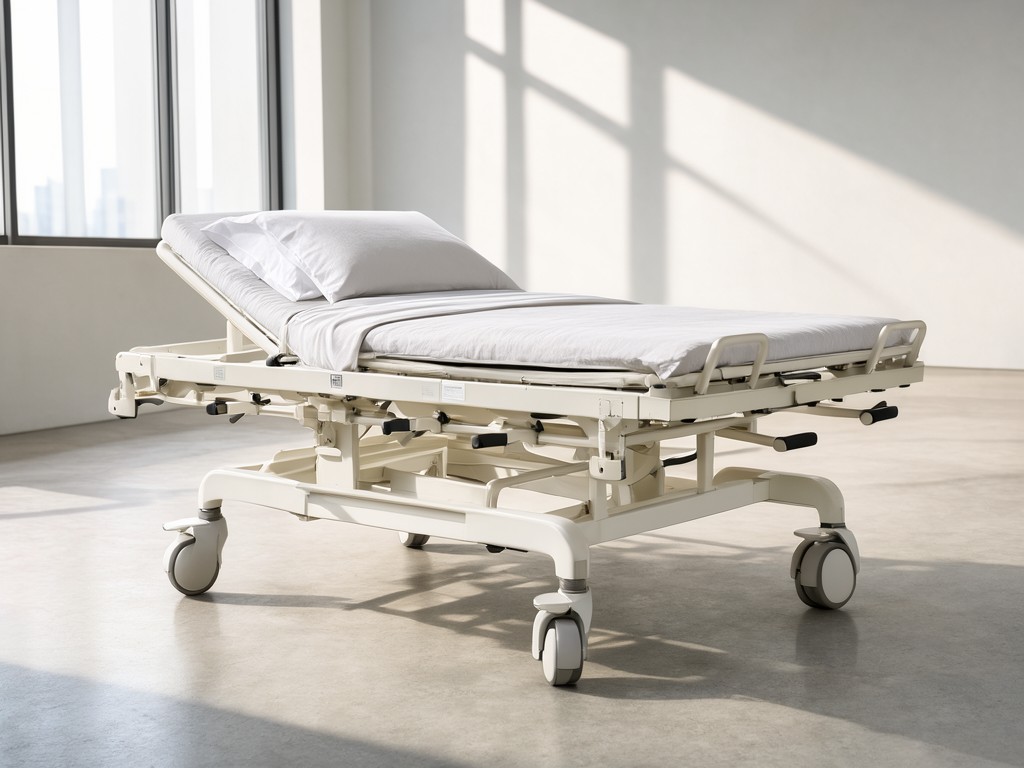
Specifying CE Certified single crank manual hospital beds with casters Supplier for Wholesale and OEM Orders
The core trade-off on single-crank beds is between articulation range and crank torque. A longer crank arm reduces operator effort by 15–20 % but increases the bed's footprint and snag risk in tight wards. Most OEM buyers spec a 280 mm crank arm with a 12 mm square drive as the sweet spot for 180 kg safe working load.
What This Product Is and Where It Fits
Balance and load analysis shows these beds serve sub-acute wards, nursing homes, and budget-conscious private clinics where electric beds cannot be justified on capex or where power infrastructure is unreliable. The single crank drives both back-rest and knee-break sections through a shared linkage — typically a 6 mm steel cable or a rack-and-pinion shaft — so one handle adjusts both planes simultaneously.
Buyers often assume the crank mechanism is a commodity, but the linkage geometry determines whether the knee-break lifts before the back-rest exceeds 30°, a clinical requirement for pressure redistribution. Beds that lift the knee first reduce shear forces on the sacrum by roughly 18 % compared to simultaneous-lift designs.
Construction Method and Its Effect on Consistency
The interface between parts determines long-term crank feel. Frames are robotic MIG-welded from 1.5 mm × 50 mm × 30 mm rectangular steel tube; the weld pitch is held to 50 mm ± 2 mm to prevent distortion that would bind the crank shaft. After welding, frames pass through a 180 °C cure oven for epoxy-polyester powder coat — minimum 80 µm DFT — which resists chloride disinfectants better than wet paint but chips if caster horns are not masked during coating.
Crank housings are die-cast zinc alloy (Zamak 5) with a 0.3 mm machining tolerance on the 12 mm square bore. Loose tolerances here cause the "sloppy crank" complaint that appears after 6–8 months of daily use. We specify a 0.05 mm interference fit between the crank shaft and the housing bore, secured with a DIN 6885 keyway and an M8 nyloc nut torqued to 18 Nm.
Casters are the other failure hotspot. Twin 125 mm conductive polyurethane wheels on precision ball bearings (6201-2RS) carry 100 kg each. The stem is M12 × 1.5 threaded into a welded nut plate, not a pressed insert — pressed inserts walk out under lateral loads when beds are pushed over thresholds.
Specification Range and Customisation Limits
Standard deck size is 900 mm × 2000 mm with a 60 mm EPS-cored HPL panel (0.8 mm skin). Width can move to 1000 mm without new tooling; length beyond 2100 mm requires a longer side rail extrusion and a re-certified crank linkage because the cable stretch exceeds 3 mm at full articulation.
Back-rest angle: 0–75 °. Knee-break: 0–35 °. Height range is fixed at 500 mm deck-to-floor (no hi-lo). Crank force at 180 kg load: ≤ 12 Nm with 280 mm arm. Finishes: RAL 9016 white or RAL 7035 light grey; custom colours add 10 days lead time for powder batch matching. Side rails are two-piece ABS with gas-spring assist — optional full-length aluminium rails add 4.2 kg per bed.
OEM branding: laser-etched logo on headboard (max 120 × 40 mm) or silk-screen on deck panel. Artwork must be vector AI/EPS, Pantone solid coated, submitted at least 15 working days before PPAP.
Comparing Two Standard Configurations
Config A: Cable-Drive Linkage
6 mm 7×19 galvanised steel cable, pulley radius 32 mm. Back-rest leads knee-break by 12 °.
Crank torque at 180 kg: 10.5 Nm. Cable inspection window in footboard.
Failure mode: cable fray at pulley after ~45 k cycles. Replacement 15 min, no tools.
Config B: Rack-and-Pinion Shaft
16 mm hardened chrome shaft, 20° pressure angle rack. Simultaneous lift profile.
Crank torque at 180 kg: 13.8 Nm. Sealed for life, no inspection window.
Failure mode: rack tooth pitting after ~70 k cycles. Requires deck removal to replace.
Config A wins on clinical ergonomics and field serviceability; Config B wins on unit cost (–€18) and IP rating (IPX4 vs IPX2). Most tenders specify the cable-drive profile explicitly.
How to Choose Before Requesting a Quote
Consistency depends on defining the clinical workflow first. If nurses adjust beds with patients in situ, the 12 ° lead of Config A reduces peak crank force by 2.3 Nm — meaningful over 20 adjustments per shift. If beds are mostly adjusted empty (day-room turnover), Config B's lower unit cost and higher IP rating pay back in 14 months.
Check door clearances: overall width with rails folded is 980 mm (Config A) vs 965 mm (Config B). Corridor width below 1000 mm forces Config B or rail deletion. Caster stem thread length is 25 mm; verify your floor sockets accept M12 × 1.5 or budget for stem adapters.
Ask for the crank torque test report at 180 kg — not the catalogue claim. Factory data should show ≤ 12 Nm at 280 mm arm for Config A, ≤ 14 Nm for Config B. Anything higher indicates misaligned linkage or undersized pulley radius.
Inspection Items and Test Methods
| Inspection Point | Method | Acceptance |
|---|---|---|
| Crank torque under load | Digital torque wrench, 180 kg sandbag on deck, 5 cycles | ≤ 12 Nm (Config A) / ≤ 14 Nm (Config B) |
| Back-rest / knee-break angle | Digital inclinometer at 0, 30, 45, 60, 75 ° | ± 2 ° vs nominal |
| Cable tension / shaft backlash | Dial indicator on crank handle, reverse direction | ≤ 1.5 mm free play |
| Caster swivel resistance | Spring scale, 90° turn on vinyl | ≤ 8 N per caster |
| Powder coat adhesion | Cross-hatch (ISO 2409) after 24 h salt spray | Rating 0 or 1 |
| Electrical continuity (conductive casters) | Megohmmeter, 500 V DC, frame to floor | ≤ 1 MΩ |
Every 50th unit gets a 50 k cycle endurance run (crank to 75 °/35 ° and back at 6 cycles/min). Cable-drive units must show < 3 mm cable elongation; rack units must show < 0.15 mm tooth wear measured on profile projector.
Questions Buyers Ask Before Ordering
Can the crank handle be folded or removed for storage?
Standard handle is fixed. A fold-down version (spring-loaded detent) adds €4.50 and 3 mm to the folded width. Removable handle with a captive knurled knob adds €7.20 but risks loss — we only recommend it for pediatric wards where entanglement is a hazard.
What is the real-world lifespan of the cable linkage?
In a 30-bed geriatric unit averaging 12 adjustments/day, cables last 9–11 years. In high-turnover rehab (25 adjustments/day), expect 4–5 years. We supply a spare cable kit (cable, two ferrules, thimble) at €12 per bed for stockholding.
Are the beds stackable for container loading?
Two-high with rails folded and crank handles aligned. A 40 HQ fits 96 beds (48 stacks) on standard EUR pallets. Add corner protectors (€0.80/set) to prevent powder coat damage on the top frame rails during transit.
How is CE marking documented for the technical file?
We provide the Declaration of Conformity to MDR 2017/745 Class I, risk management file (ISO 14971), biocompatibility (ISO 10993-1) for patient-contact surfaces, and EMC test report (IEC 60601-1-2) for the conductive caster path. Design dossier references EN 60601-2-52 for medical beds.
What changes trigger a new PPAP?
Any change to crank linkage geometry, caster stem specification, powder coat chemistry, or deck panel material. Colour change alone does not require PPAP if the RAL code stays within the qualified powder series.
Next Steps: Artwork and Branding Review
Send vector artwork (AI/EPS, Pantone solid coated) and your target launch date to /contactus. We return a digital proof within 48 hours, confirm crank configuration against your clinical workflow, and lock the BOM for first-article inspection. MOQ is 20 units per configuration; mixed Config A/B orders allowed above 40 total.