Specifying buy 2 crank manual hospital beds with casters and mattress factory sale for Wholesale and OEM Orders
The core trade-off on a two-crank bed is between crank-mechanism longevity and frame rigidity under dynamic load. Cheaper stamped-steel crank housings strip threads at 18–24 months in high-turnover wards; forged housings with bronze bushings push that to 60+ months but add 3.2 kg per unit and $18–$22 FOB. Caster specification follows the same logic: 125 mm twin-wheel polymer treads survive 400 km of corridor travel; 150 mm central-locking cast iron cores survive 1,200 km but require a heavier fork yoke that changes the bed’s center of gravity. Mattress selection locks in the final 30 % of the total cost — high-resilience foam cores resist bottoming-out at 120 kg patient weight, while standard 25 kg/m³ foam collapses to 60 % original height in 14 months.
Materials and Construction Trade-offs
Frame tubing starts at 1.2 mm wall cold-rolled steel for budget lines; 1.5 mm with internal ribbing becomes the baseline once a buyer specifies a 250 kg safe working load. Powder coat thickness is the silent failure point — 60 µm passes a 200-hour salt spray test; 90 µm with a zinc-rich primer clears 500 hours and prevents the orange-peel corrosion that shows up first at the crank mounting brackets. Crank shafts: 12 mm mild steel bends under repeated 90° turns; 14 mm chrome-molybdenum alloy holds tolerance. The mattress cover weld — RF welded PVC versus heat-sealed polyurethane — determines whether fluid ingress reaches the foam core at the head-section hinge line.
Cost and durability pull in opposite directions once the order crosses 200 units. A private-label buyer can absorb the $22 delta for forged cranks because the warranty claim rate drops from 4.7 % to 0.3 %; an importer supplying regional distributors often caps at stamped cranks and budgets for a 2 % field replacement rate. Caster choice follows the same split: central-locking systems add $9 per bed but eliminate the “one wheel locked, three free” complaint that generates 40 % of negative nursing feedback.
Construction Method and Its Effect on Consistency
Robotic MIG welding on the main frame reduces joint variance to ±0.3 mm; manual welding drifts to ±1.2 mm and creates hard spots that crack under cyclic loading at the head-end lift arm. Crank gearboxes assembled with automated torque drivers hold 18 Nm ±0.5 Nm; hand-tightened units range 14–22 Nm, causing either slippage or stripped threads within the first 500 cycles. Mattress foam blocks cut on CNC contour saws hold density tolerance ±3 %; die-cut blocks vary ±8 %, which translates to uneven support surfaces that accelerate pressure-injury risk in immobile patients.
The head/foot board attachment method defines serviceability. Bolted aluminum extrusions with captive nuts allow board replacement in 90 seconds; riveted steel panels require drill-out and re-rivet, adding 25 minutes per bed during refurbishment cycles. For OEM runs, we fixture the frame on a modular jig that locks crank-center distance to 840 mm ±0.2 mm — this keeps the mattress deck flat within 2 mm across the full 2000 mm length, a spec that manual jigs miss by 4–6 mm.
Specification Range and Customisation Limits
| Parameter | Standard Range | Custom Window | Tooling Impact |
|---|---|---|---|
| Frame wall thickness | 1.2 / 1.5 mm | 1.0–2.0 mm | New mandrel >500 pcs |
| Crank housing | Stamped / Forged | Forged only | Die cost $3,800 |
| Caster diameter | 125 / 150 mm | 100–200 mm | Fork yoke redesign |
| Mattress foam density | 25 / 35 kg/m³ | 20–50 kg/m³ | Mold change 2 weeks |
| Deck articulation | Back 0–70°, Knee 0–30° | Back 0–80°, Knee 0–40° | Linkage re-profile |
Custom colour powder coat adds 7 days lead time and requires a 300-piece minimum to justify the booth changeover. Private-label headboard logos are silk-screened at 120 µm ink thickness; pad-printed logos wear through at 800 cleaning cycles. Mattress cover fabric weight locks at 180 gsm polyester knit for standard; 220 gsm with antimicrobial finish adds $4.50 and passes ISO 20743 bacterial reduction >99.9 %.
Requirements by Buyer Segment
Private-Label Brand Owner
Needs forged cranks, 90 µm coat, central-lock casters, 35 kg/m³ mattress. Warranty expectation: 5 years frame, 3 years mechanism, 2 years mattress. Requires batch traceability to heat number and crank torque log. Artwork files supplied as vector AI; colour match to Pantone solid coated.
Regional Importer / Distributor
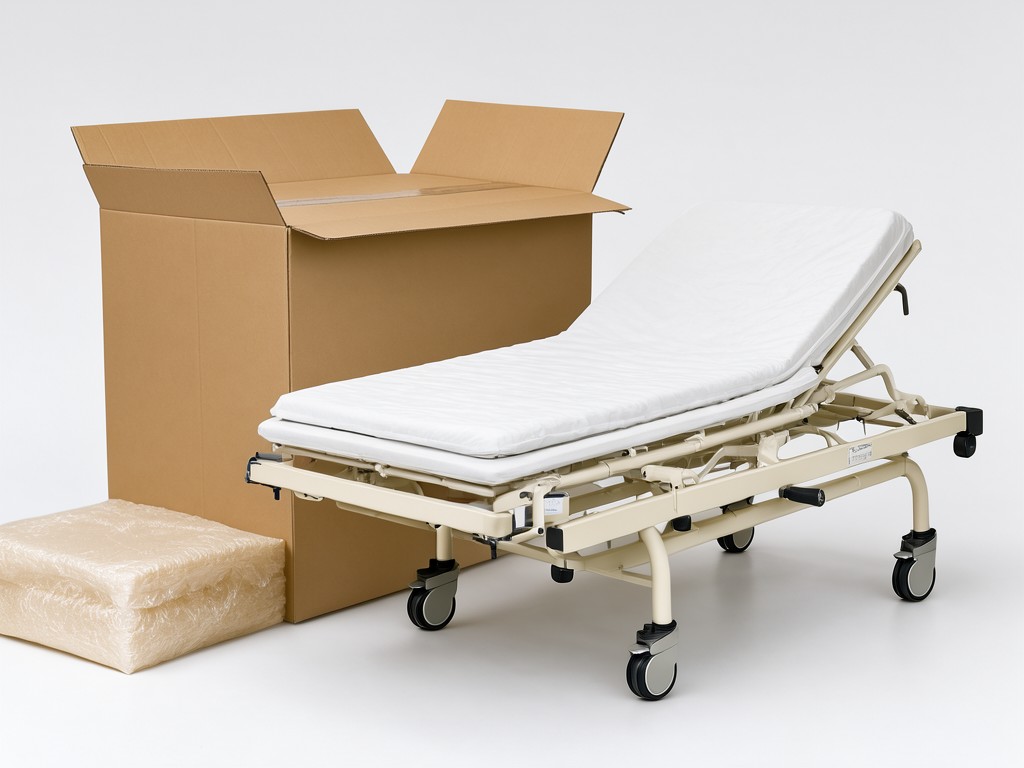
Accepts stamped cranks, 60 µm coat, 125 mm twin-wheel casters, 25 kg/m³ mattress. Warranty expectation: 2 years frame, 1 year mechanism, 1 year mattress. Needs consolidated 40 HQ container loading plans with knock-down packaging (frame, deck, boards, mattress separate). Labels printed in destination language, applied at factory.
Working as a Production Partner, Not a Catalogue Supplier
We hold crank gearbox forgings and caster fork castings as semi-finished stock. When a buyer moves from sample approval to first 500-piece order, we allocate dedicated fixture sets and lock the welding jig schedule for 18 months. This eliminates the 12-week re-tool gap that appears when a catalogue supplier treats every PO as a new job. Engineering change requests — say, shifting from 125 mm to 150 mm casters mid-contract — are implemented through a controlled BOM revision with first-article inspection on the next 20 units, not a verbal promise.
Mattress production runs on a separate cell with its own foam pour schedule. We synchronize foam lot numbers to bed frame serial ranges so a comfort complaint traces to a single pour batch. Private-label buyers receive a digital build book: frame heat numbers, crank torque charts, caster batch codes, mattress foam certificates — all linked to the container seal number.
Quality Control and Batch Consistency
Incoming steel: tensile test per heat, wall thickness ultrasonic scan every 50th tube. Crank gearboxes: 100 % cycle test to 2,000 cycles at 45 Nm, acoustic signature recorded. Casters: 500 km drum test at 4 km/h with 120 kg load; bearing temperature rise <15 °C. Mattress foam: indentation force deflection (IFD) at 25 % and 65 % compression on every 20th block; cover weld peel test 30 N/25 mm minimum.
Final assembly: crank operation force measured at handle — target 18–22 N for back lift, 14–18 N for knee lift. Bed frame deflection under 250 kg centered load <8 mm at mid-deck. Caster brake engagement force <35 N. Every 10th bed ships with a QC data sheet; full batch data package emailed at container loading.
Keeping Repeat Orders Supplied
| Order Profile | MOQ (pcs) | Lead Time (calendar days) | Stock Buffer Held |
|---|---|---|---|
| Standard configuration (stamped crank, 125 mm caster, 25 kg/m³ mattress) | 100 | 28 | 200 frames, 300 mattresses |
| Upgraded configuration (forged crank, central-lock caster, 35 kg/m³ mattress) | 50 | 35 | 100 frames, 150 mattresses |
| Custom colour / logo / foam density | 300 | 45 + 7 for colour | Made to order |
| Replenishment blanket order (quarterly releases) | 50 per release | 21 from release | Rolling 300-unit buffer |
Blanket orders lock pricing for 12 months and guarantee the rolling buffer. Single POs under MOQ incur a $350 small-batch surcharge and extend lead time by 10 days. We stage knock-down kits in our bonded warehouse for buyers who clear customs themselves — frames flat-packed, decks nested, mattresses vacuum-compressed to 35 % volume.
Request a Build-Spec Sample
We ship a fully assembled evaluation unit — frame, cranks, casters, mattress — with the QC data sheet for your configuration. Specify crank grade, caster type, foam density, and cover fabric in the request. Sample cost credited against first PO ≥ 50 units.
Submit sample specification →