bulk 4 crank manual hospital beds with casters and mattress supplier: What Buyers Should Check Before Ordering
Moving from sample orders to container loads changes every assumption about what "equivalent" means on a spec sheet. A bed that passes a single-unit inspection at the factory gate can still generate warranty claims at 3% by month six if the crank gear hardening spec was relaxed by two Rockwell points to save CNC cycle time. Procurement officers who treat this category as a commodity line item end up absorbing the cost of mattress cover delamination, caster stem fatigue, and side-rail latch failure — costs that never appear on the unit price column.
This page outlines the mechanical and material decision points that separate a bed rated for 30,000 crank cycles from one that binds at 8,000, and the inspection checkpoints that keep batch variance inside the tolerance your facility management team actually budgets for.
Scope of Supply and Physical Form
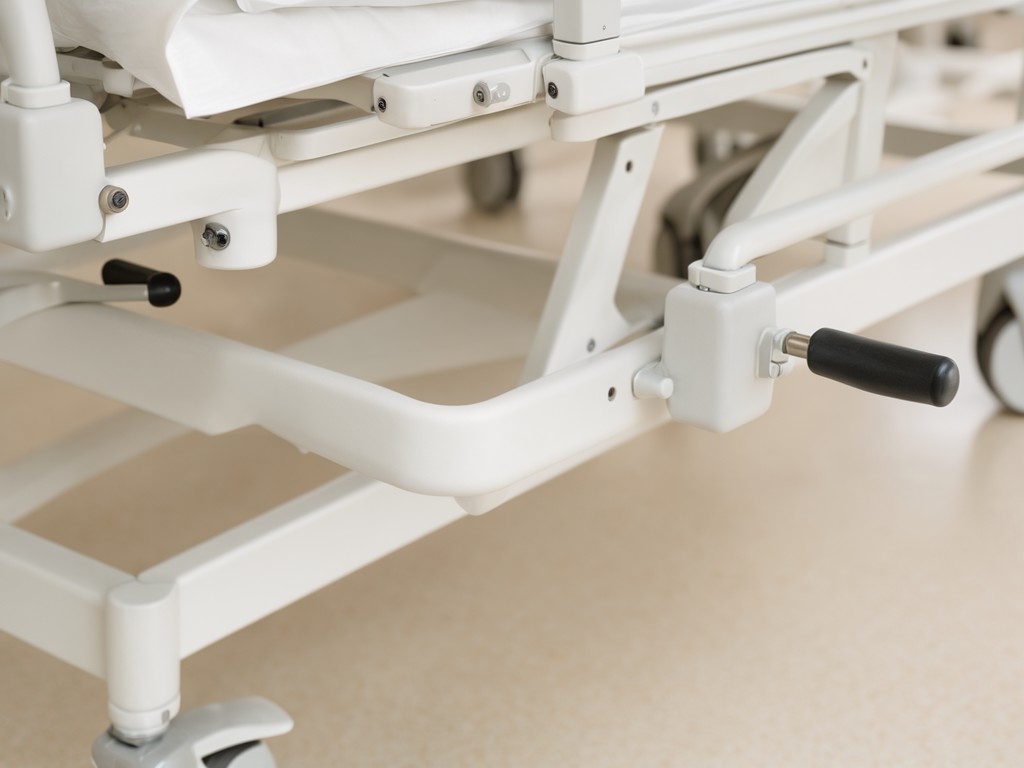
Standard configuration per unit: Bed frame with integrated four-crank mechanism (backrest, knee break, height, Trendelenburg/reverse Trendelenburg), four 125 mm casters with central-locking pedal, two-piece ABS side rails with single-hand release, IV pole sockets at four corners, drainage bag hooks, and a 150 mm high-density foam mattress with welded-seam PU cover.
Packaging: knock-down frame in five sub-assemblies per carton, mattress vacuum-compressed in poly sleeve, hardware kit bagged separately. Gross weight per set 85–92 kg depending on side-rail option. Container load plan: 48 sets per 40'HQ when mattress ships compressed, 36 sets if mattress ships expanded.
The crank shafts run in sintered bronze bushings, not ball bearings — a deliberate cost/performance trade-off. Bushings tolerate misalignment from frame welding distortion better than bearings, but they demand a consistent grease spec (NLGI #2 lithium complex, -20 °C to 120 °C) applied at assembly. Skip the grease or substitute a general-purpose grade, and the torque required to raise the backrest under 120 kg patient load jumps from 1.8 Nm to 4.5 Nm within 500 cycles.
Where Cheaper Alternatives Fall Short
On a private-label launch with a fixed ship date, the temptation is to accept a 12% lower FOB from a supplier who swaps 2.0 mm wall tube for 1.6 mm on the longitudinal frame members. The static load test still passes at 250 kg. What the test doesn't show: after 18 months of daily height adjustment cycles, the thinner wall develops micro-cracks at the crank bracket weld toes. The bed doesn't collapse — it develops a 3 mm vertical play at the head end that nurses describe as "wobble." That wobble triggers premature caster bearing wear because the frame no longer tracks square.
Another common substitution: replacing the welded-seam PU mattress cover with a stitched polyester/PVC laminate. The laminate passes the initial fluid ingress test (IPX4 equivalent). After 30 industrial wash cycles at 71 °C with quaternary ammonium disinfectant, the stitch lines wick moisture into the foam core. Foam degradation follows — indentation force deflection drops 22%, and the mattress fails pressure-redistribution criteria. The replacement cost per bed exceeds the original unit price delta by 3.5×.
How It Performs in Use
Nursing staff evaluate these beds on three operational metrics: crank effort under load, caster steering feel when the central lock is engaged, and side-rail deployment speed. The four-crank layout means each function has a dedicated shaft — no selector lever to misalign. Backrest crank: 0–75° in 14 turns. Knee break: 0–40° in 9 turns. Height range: 450–750 mm deck-to-floor in 22 turns. Trendelenburg: ±12° in 6 turns. All figures measured with 135 kg distributed load.
Caster specification drives the steering feel. We specify 125 mm diameter, 32 mm tread width, precision ball bearing swivel head, and a central-locking cam that engages all four wheels with 18 N pedal force. Cheaper casters use a 28 mm tread and a stamped steel fork that flexes under lateral load. The result: the bed crabs 15–20° off the push vector when maneuvering through 900 mm doorways with the brake engaged. That crabbing force transmits back to the frame, accelerating the longitudinal member fatigue mentioned above.
Mattress cover zipper is a #8 nylon coil with auto-lock slider, rated for 500 cycles. The zipper garage is heat-sealed, not stitched, to eliminate a fluid ingress path. Foam core: 35 kg/m³ density, 120 N IFD (25% compression), 95% recovery after 80,000 cycles per ISO 3386-1. Cover tensile strength 450 N/50 mm warp, 400 N/50 mm weft per ISO 13934-1.
How It Is Built and What That Changes
| Component | Our Spec | Common Substitute | Failure Mode if Substituted |
|---|---|---|---|
| Longitudinal frame tube | 50×30×2.0 mm Q235B, CO₂ weld | 50×30×1.6 mm Q195 | Weld toe cracking at 18–24 months; frame wobble |
| Crank gear material | 20CrMnTi, carburized 58–62 HRC, 0.8 mm case | 45# steel, induction hardened 48–52 HRC | Tooth pitting at 8k cycles; binding under load |
| Caster fork | Cold-formed 3.0 mm steel, double ball race | Stamped 2.5 mm, single race | Fork flex → crabbing → premature frame fatigue |
| Mattress cover | PU/PVC composite, RF welded seams | Stitched laminate, taped seams | Wicking at stitch lines → foam rot → IFD loss |
| Side rail latch | Zinc alloy die-cast, spring-loaded pin | Stamped steel, plastic cam | Cam wear → rail drops unexpectedly |
The epoxy powder coating on the frame is 80–100 µm DFT, salt spray 500 hours per ASTM B117 before first red rust. Some suppliers quote 60 µm to save booth time; that coating fails at 200 hours in high-humidity coastal deployments. The cost difference per bed is $1.80. The re-coat cost after field failure is $45 plus freight both ways.
Size, Weight and Specification Range
Standard deck size 900×2000 mm (external 1020×2150 mm with side rails folded). Optional 1000 mm width adds 12 kg per set and reduces container density to 42 sets per 40'HQ. Safe working load 250 kg evenly distributed; dynamic load test 300 kg for 5 minutes per IEC 60601-2-52 clause 201.12. Crank torque under max load: backrest 2.1 Nm, knee break 1.6 Nm, height 3.8 Nm, Trendelenburg 2.4 Nm. All cranks fold flush to frame profile (projection <15 mm) to meet corridor clearance requirements.
Caster options: standard 125 mm central-lock (included), optional 150 mm directional-lock for ICU corridors (adds $4.20/set, +3 kg), optional 100 mm low-profile for bariatric deck height reduction (reduces min deck height to 400 mm). IV pole: 19 mm diameter stainless steel, 1.2 m extended height, two hooks, removable. Drainage hooks: two per side, 6 mm diameter rod, 15 kg vertical pull rating.
Customisation Options and Their Limits
Colour & Branding
Frame powder coat: RAL 9016 (traffic white) standard. Custom RAL adds 7 days lead time, MOQ 50 sets per colour. Logo pad-print on headboard: single colour, 120×60 mm max, setup $85, $0.45/unit. Mattress cover: Pantone-matched PU film available at 200 sets MOQ; adds 10 days for film procurement.
Mechanical Variants
Three-crank version (no Trendelenburg) reduces BOM $18, saves 2 kg, but eliminates a clinical function required in step-down units. Five-crank adds cardiac chair position — requires different gearbox casting, MOQ 100 sets, +$27. Side rail: full-length single piece (adds $9, +4 kg) or split two-piece (standard). Split rails allow patient egress from either side; full-length reduces entrapment risk but requires two-hand release.
Electrical accessories (under-bed light, nurse call integration, battery backup for crank assist) are not compatible with the manual four-crank platform — the frame lacks cable routing channels and the crank shafts occupy the actuator mounting points. Specify the electric/hydraulic platform if those features are needed; do not attempt field retrofit.
How Consistency Is Held Across Batches
Every production lot (50 sets) undergoes three hold points. First: frame geometry check on coordinate measuring arm — diagonal variance ≤3 mm, deck flatness ≤2 mm/m. Second: crank torque audit at 0, 50, and 100 kg load — each crank must stay within ±0.15 Nm of the master sample curve. Third: caster swivel force and lock engagement force measured with calibrated spring gauge — swivel ≤2.5 N, lock engage 16–20 N, release ≤3 N.
Mattress batch testing: one unit per 200 tested for IFD retention after 80k cycles, cover peel strength at welded seams (≥45 N/25 mm), and zipper cycle life to 500 operations. Failed lot triggers 100% inspection of that mattress batch and root cause trace to foam supplier lot number or cover welding parameter log.
We maintain a retained sample library for 36 months — one complete bed per production month, stored in controlled conditions (23±2 °C, 50±10% RH). When a field claim arrives, the retained sample runs the same three hold-point tests. If the retained sample passes, the claim is installation or usage related. If it fails, the entire lot from that month is quarantined for rework or replacement. This library has resolved four supplier material deviations in the last 18 months before they reached your warehouse.
Next Steps
Request the full technical data package — including crank torque curves, caster force-displacement plots, and mattress IFD decay curves — along with the current production lot inspection records. We'll also share the container load optimisation sheet for your target port and the private-label artwork template if branding is required.
Submit a specification review request