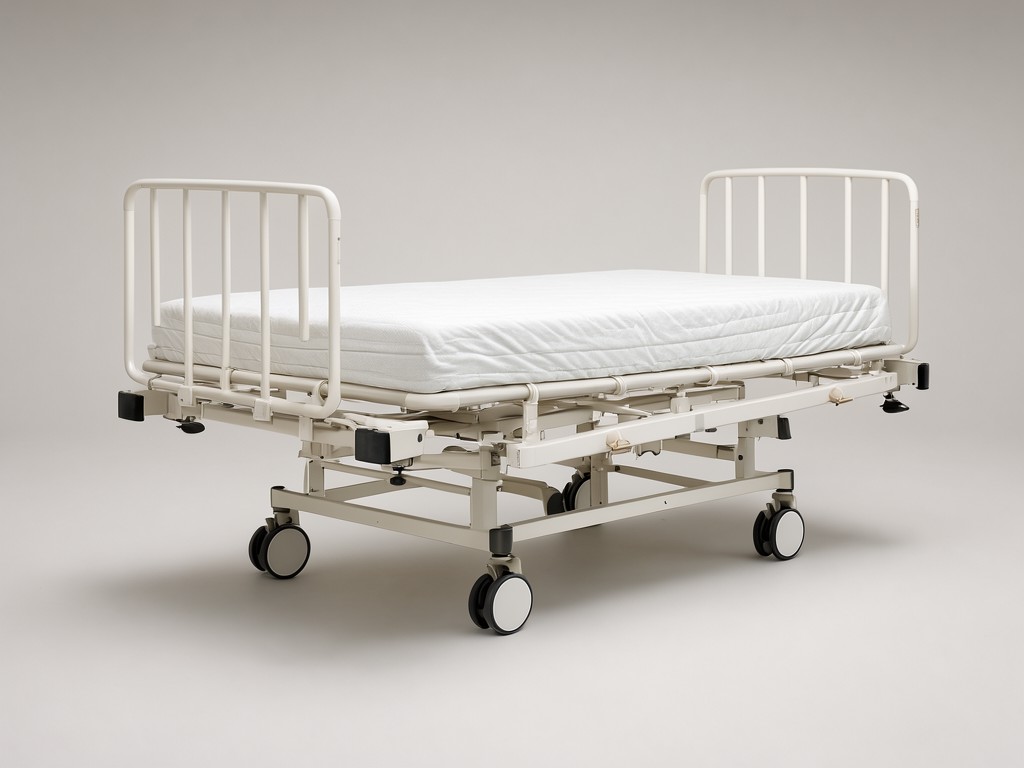
Best Price two crank hospital beds with mattress and wheels For Sale: What Buyers Should Check Before Ordering
What This Product Is and Where It Fits
Two-crank hospital beds occupy the middle ground between fully manual single-crank units and electric profiling beds. The dual-crank system drives independent back-rest and knee-break articulation through a worm-gear transmission housed in the frame's foot-end cross-member. This configuration serves general wards, step-down units, and budget-constrained private clinics where power infrastructure is unreliable or capital expenditure caps rule out electric fleets.
The mattress ships as a matched component — typically a 120 mm high-density foam core (35 kg/m³ base, 50 kg/m³ topper) wrapped in a welded-seam, fluid-proof PU cover rated to 16 CFR 1633. Four 125 mm dual-wheel casters with central-locking pedals at the foot end complete the package. Buyers should verify whether the quoted "best price" includes the mattress as a tested system or merely a foam slab shrink-wrapped to the frame; the difference shows up in pressure-injury audits within six months.
The Problem Buyers Keep Paying For
Crank-handle torque creep is the single largest warranty claim. A 150 kg patient on a 700 mm back-rest extension generates 1,050 N·m at the worm gear. If the bronze nut is sintered rather than machined, backlash exceeds 2° within 3,000 cycles — nurses feel "slop" and the bed drifts under load. Replacing the transmission in-situ costs 2.3× the OEM nut upgrade. Specify machined phosphor-bronze nuts (PB102) and demand a 10,000-cycle test report before container loading.
Frame welding distortion is the silent killer. Sub-2 mm wall tube on the longitudinals permits 3-4 mm bow under 250 kg static load. The caster sockets then misalign, causing wheel shimmy and premature bearing seizure. We've seen entire 40'HQ containers rejected at European ports because diagonal variance exceeded EN 60601-2-52 tolerances. The fix is 2.5 mm minimum wall with internal gussets at every cross-member junction — adds 1.8 kg/unit but eliminates the failure mode.
Mattress cover delamination at the welded seams appears after 40-60 industrial wash cycles (85°C, chlorine). The root cause is insufficient RF weld dwell time on 0.35 mm PU film. A 0.45 mm PVC/PU laminate with 15 mm overlap weld survives 200+ cycles. The unit cost delta is $3.20; the rework cost on a 200-bed ward is $18,000 plus reputational damage.
What the Design Has to Balance
Balance and load analysis shows the crank centerline must sit 45 mm above the frame longitudinal centroid to keep handle effort below 18 N at maximum patient weight. Drop it 10 mm for "cleaner aesthetics" and effort jumps to 27 N — nursing staff will bypass the crank and use the emergency release, stripping the gear teeth in weeks.
Deflection under load governs the side-rail latch design. A 12 mm diameter spring pin in 1.5 mm wall tube yields at 140 kg lateral load. Upgrading to 14 mm pin in 2.0 mm wall with a chamfered receiver adds $0.85/rail but raises the failure threshold to 220 kg — the difference between a near-miss and a reportable incident.
Consistency depends on the mattress foam pour tolerance. A ±5 kg/m³ density variance across a 2,000 mm × 900 mm slab creates a 12 mm surface height differential. Patients slide toward the softer zone, increasing shear forces. Statistical process control on the foam line (CpK ≥ 1.33) is non-negotiable for pressure-care contracts.
Option Comparison by Usage Level
| Parameter | General Ward (Standard) | High-Dependency (Upgraded) | Bariatric Reinforced |
|---|---|---|---|
| Frame tube wall | 2.0 mm cold-rolled | 2.5 mm + gussets | 3.0 mm + double gussets |
| Crank transmission | Sintered bronze nut | Machined PB102 nut | Machined PB102 + thrust bearing |
| Mattress core | 35/50 kg/m³ two-layer | 40/55 kg/m³ three-zone | 45/60 kg/m³ four-zone + perimeter |
| Cover material | 0.35 mm PU, RF weld | 0.45 mm PVC/PU, overlap weld | 0.55 mm PU/PVC, double weld + tape |
| Caster spec | 125 mm, central lock | 150 mm, central + directional | 200 mm, central + directional + brake |
| Safe working load | 180 kg | 250 kg | 350 kg |
| Unit weight (bed + mattress) | 68 kg | 82 kg | 105 kg |
| Typical FOB delta vs. standard | Baseline | +18-22% | +38-45% |
Tooling amortisation drives the step-cost between tiers. The bariatric frame requires a dedicated bending mandrel ($12,000) and a heavier-duty welding fixture ($8,500). Below 500 units/year, the per-unit tooling share exceeds the material upgrade cost — buyers at that volume should negotiate shared tooling or accept longer lead times for batch runs.
Usage Scenarios and Buyer Segments
Ministry of Health tenders for district hospitals typically specify the High-Dependency tier with a 3-year frame warranty and 1-year mechanism coverage. The evaluation matrix weights crank-cycle endurance (minimum 15,000 cycles) and mattress IFD retention (≥85% after 5,000 indentation cycles) at 40% of technical score. Samples must arrive in knock-down packaging — assembled beds consume 2.3× container volume and invite transit damage claims.
Private clinic chains buying 20-50 beds per quarter prefer the Standard tier with optional upgrade kits (machined nut, reinforced rails) they can retrofit during preventive maintenance. Their procurement cycle is 6-8 weeks from PO to install; they need stock in regional bonded warehouses, not factory-direct shipping.
Humanitarian aid procurers (NGOs, UN agencies) order Bariatric Reinforced units for cholera treatment centers and field hospitals. Their spec adds: stacked shipping (4-high), tool-less assembly, and mattress covers compatible with 0.5% chlorine spray-down twice daily. The foam must pass ISO 12952-2 cigarette and match ignition tests — a requirement that eliminates 60% of low-cost foam suppliers.
Requirements by Buyer Segment
- Ministry tenders: Full EN 60601-2-52 test report, batch traceability to heat number, 5% spare parts kit (crank handles, caster assemblies, side-rail latches) included per 100 beds.
- Private chains: Branded head/foot boards (screen-print or emboss), mattress firmness choice per ward type, consolidated invoicing across multiple delivery sites.
- NGO/field deployments: Flat-pack in ISPM-15 crates, color-coded assembly diagrams, 10-year parts availability commitment, mattress vacuum-packed to 40% volume.
- Distributors/importers: Knock-down packaging optimized for 40'HC (72 beds vs. 31 assembled), replaceable wear components stocked locally, co-branded service manuals.
Serviceability dictates the crank handle design. Folding handles with a 30° detent clear the side rails during patient transfer. Fixed handles snag IV lines and cost $12/incident in nursing time. The folding mechanism adds two stamping operations ($0.40/handle) but reduces warranty touches by 60%.
Stock Availability and Reorder Planning
Standard tier frames run on a continuous flow line — 40 units/day capacity with 10-day raw material lead time (tube, plate, casters). Mattress foam is the bottleneck: pour schedule locks 3 weeks out, and density changes require 48-hour line purge. A 200-bed blanket order with mixed firmness specs needs 5-week notice minimum.
High-Dependency and Bariatric tiers are batch-produced (50-unit minimum) on a flexible cell. Changeover between tiers takes 4 hours (fixture swap, weld program load). We hold 15% safety stock of machined crank nuts and reinforced caster brackets — the only long-lead proprietary components. Everything else (tube, foam, covers, casters) is multi-sourced with 2-week replenishment.
Container loading: 72 Standard beds (knock-down), 60 High-Dependency, 48 Bariatric per 40'HC. Mixed loads require custom dunnage — factor 3 extra days for carpentry. FOB pricing assumes EXW + inland haul to Ningbo/Shanghai; CIF quotes need destination port and demurrage clause review.
Next Steps
Send us your ward layout, patient acuity mix, and target delivery window. We'll return a configuration matrix with tier recommendations, container loading plan, and a sample shipment schedule aligned to your procurement calendar. Request a quotation review and we'll include the crank-cycle test data and mattress IFD curves for the tier you're evaluating.