best price 5 function manual medical patient beds with casters exporter - Bulk Supply and Specification Guide
Scope of Supply and Physical Form
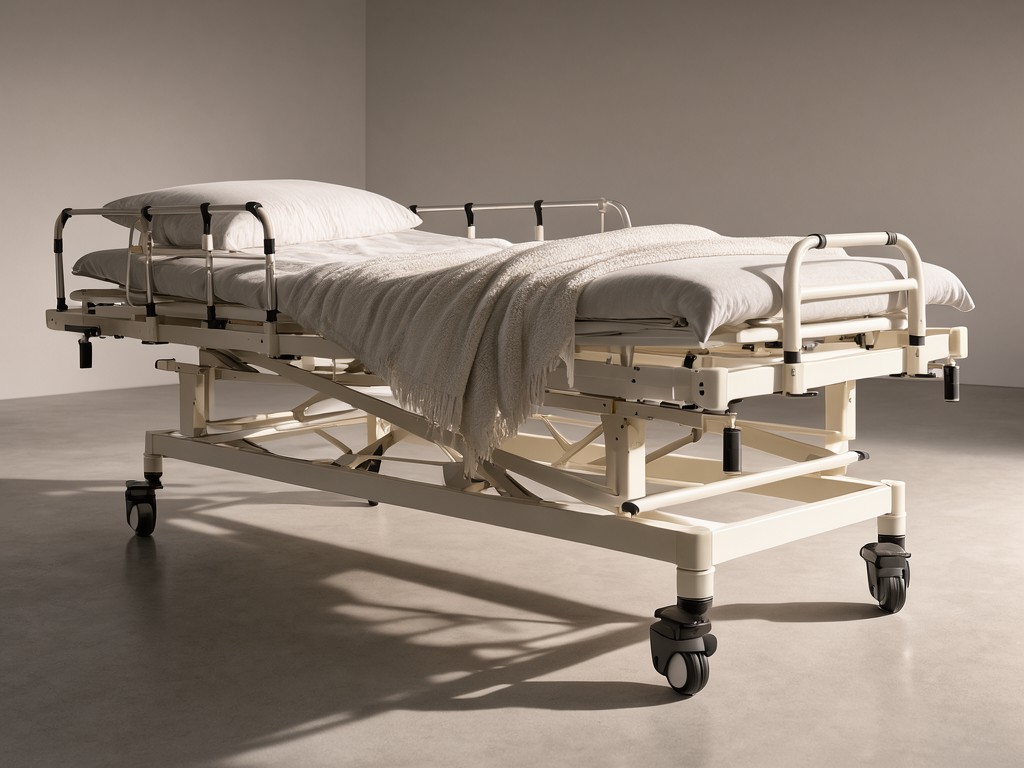
Each unit ships as a fully assembled frame with integrated crank handles, five preset position locks, and four 125 mm lockable casters. The bed deck uses a 1.2 mm cold‑rolled steel platform perforated for drainage and mattress airflow.
The table below compares the two most common material grades used for the frame and deck. Choose Grade A when the budget allows a 15 % longer fatigue life; Grade B meets the same static load with a lower unit cost.
| Component | Grade A (Q235B) | Grade B (Q195) |
|---|---|---|
| Frame tube | 2 mm wall, 350 MPa yield | 1.8 mm wall, 280 MPa yield |
| Deck plate | 1.2 mm perforated, 300 MPa | 1.0 mm perforated, 250 MPa |
| Surface finish | Epoxy powder coat, 80 µm | Epoxy powder coat, 60 µm |
What Actually Determines Performance
Bed articulation precision hinges on crank gear backlash and lock‑pin engagement depth. A 0.3 mm backlash translates to a 2 mm positional error at the head section, which clinicians notice during Trendelenburg adjustments.
Caster swivel resistance should stay below 0.15 Nm to permit one‑hand steering with a 250 kg load. Excess resistance forces staff to use two hands, raising injury risk and slowing patient transfer.
Comparing Two Standard Configurations
Configuration X uses Grade A frame, 5‑position crank, and premium casters. Configuration Y uses Grade B frame, 4‑position crank, and standard casters. The table quantifies the trade‑offs that affect total cost of ownership.
Configuration X
- Frame: Q235B, 2 mm wall
- Crank: 5‑position, hardened gear
- Casters: double‑ball, total lock
- Unit cost (FOB): $185
Configuration Y
- Frame: Q195, 1.8 mm wall
- Crank: 4‑position, standard gear
- Casters: single‑ball, brake only
- Unit cost (FOB): $158
| Parameter | Config X | Config Y |
|---|---|---|
| Backlash after 2 000 cycles | ≤0.3 mm | ≈0.6 mm |
| Caster swivel torque (Nm) | 0.12 | 0.18 |
| Estimated service interval | 24 months | 12 months |
| Total 5‑year cost (incl. service) | $1 020 | $1 190 |
Buying Mistakes That Lead to Returns
The complaint that repeats across reorders is caster lock failure after six months of daily use. Buyers often specify “lockable casters” without confirming total‑lock versus brake‑only design.
- Selecting brake‑only casters for high‑traffic wards; wheels drift under load.
- Ordering Grade B frames for bariatric wards; static rating met but fatigue cracks appear at 18 months.
- Skipping crank gear hardness verification; backlash grows, position locks slip.
- Neglecting to request powder‑coat thickness report; thin coat corrodes in humid climates.
How Consistency Is Held Across Batches
Tooling for the crank gear is a dedicated CNC hobbing cell; each batch of 500 gears is sampled at 1 % for Rockwell hardness and tooth profile. The frame welding fixture uses laser‑tracked jigs that hold tube alignment within ±0.2 mm.
Powder‑coat thickness is monitored inline by an eddy‑current gauge; any part reading below 70 µm is diverted for re‑coat. This closed loop keeps the coefficient of variation for coating thickness under 4 % across the production year.
Inspection Items and Test Methods
Final inspection follows a 12‑point checklist that covers structural, functional, and cosmetic criteria. The most critical tests are listed below.
- Static load test: 250 kg applied to deck centre for 5 min; deflection ≤12 mm.
- Crank cycle test: 5 000 full articulation cycles; backlash measured each 1 000 cycles.
- Caster swivel torque: measured with calibrated torque wrench; must be ≤0.15 Nm.
- Lock‑pin engagement force: 30 N ±5 N required to seat each position.
- Coating adhesion: cross‑hatch test per ASTM D3359; rating ≥4B.
- Dimensional audit: overall length, width, height within ±3 mm of drawing.
Keeping Repeat Orders Supplied
A rolling 12‑week forecast shared by the distributor allows the factory to pre‑cut tube bundles and pre‑coat deck plates, cutting lead time from 45 days to 28 days for repeat SKUs.
Safety stock of 200 units per configuration is maintained in the bonded warehouse; this buffer absorbs sudden demand spikes without incurring air‑freight surcharges.
Packing, Marking and Freight Configuration
Each bed is wrapped in 0.15 mm PE film, placed on a 1200 × 800 mm Euro pallet, and secured with two 12 mm polyester straps. Corner protectors prevent strap damage to the powder coat.
- Pallet label: SKU, batch number, manufacture date, gross weight (≈95 kg).
- Inner carton (optional) for LCL shipments: double‑wall corrugated, 1150 × 750 × 550 mm.
- Container loading: 24 beds per 40‑ft HC, stacked two high with 100 mm dunnage.
- Documentation packet: packing list, test certificate, warranty card, customs invoice.
Ready to finalize artwork and branding?
Submit your logo files and colour specifications for a complimentary pre‑production proof. Our graphics team returns a digital mock‑up within 48 hours.
Submit artwork for review