wholesale patient bedside cabinets for hospital Company: What Buyers Should Check Before Ordering
What Actually Determines Performance
Load rating and edge durability drive the first‑year claim rate.
A cabinet that carries 120 kg on the top shelf and survives 10 000 open‑close cycles without hinge sag will keep warranty costs below 1 % of turnover. The powder‑coat thickness, hinge grade, and laminate bond strength are the three variables that move that number. If any one drifts, the whole unit fails the hospital’s cleaning protocol and the buyer sees a return.
Materials and Construction Trade-offs
Powder‑Coated Steel + HPL
Standard 1.2 mm cold‑rolled steel, 60 µm epoxy‑polyester coat, 0.8 mm high‑pressure laminate. Good impact resistance, cost‑effective for 150‑unit runs.
- Hinge: 3‑piece stainless, 30 kg rating
- Edge band: 2 mm ABS, laser‑welded
Stainless Steel + Antimicrobial Laminate
304 SS frame, 80 µm electropolished finish, 0.9 mm laminate with silver‑ion additive. Meets ICU cleaning cycles, higher unit price but 30 % longer service life.
- Hinge: 4‑piece SS, 45 kg rating
- Edge band: 3 mm PP, co‑extruded
Construction Method and Its Effect on Consistency
Knock‑down (KD) assembly ships flat, reduces freight volume by 38 %.
The trade‑off is tolerance stack‑up at the cam‑lock joints. A 0.3 mm hole‑diameter variance translates into a 1.2 mm door gap after assembly, which fails the hospital’s infection‑control audit. Welded sub‑frames eliminate that variance but add 12 % to tooling cost and require a dedicated fixture for each size. First‑article tooling determines whether the KD route stays within ±0.5 mm overall dimension.
Option Comparison by Usage Level
| Option | Range / Choices | Impact on Lead Time |
|---|---|---|
| Cabinet height | 720‑900 mm in 30 mm steps | +3 days per non‑standard step |
| Finish colour | RAL 9016, 7035, custom RAL | Custom RAL +5 days |
| Lock type | Keyed, electronic RFID, none | RFID +7 days |
| Antimicrobial additive | Silver‑ion, copper‑ion, none | Additive +4 days |
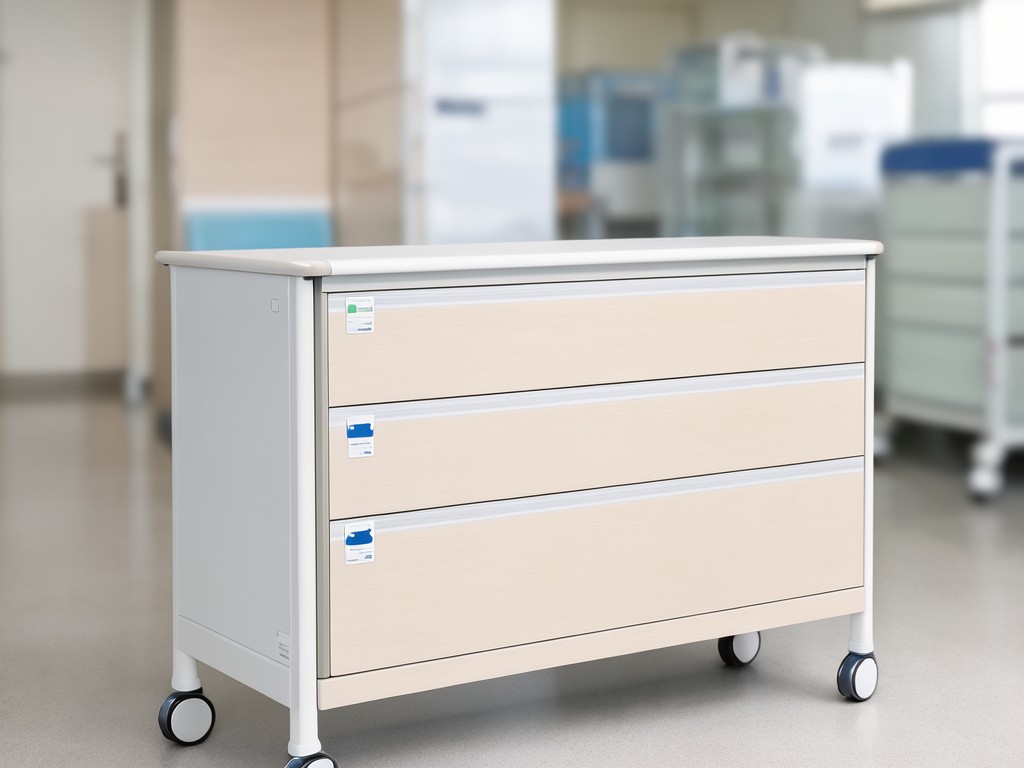
How to Choose Before Requesting a Quote
Critical spec rule: Cabinet height tolerance ±2 mm ensures alignment with standard bed rails; exceed this and you risk gaps that trap fluids and trigger infection‑control citations.
Agree the drawing set, material data sheets, and a pre‑production sample before any tooling is cut. The sample must pass a 24‑hour salt‑spray test (ASTM B117) and a 5 000‑cycle hinge endurance test. Document the acceptance criteria in the purchase order to avoid downstream disputes.
Buying Mistakes That Lead to Returns
- Ordering a single finish for mixed‑ward deployment – ICU needs antimicrobial, general ward does not.
- Skipping the first‑article inspection; hinge mis‑alignment shows up only after 200 units ship.
- Assuming KD packaging protects edges – corner crush on 40 ft containers adds 2 % damage rate.
- Not specifying lock‑type per department; retro‑fit kits cost 3× the original hardware.
Segment‑Specific Requirements
Emergency departments demand 30 % faster door swing; specify low‑friction polymer rollers.
Oncology wards require non‑porous surfaces that survive 0.5 % hydrogen peroxide vapor; choose copper‑ion laminate over silver‑ion for that chemistry.
Pediatric units prefer rounded corners (R = 8 mm) and colour‑coded drawer fronts; add a 2 mm radius CNC pass and a UV‑stable pigment batch.
Packing, Marking and Freight Configuration
| Usage Condition | Common Failure | Preventive Spec |
|---|---|---|
| High‑traffic med‑surg floor | Hinge sag after 6 months | 4‑piece SS hinge, 45 kg rating, 0.3 mm preload |
| ICU with vaporized H₂O₂ | Laminate delamination | Copper‑ion laminate, 0.9 mm thickness, edge seal ≥1 mm |
| Pediatric ward | Sharp corner injuries | R = 8 mm CNC radius, UV‑stable pigment |
| Export container 40 ft | Corner crush, paint chip | Double‑wall corrugated, corner protectors, 150 kg stack limit |
Next Steps
Lock in the drawing package, confirm the finish and hardware matrix, then request a pre‑production sample. The sample validates every tolerance before the first container ships.