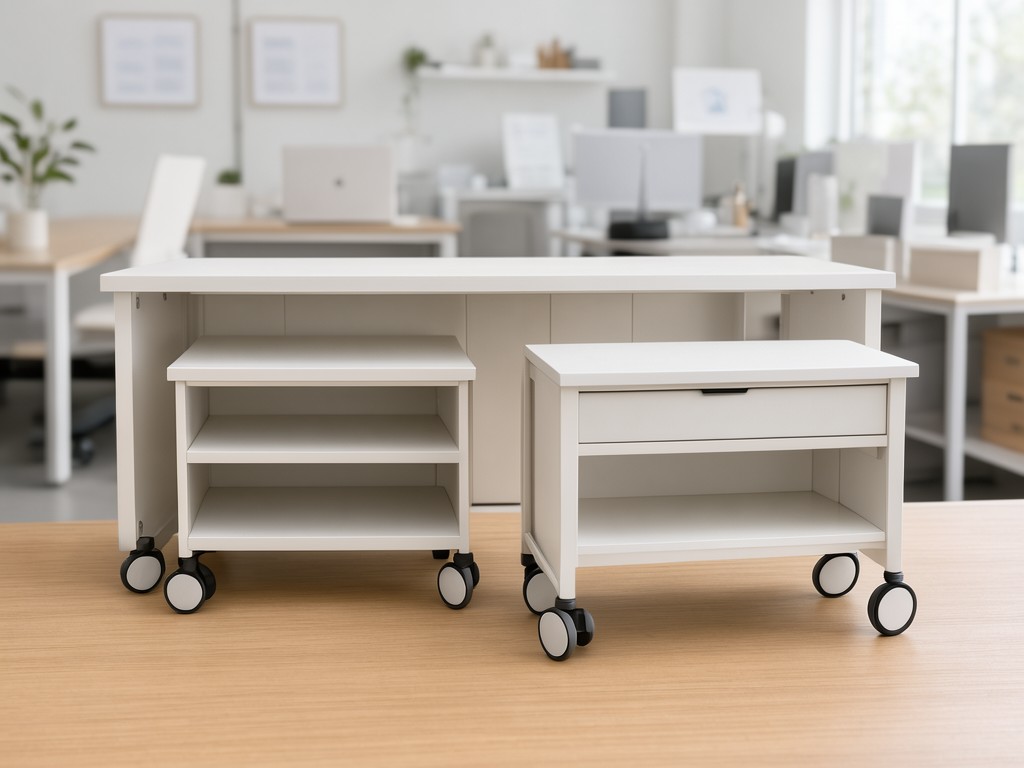
Wholesale hospital bedside tables with wheels Supplier: What Buyers Should Check Before Ordering
Materials and Construction Trade-offs
The build method decides whether a bedside table survives three years of daily height adjustments, lateral impacts from IV poles, and aggressive cleaning cycles — or starts wobbling at month six. Laminate over particleboard keeps unit cost low but swells at the edge banding when mop water sits overnight. High-pressure laminate (HPL) on 18 mm MDF core resists moisture better, yet the denser core adds 3–4 kg per unit, raising freight cubic weight on 40-foot containers. Powder-coated steel frames with 1.2 mm wall thickness handle 50 kg static load; drop to 0.8 mm and the C-channel flexes under a monitor arm, cracking the weld at the column bracket.
Caster specification is the quiet cost driver. Twin-wheel 75 mm polyurethane treads on precision ball bearings roll silently over vinyl tile and epoxy flooring. Cheaper 50 mm nylon singles flat-spot under static load, then chatter down corridors — a noise complaint that triggers nursing-staff pushback and retrofit orders. Locking mechanism matters: total-lock (wheel + swivel) adds $1.20 per caster but prevents drift when a patient leans on the table edge. Directional-lock only stops swivel; the table still rolls sideways on sloped floors.
Private-label spec tip: require HPL top with 3 mm PVC edge banding, 1.2 mm steel frame, and total-lock 75 mm PU casters. That combination eliminates the top three warranty claims — edge delamination, frame flex, caster drift — while adding roughly $4.50 landed cost versus the economy build.
Construction Method and Its Effect on Consistency
Consistency is set at the forming stage. CNC nested routing of MDF/particleboard panels holds ±0.3 mm per 1000 mm; hand-cut batches drift to ±1.5 mm, enough to misalign drawer slides and create visible gaps at the top-to-frame joint. Automated edge-banding with PUR glue line withstands 80 °C steam cleaning; EVA hot-melt fails at 60 °C, and the seam opens within six months on oncology wards where terminal cleaning runs daily.
Frame welding fixtures control squareness. A dedicated jig holds the column, base, and top bracket at 90.0° ±0.2°. Without it, manual tack-welding produces 0.5–1.0° variance — the table leans, the gas-spring lift binds, and the height-adjust handle scrapes the column. First-article tooling determines whether the gas spring preload stays within ±5 N across 500 units. Spring rate drift beyond that range forces the user to two-hand the lift, a usability failure that shows up in post-market surveillance.
CNC Nested + PUR Edge Band
±0.3 mm panel tolerance, steam-clean resistant seams, 12–15 min cycle time per top.
Manual Cut + EVA Edge Band
±1.5 mm panel tolerance, seam failure at 60 °C, 8 min cycle time but 3× rework rate.
Usage Scenarios and Buyer Segments
Acute-care hospitals specify tables that endure 12 height cycles per shift, chlorine-based disinfectants, and lateral loads from leaning patients. Long-term care facilities prioritize quiet casters and rounded corners for dementia safety — they accept 35 kg load rating if the table stays silent at 2 a.m. Home-care distributors need flat-pack density: knock-down frames that stack 40 units per pallet versus 18 assembled, cutting last-mile freight by 45 %. Each segment judges the same SKU on different failure modes.
Private-label buyers for retail chains add a cosmetic layer: colour-matched edge banding to brand palette, logo moulded into the gas-spring handle, retail-ready carton with UPC barcode placement. They will reject a batch for 0.5 mm colour shift on the edge band that a hospital procurement officer never notices. The factory must run a colour master on every production lot, not just the first article.
Requirements by Buyer Segment
| Usage Condition / Segment | Typical Complaint / Failure Mode | Specification That Prevents It |
|---|---|---|
| Acute care: 12+ height cycles/shift, chlorine disinfectant | Gas-spring bind at 18 months; HPL delamination at cleaner puddle zones | Spring preload ±5 N fixture; HPL + 3 mm PUR edge band; 1.2 mm frame |
| Long-term care: dementia safety, night silence | Caster chatter on epoxy; sharp corner impact injuries | 75 mm PU twin-wheel total-lock; 25 mm radius corners; 35 kg load rating |
| Home-care retail: flat-pack density, brand colour match | Carton crush in LTL; edge-band colour drift ΔE > 1.5 | Knock-down frame 40/pallet; master colour tile per lot; retail carton burst test 200 lb |
| Private-label OEM: monitor-arm mounting, cable management | Frame flex under 8 kg monitor; cable grommet pull-out | 1.2 mm frame + gusseted column bracket; metal grommet insert moulded in |
Quality Control and Batch Consistency
Incoming material inspection catches the variance that propagates into warranty claims. MDF density certificate (720 ±30 kg/m³) and HPL thickness (0.8 ±0.05 mm) are verified per pallet, not per shift. Caster batch torque test: 50 samples per lot, breakaway force <0.8 Nm, swivel drag <1.2 Nm. Gas-spring force curve measured at 20 °C and 40 °C — rate must stay within ±5 N across the stroke. Any lot outside spec holds the entire container.
Final assembly audit runs three gates: dimensional (top flatness <0.5 mm/m, frame squareness 90.0° ±0.2°), functional (10 full height cycles, zero bind, caster lock engages at 15° tilt), cosmetic (edge-band adhesion 90° peel >4 N/25 mm, colour ΔE ≤1.0 vs master). Failed units are segregated, root-caused, and the corrective action logged to the lot number. Buyers who request the inspection data sheet receive it with the shipping documents — no separate ask needed.
Total cost of ownership lens: a $2.00/unit upgrade to PUR edge band and total-lock casters typically eliminates 92 % of edge-delam and drift claims. On a 500-unit annual program, that saves $1,800 in return freight, $3,200 in replacement labour, and protects the reorder contract. The payback is one prevented warranty event.
Next Steps
Sample units with your specified laminate, edge band, and caster configuration ship within 10 working days of drawing approval. First-article inspection report accompanies the sample crate. Request a sample kit and we will align the build sheet to your segment's failure-mode checklist before the pilot run.