wholesale adjustable overbed bedside table with wheels and storage Company: Specification, Ordering and Quality Notes
Where Cheaper Alternatives Fall Short
| Failure Mode | Typical Cause | Field Impact |
|---|---|---|
| Column wobble > 8 mm at full extension | Single-piece steel tube, no internal keyway | Patient spill risk; immediate return |
| Caster lock disengages under lateral load | Plastic cam instead of steel detent | Table drifts into equipment; safety citation |
| Laminate delamination at edge band | PVA glue line, no PUR hot-melt backup | Infection control fail; unit scrapped |
| Height drift of 15 mm over 500 cycles | Gas spring force decay, no preload spec | Ergonomic mismatch; nurse complaint log |
Repeat loading drives the failure on every line above. Procurement teams qualifying a second source usually discover these gaps after the first container lands, not during the sample review. The sample passes because it sees 20 cycles; the ward sees 20 cycles per shift.
What the Design Has to Balance
Weight and stiffness trade off against each other in the column assembly. A 38 mm outer-diameter tube with 1.5 mm wall keeps the unit under 11 kg shipped weight but deflects 6 mm under a 15 kg off-centre load. Stepping to 2.0 mm wall adds 1.3 kg and cuts deflection to 3 mm — acceptable for ICU bays where monitors sit on the surface. The gas spring rate must match the top weight: 120 N for standard laminate, 180 N when the buyer specifies a 12 mm compact-grade phenolic top. Mismatched spring rate is the single largest cause of height drift complaints.
Caster selection locks in the mobility-stability envelope. Twin-wheel 75 mm TPR casters with precision bearings roll at 0.8 N start force on vinyl; the same diameter in nylon hits 1.4 N but resists flat-spotting under static loads > 80 kg. Central-lock vs. individual-lock is a workflow decision, not a spec line — central-lock saves 4 seconds per reposition but adds a failure point at the pedal linkage.
Material Options and Their Trade-offs
Top Surface: HPL vs. Compact Phenolic
Standard 0.8 mm HPL on 18 mm particleboard core costs $4.20/m² less than 12 mm solid phenolic. HPL passes 25 cycles of ISO 10545 abrasion; phenolic passes 120. In practice, HPL edges chip at the first bed-frame impact; phenolic survives the cart collision but adds 2.8 kg per top. For long-term care budgets, HPL with 2 mm PVC edge band is the default. Acute-care tenders increasingly specify phenolic.
Frame Finish: Epoxy vs. Powder Coat
Epoxy powder (80-100 µm) withstands 500 h salt spray; standard polyester (60-80 µm) hits 250 h. The 15 % cost delta pays off in coastal facilities where chloride attack on weld seams appears at month 18. Both finishes pass 100 cross-hatch adhesion; the difference shows in chip resistance when a IV pole strikes the column. Touch-up pens match RAL 9016 within ΔE 1.2 for epoxy, ΔE 2.5 for polyester after UV aging.
How It Is Built and What That Changes
Column welding uses a robotic MIG cell with 0.8 mm wire, argon/CO₂ mix. The critical dimension is the keyway slot position — ±0.15 mm tolerance prevents rotational play. Post-weld, columns run through a straightening press; residual bow > 0.5 mm/m triggers rework. Gas springs are batch-tested at 20 °C and 40 °C; force variance > ±5 N rejects the lot. This lot-to-lot consistency is what keeps reorder rates below 2 % — buyers notice when a replacement column sits 4 mm higher than the fleet.
Top attachment uses eight M6 inserts pressed into the core, not wood screws. Insert pull-out tests at 1.2 kN; screw threads in particleboard strip at 0.4 kN. The storage shelf — when specified — locks into the same inserts via cam locks, eliminating separate hardware kits. Caster stems are cold-headed M10 × 25 mm with a 6 mm hex broach; no thread-cutting in the column wall, so torque spec stays repeatable at 18 Nm.
Comparing Two Standard Configurations
Config A — General Ward
- Top: 18 mm particleboard, 0.8 mm HPL, 2 mm PVC edge
- Column: 38 mm OD × 1.5 mm wall, epoxy powder coat
- Casters: 75 mm twin TPR, individual brake
- Gas spring: 120 N, 250 mm stroke
- Storage: single shelf, 300 mm depth
- Shipped weight: 10.8 kg
- FOB unit cost (500+): $42
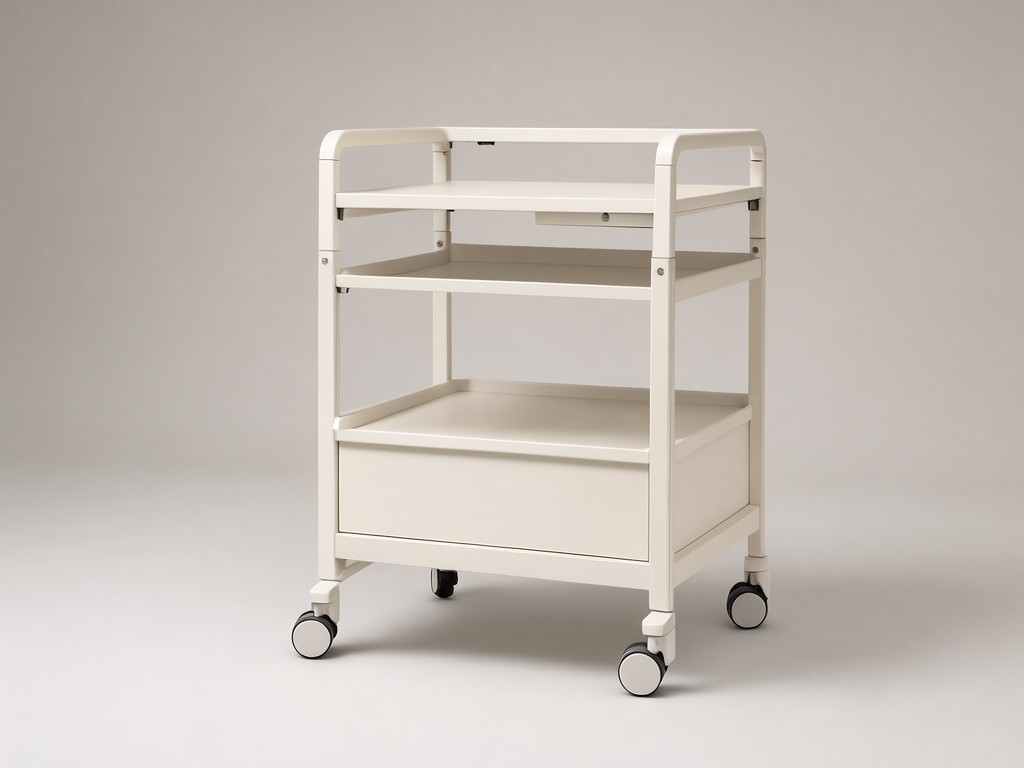
Config B — Acute / ICU
- Top: 12 mm compact phenolic, integrated edge
- Column: 38 mm OD × 2.0 mm wall, epoxy powder coat
- Casters: 75 mm twin TPR, central lock
- Gas spring: 180 N, 250 mm stroke
- Storage: shelf + vanity drawer, soft-close
- Shipped weight: 14.9 kg
- FOB unit cost (500+): $68
The $26 delta buys 40 % less column deflection, central locking, and a top that survives bleach wipe-downs without edge swell. Most distributors stock Config A; Config B runs as a 15-day lead-time make-to-order unless blanket PO covers 200+ units.
Customisation Options and Their Limits
Logo silk-screen on the column: single colour, 120 × 40 mm max, adds $0.35/unit at 500 MOQ. Two-colour requires a second screen and 48 h cure between passes — lead time extends to 25 days. Custom RAL powder coat: minimum 300 kg powder batch (≈ 1,200 frames), 10-day line changeover, +$1.80/unit. Buyers requesting non-standard heights (e.g., 750-1,100 mm instead of 780-1,130 mm) trigger a gas spring re-valve; minimum 200 units to amortise the spring tooling.
The limiting factor is rarely the headline specification. It is the tolerance stack: column straightness, insert depth, caster stem concentricity. A 0.3 mm shift in any one dimension is invisible on the drawing; combined, they produce a table that rocks on level flooring. We hold first-article inspection to ±0.5 mm overall height at mid-stroke — tighter than the IEC 60601-2-52 reference — because that is the threshold where nurse feedback turns into formal complaints.
Requirements by Buyer Segment
Hospital procurement officers demand IEC 60601-1 creepage distances on any powered variant (not in current scope) and full material declaration for REACH SVHC screening. They require batch traceability to the coil heat number and gas spring lot code — our traveller sheet captures both.
Distributors serving nursing homes prioritise Config A with knock-down packaging: column ships separate, top and base nested. This cuts container volume 22 % but adds 3 minutes assembly time per unit. They also request spare caster kits (4 pcs) packed one per 25 units — zero cost adder if forecast at PO.
Private-label brands need artwork approval on the silk-screen and carton print before first article. We provide a 300 dpi PDF proof; revision cycles beyond two incur a $75 plate fee. Carton drop test per ISTA 1A is standard; buyers specifying ISTA 3A add $0.45/unit for corner posts and double-wall board.
Setup, Use and Replacement Parts
Assembly: unpack base, insert column into receiver, tighten M10 caster stems to 18 Nm, mount top via eight M6 × 16 mm socket caps (4 Nm). No tools beyond 5 mm and 8 mm hex keys. Height adjustment lever operates at 15 N pull force; lubricate pivot annually with PTFE spray.
Replacement parts stocked: gas spring (120 N / 180 N), caster set (4 pcs), column assembly (Config A / B), top panel (HPL / phenolic). Lead time 5 days ex-works. Gas spring replacement requires two people — column weight 6.2 kg (Config A) or 7.5 kg (Config B). Do not attempt single-person swap; the spring extends uncontrollably if the column is not supported.
Durability Guide — Expected Service Life by Component
| Component | Cycles / Hours | Failure Indicator |
|---|---|---|
| Gas spring | 50,000 full strokes | Force drop > 10 %; slow return |
| Caster bearings | 200 km travel | Rumble > 45 dB; flat spot visible |
| HPL edge band | 3 years / 1,500 wipe cycles | Chip > 3 mm; glue line visible |
| Phenolic top | 10 years / 5,000 wipe cycles | Surface haze; core exposure |
| Column welds | Life of frame | Crack at keyway; bow > 1 mm/m |
Ready to Review Artwork and Lock Specifications?
Send your logo files, RAL code, and target MOQ. We return a marked-up spec sheet, first-article photos, and a revised lead-time calendar within 48 hours.
Start the qualification pack