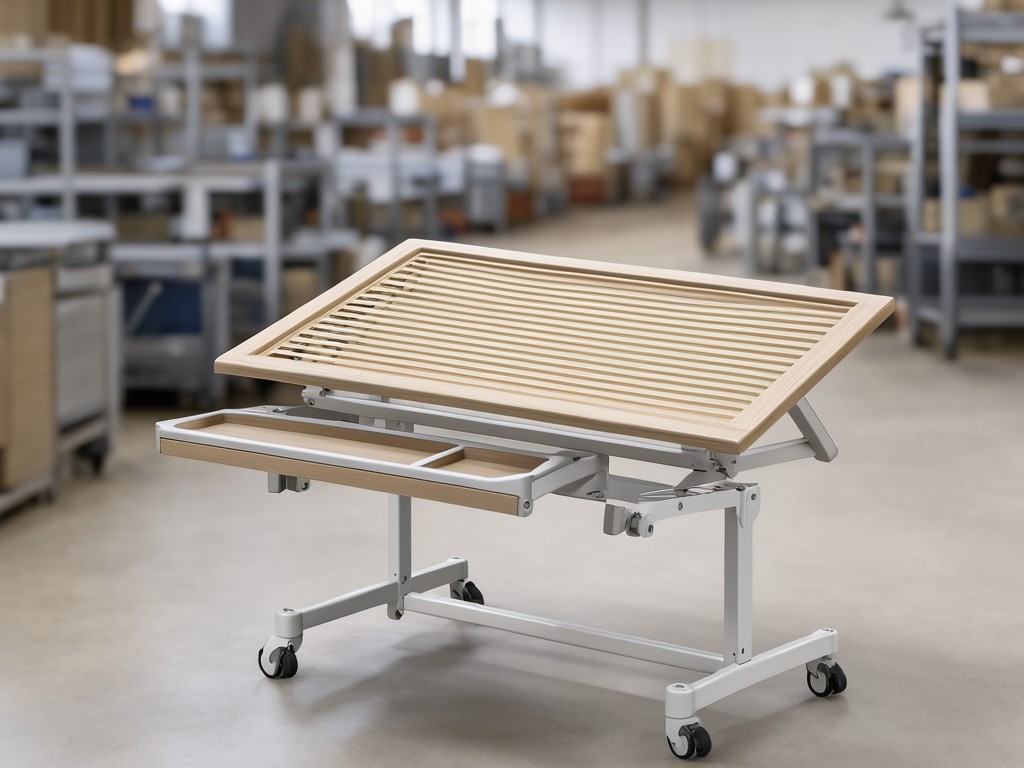
The daily trade-off is tilt friction versus adjustment speed. A low-friction tilt linkage lets care staff change tabletop angle with one hand, but it drifts under repeated use unless the gear teeth are specified at a minimum module. Choose the locked-gear variant when beds are repositioned daily; specify the friction-only version only for low-turnover rooms where adjustment happens once per stay.
Specifying factory direct adjustable overbed bedside table with tilt facility supplier for Wholesale and OEM Orders
Construction Method and Its Effect on Consistency
Deflection under load governs whether an overbed table holds its position through a shift or sags by the third month. Buyers reporting repeat returns usually point to two failure modes: the tilt mechanism slipping under a tray, and the height-lock plunger creeping when a patient leans on the tabletop edge. Both trace back to thin-wall square tube mitred at the corners without a continuous weld bead, then finished with a coat that chips at the first impact.
The frame is built from 20 mm × 20 mm × 1.2 mm cold-rolled steel tube, fillet-welded before a two-stage epoxy powder coat. Tabletops use 15 mm particleboard with a melamine laminate face and a 2 mm PVC edge band. The tilt facility runs on a six-tooth steel gear with a spring-loaded plunger, while height adjustment uses a two-stage telescopic column locked by a cam lever.
Changing the tube wall from 1.2 mm to 1.5 mm adds roughly 1.1 kg per frame and cuts mid-span deflection at a 15 kg edge load from about 3.5 mm to under 1.2 mm. That mass difference shows up in freight cost and in how easily a single caregiver moves the unit, so the specification should match the ward's actual loading rather than defaulting to the heaviest option.
Measured Performance in Real Use
The interface between parts determines where the first failure appears. Caster stems pull out of the base plate when the swivel head is loaded off-centre, tilt gears strip when the plunger does not fully engage, and laminate delaminates at the front edge where trays slide on and off. These are tolerance stack-ups that survive a sample run but show up in batch two or three.
| Attribute | Standard Build | Reinforced Build | Service Limit |
|---|---|---|---|
| Tilt cycle life (angle changes) | 5,000 cycles | 15,000 cycles | No slippage beyond 2° drift |
| Height-lock retention under 20 kg | 8 mm creep over 1,000 cycles | 2 mm creep over 1,000 cycles | < 3 mm total |
| Tabletop edge load at 400 mm overhang | 12 kg before visible sag | 20 kg before visible sag | Deflection < 2 mm |
| Caster load per unit | 35 kg | 50 kg | No swivel bind after 10 km roll test |
| Powder-coat adhesion (cross-hatch) | Class 3 | Class 1 | No flaking after 100 impact cycles |
Customisation Options and Their Limits
Consistency depends on holding the same tube gauge and weld sequence across every batch. OEM buyers can specify height range, tilt angle limits, tabletop laminate colour, caster type, and frame finish without changing the core tooling, but each variation adds a verification step to incoming inspection and first-article approval.
Height is normally adjustable from 720 mm to 1,120 mm in 25 mm increments. Tilt runs from 0° to 35° in 5° steps. Extending either range beyond those figures requires a longer lead screw or a deeper gear housing, which pushes the minimum order quantity upward and lengthens the sample approval cycle. Branding is limited to a silkscreen logo on the side panel; embossing or custom mouldings require new tooling.
| Option | Standard Range | Extended Range | MOQ Impact |
|---|---|---|---|
| Height adjustment | 720–1,120 mm | 650–1,200 mm | +200 units |
| Tilt angle | 0–35° | 0–50° | +300 units |
| Tabletop width | 700 mm | 800 mm | New die, +500 units |
| Frame finish | Epoxy powder coat, white or grey | Custom RAL | +1,000 units |
Working as a Production Partner, Not a Catalogue Supplier
Repeat orders fail when the factory treats each run as a fresh quote instead of a controlled batch. The bill of materials is locked at sample approval, and tube gauge, weld current, and powder-coat batch number are recorded for every production order. Pre-shipment samples are held for 90 days so a warranty claim can be traced to a specific run.
Export packaging uses five-layer corrugate with corner guards and stretch wrap to prevent finish abrasion during consolidated loads. Lead times run 30 to 45 days after deposit, depending on whether the frame finish is a stock colour or a custom RAL. Warranty covers structural weld failure and tilt mechanism replacement for 12 months from delivery, excluding caster wear and laminate surface scratches.
Questions Buyers Ask Before Ordering
- Can the tilt gear be retrofitted to an existing frame? Yes, provided the column spacing matches the current mounting holes; otherwise the base plate must be replaced.
- What is the lead time for a custom RAL frame? Add two weeks to the standard 30-day window for powder-coat line changeover.
- Is batch traceability included? Each unit carries a date-coded sticker linking it to weld and coating records.
- What packaging is used for LCL shipments? Double-wall cartons with internal foam edge protectors and palletisation on request.
Ready to review the specification for your next repeat order?