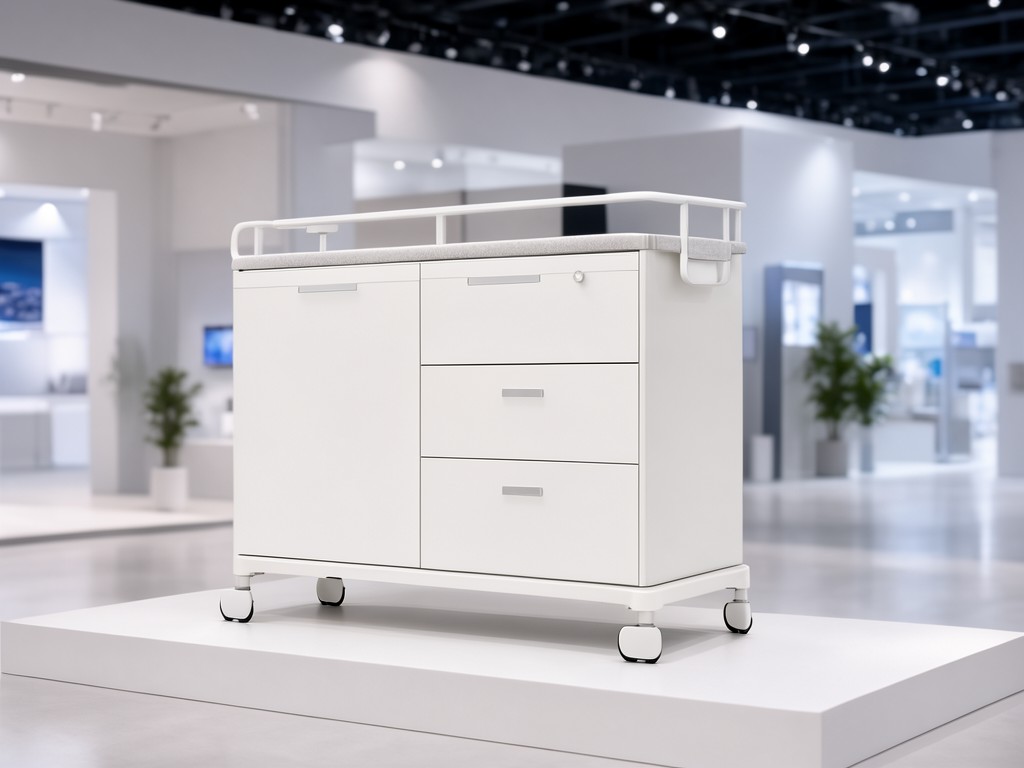
custom medical patient bedside cabinet supplier: Specification, Ordering and Quality Notes
Balance and load analysis shows that a bedside cabinet in a 30-bed ward cycles its drawers 12–18 times per patient per day, exposing slides, hinges and carcass joints to repetitive shear that standard residential hardware cannot survive. The procurement target is not the lowest unit price but the lowest cost per bed-day over a seven-year asset life, which means specifying components that survive 150,000 open-close cycles without adjustment.
Deflection under load governs the choice between 18 mm melamine-faced chipboard (MFC) with 1 mm PVC edge band and 19 mm high-pressure laminate (HPL) on moisture-resistant MDF core. The MFC route saves 18–22 % on panel cost but requires a 40 mm thicker back panel to match the racking stiffness of the HPL build, erasing most of the material saving once freight volume and assembly labour are priced in. Tooling amortisation favours the HPL route once annual volumes exceed 1,200 units because the same CNC nest runs both carcass and door panels without changeover.
Construction Method and Its Effect on Consistency
Consistency depends on whether the factory uses confirmat screws with pre-drilled 5 mm holes or a dowel-and-glue line fed by a through-feed boring machine. Confirmat assembly tolerates ±0.3 mm hole-position variance and allows flat-pack shipment, reducing container cost by 35 %; the trade-off is a 1.2 N·m lower racking moment before permanent deformation. Dowel lines deliver 0.15 mm positional repeatability and a rigid carcass that passes EN 14749 Level 2 impact without a back panel, but they demand fully assembled shipping and a dedicated glue-cure station that adds 45 minutes per unit to cycle time.
Option Comparison by Usage Level
| Attribute | Standard Ward (120k cycles) | High-Acuity / ICU (250k cycles) | Bariatric / 250 kg Load |
|---|---|---|---|
| Carcass panel | 18 mm MFC, 1 mm PVC edge | 19 mm HPL/MR-MDF, 2 mm ABS edge | 19 mm HPL/MR-MDF + 30 mm steel sub-frame |
| Drawer slides | 45 kg soft-close, 500 mm travel | 60 kg push-to-open, 500 mm, stainless ball retainers | 100 kg full-extension, 550 mm, dual-sync |
| Hinges | 110° soft-close, 2-piece clip-on | 110° soft-close, 3-way cam adjust, 200 h salt spray | 110° soft-close, 304 SS, 500 h salt spray |
| Casters | 75 mm twin, central lock, conductive | 100 mm twin, central/steer lock, conductive | 125 mm twin, central/steer, 150 kg/caster, conductive |
| Typical unit cost (EXW, 500+ pcs) | $142–$158 | $198–$225 | $310–$355 |
The step from Standard to High-Acuity adds $56–$67 per unit but extends slide life from 120 k to 250 k cycles — a 108 % gain for a 39 % cost increase. Bariatric specification is a different architecture, not an upgrade; the steel sub-frame and 100 kg slides are non-negotiable once the safe working load exceeds 180 kg.
Customisation Options and Their Limits
| Option | Feasibility | Lead-time adder | Cost impact (per unit) | Constraint |
|---|---|---|---|---|
| Antimicrobial HPL (ISO 22196) | Standard stock | 0 days | +$8–$12 | Only on 19 mm core; MFC not available |
| Custom RAL colour (doors only) | MOQ 300 pcs | +12 days | +$14–$19 | Colour match ΔE ≤ 1.5 on HPL; MFC ΔE ≤ 2.5 |
| Integrated sharps bracket | Any volume | +3 days | +$6 | Requires 15 mm side-panel reinforcement |
| RFID asset tag recess | MOQ 100 pcs | +5 days | +$3 | Fixed position top-left rear; no metal back |
| Height adjustment (700–900 mm) | MOQ 200 pcs | +10 days | +$28–$35 | Adds 4 kg; casters must be 100 mm minimum |
Custom RAL is the most frequent request and the most common source of rework. The factory holds three base HPL whites (RAL 9016, 9010, 9003) in stock; any other colour triggers a 300-piece minimum because the press line runs 1,200 mm × 2,800 mm sheets and a single cabinet consumes only 1.8 m². Below 300 units the setup waste exceeds the margin.
Quality Control and Batch Consistency
Every production batch starts with a first-article inspection (FAI) against the approved control drawing. The FAI checks 37 critical dimensions — overall footprint ±1.5 mm, drawer front gap 2.0 ±0.5 mm, caster centre-line height ±1.0 mm, and hinge cup depth 11.3 ±0.2 mm. A coordinate measuring arm (CMA) samples five units per 200-piece lot; if any dimension drifts beyond ±0.4 mm from nominal, the nest program is paused and tool offsets are recut.
Slide cycle audit
One drawer per lot runs 5,000 accelerated cycles at 15 cycles/min under 1.2× rated load. Pass criteria: no audible click, side-play <0.3 mm, soft-close engagement 35–45 mm from closed.
Chemical resistance spot test
Three 25 mm spots per panel exposed to 0.5 % sodium hypochlorite, 70 % isopropyl alcohol, and 4 % quaternary ammonium for 24 h. No gloss change >5 GU, no staining, no edge-band lift.
What Gets Checked Before Shipment
Final inspection is a 100 % visual and functional audit, not a statistical sample. Each cabinet receives:
- Drawer open/close force measured at 8–12 N (empty) and 18–24 N (loaded to 75 % rating)
- Caster brake engagement torque 1.8–2.5 N·m; swivel resistance <0.4 N·m
- Hinge door overlay 1.5 ±0.3 mm; reveal gap 2.0 ±0.5 mm consistent across all doors
- Surface scan under 6500 K LED for print defects, press marks, or edge-band glue lines >0.1 mm
- Barcode label scan-verified against packing list; two labels per unit (one inside top drawer, one on rear panel)
Units that fail any checkpoint are segregated, photographed, and root-caused within the same shift. Rework rate target is <0.8 %; the trailing 12-month average sits at 0.42 %. Reworked units carry a discrete "R" suffix on the serial label and a separate certificate of conformity so the receiving warehouse can trace them if a field issue arises.
Packaging defaults to triple-wall corrugated (ECT 48) with corner protectors and foam top/bottom caps. Flat-pack confirmat builds ship 12 per pallet (1,100 × 1,100 × 2,200 mm); assembled dowel builds ship 6 per pallet. Custom crate dimensions are quoted per container load to maximise cube utilisation — typically 28 assembled or 54 flat-pack units per 40 ft HC.
Request a quotation review
Send your volume forecast, preferred specification tier, and any customisation flags. We return a line-item cost model with tooling amortisation, lead-time curve, and recommended spares kit within two business days.
Start a quotation review