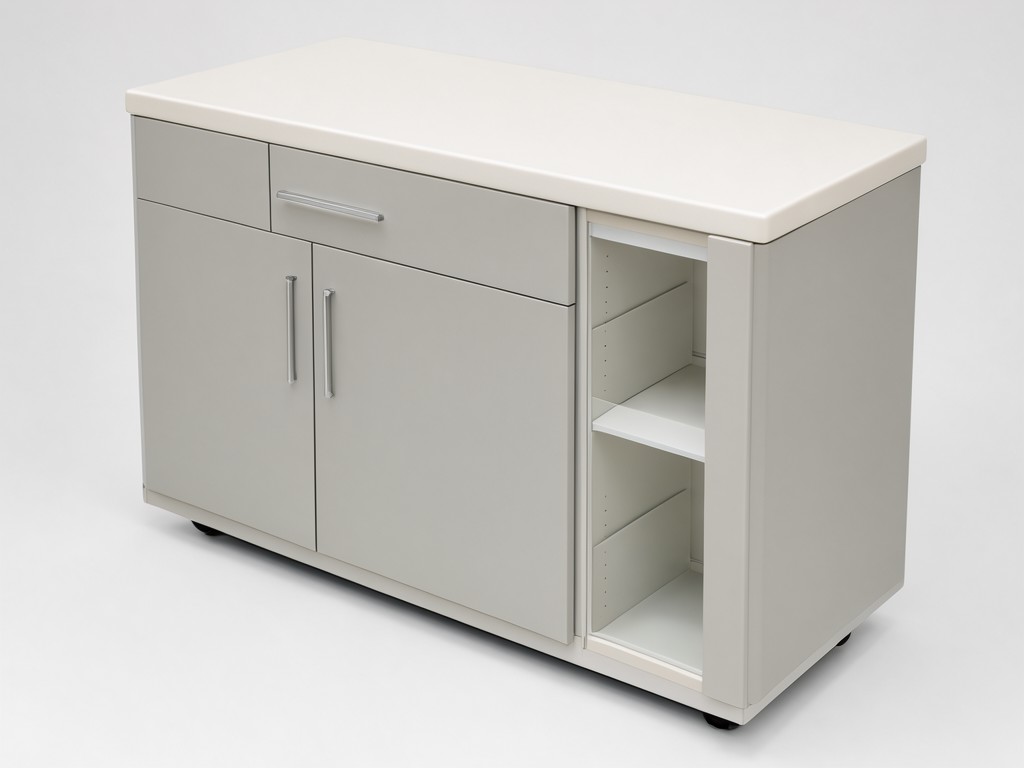
Specifying Custom hospital bedside medicine cabinet manufacturer for Wholesale and OEM Orders
Before comparing quotations, the buyer must lock down the load rating, hinge cycle count, and surface‑cleanability spec that the ward will actually see.
Unit price and service life diverge when the same nominal gauge is sourced from different coil batches; a 0.8 mm cold‑rolled steel panel with a 120 µm epoxy‑powder coat will survive 10 000 hinge cycles, while a 0.7 mm panel with a 80 µm coat typically fails at 6 000 cycles under the same cleaning regime. The difference shows up in warranty claims and reorder frequency, not in the catalogue line item.
What Actually Determines Performance
The cabinet’s daily exposure to disinfectants, impact from equipment carts, and repeated door opening drives three measurable limits: corrosion resistance (salt‑spray hours), hinge fatigue (cycle count), and surface hardness (pencil hardness).
Specification rule: require a minimum 500 h neutral salt‑spray rating on all exposed steel, a hinge rated for ≥15 000 cycles at 90° opening, and a powder‑coat hardness of ≥2H. Anything below these thresholds will generate premature touch‑up cycles in a high‑turnover ward.
When the spec sheet meets those three numbers, the remaining variables — interior shelf adjustability, lock type, and label‑holder placement — become cost levers rather than performance risks.
Working as a Production Partner, Not a Catalogue Supplier
Cold‑rolled steel (0.8 mm)
Heavier, gives a solid feel that staff associate with durability.
Powder‑coat thickness can be built to 150 µm for extended salt‑spray life.
Higher freight weight; pallet count rises 12 % versus aluminum.
Aluminum alloy (1.0 mm)
Lighter, reduces handling injury risk during installation.
Anodized finish offers 300 h salt‑spray; may need clear‑coat for harsh disinfectants.
Lower per‑unit shipping cost, but tooling for extruded profiles adds upfront expense.
Volume Planning and Lead Time
| Annual Volume | Typical Lead Time (weeks) | Tooling Amortization | Recommended Buffer Stock |
|---|---|---|---|
| Low (<500 units) | 6‑8 | Full tooling cost absorbed in first order | 10 % of annual volume |
| Medium (500‑2000 units) | 5‑6 | Tooling split over 2‑3 releases | 8 % of annual volume |
| High (>2000 units) | 4‑5 | Tooling amortized across full run | 5 % of annual volume |
Packing, Marking and Freight Configuration
Cabinets ship either flat‑packed on 1200 × 800 mm Euro pallets or pre‑assembled in custom crates; the choice hinges on the receiving dock’s forklift capacity and the hospital’s installation window.
Each unit receives a laser‑etched serial tag on the interior frame, a barcode label on the exterior carton matching the purchase order, and a moisture‑indicator strip inside the wrapper; this satisfies traceability without adding a separate documentation packet.
Freight class 150 applies to the assembled crate configuration, while flat‑pack drops to class 100, shaving 18 % off the line‑haul cost for full‑container loads.
Ordering, Tooling and Lead-Time Questions
What drawing approvals are required before tooling?
A fully dimensioned 2‑D drawing with tolerance blocks, a material call‑out, and a surface‑finish spec must be signed off by both the buyer’s quality engineer and our process engineer; any change after sign‑off triggers a new tooling quote.
How does sample approval affect lead time?
First‑article inspection adds 7‑10 days; if the sample passes dimensional, hinge‑cycle, and salt‑spray checks, production releases on the original schedule. A failure resets the clock to the next available press slot.
What is the minimum order quantity for a new colour?
Powder‑coat change‑over requires a 200‑unit batch to keep the line efficient; smaller runs are possible but incur a $1,200 colour‑setup surcharge.
Can the cabinet be shipped with pre‑installed lock hardware?
Yes, provided the lock model is specified at the drawing stage; we stock the two most common cam‑lock families and can integrate others with a 3‑week lead‑time for the lock sub‑assembly.
Ready to lock in tooling and confirm the spec? Start a tooling review and we’ll return a detailed DFM package within 48 hours.