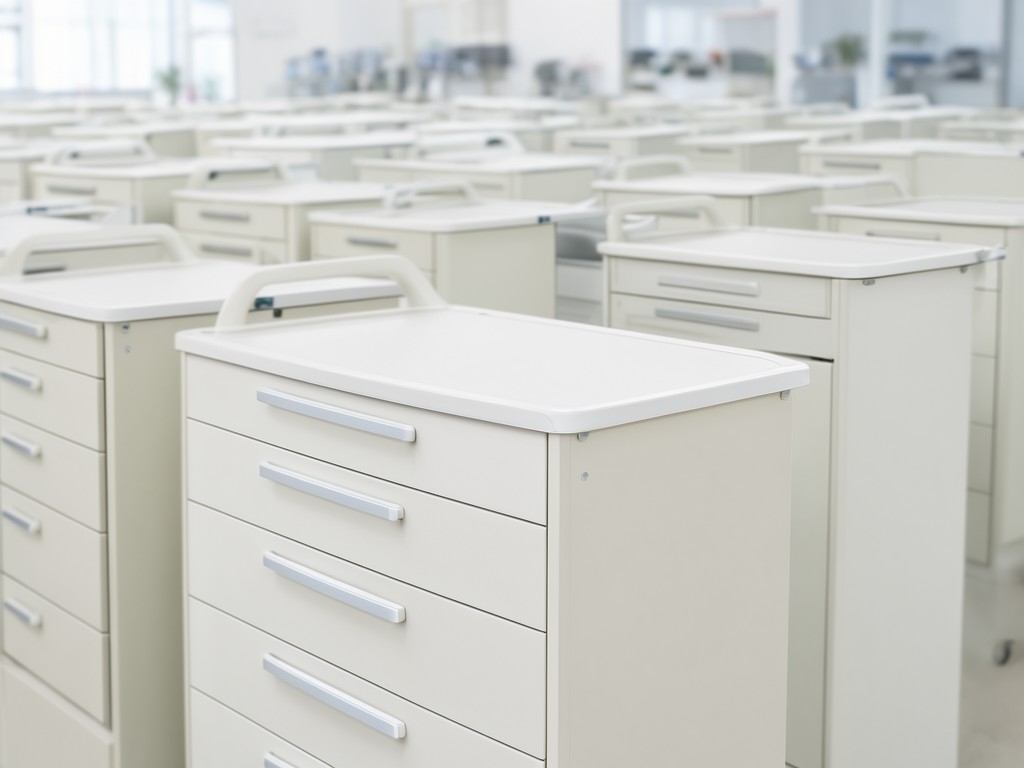
Custom hospital bedside cabinet with drawers Manufacturer: What Buyers Should Check Before Ordering
Selection trade-off: thermofoil-wrapped MDF cores resist common quaternary disinfectants but show edge delamination after 18-24 months in high-turnover wards; HPL-faced plywood cores cost 22-30% more but survive 5+ years of bleach-based protocols. Choose based on your facility's cleaning SOP, not catalogue price.
What This Product Is and Where It Fits
Deflection under load governs every dimension decision. A bedside cabinet in an ICU sees 12-15 kg static load from monitors and pumps, plus dynamic impact when staff lean on the top surface during emergencies. The cabinet must not deflect more than 3 mm across a 500 mm span under 25 kg, or drawer alignment shifts and soft-close mechanisms bind.
These units sit in three distinct environments: acute care (bleach wipes 6-8 times daily), long-term care (quaternary ammonium 3-4 times daily), and behavioural health (impact resistance outweighs chemical resistance). Each environment demands a different core material, edge treatment, and hardware grade. A single SKU cannot serve all three without premature failure.
Buying Mistakes That Lead to Returns
Balance and load analysis shows the most expensive error is specifying residential-grade drawer slides (35 kg dynamic rating) for clinical loads that regularly hit 45-50 kg when fully stocked with supplies. Slides fail at the rear mount first, causing drawer racking that jams adjacent drawers. The fix — 50 kg undermount slides with full-extension travel — adds $18-22 per unit but eliminates the top warranty claim.
Second mistake: ordering 18 mm MDF cores with 0.4 mm PVC edge banding for facilities using sodium hypochlorite 1:10 solutions. The banding lifts at the top front edge within 14 months, exposing the core to moisture wicking. Specify 1 mm ABS laser-edged or post-formed HPL edges, or move to 18 mm birch plywood with phenolic backer.
Third: ignoring caster specification. Twin-wheel 75 mm polyurethane casters with precision bearings and thread guards are standard, but behavioural health units require tamper-proof axle bolts and 100 mm single-wheel conductive casters to prevent static discharge near oxygen outlets. Mixing caster types across a single PO creates maintenance chaos.
Segment-Specific Requirements
Acute care cabinets need seamless top surfaces — integral solid surface or coved HPL with zero joints — because fluid ingress at seams triggers infection control citations. Drawer interiors require removable polymer liners (not felt) that withstand autoclave cycles at 121°C. Locking: electronic RFID compatible with hospital badge systems, not mechanical cam locks.
Long-term care prioritises cost-per-year. Thermofoil on 18 mm furniture-grade MDF with 1 mm ABS edges delivers 4-5 year service life at 60% of HPL plywood cost. Three-drawer configuration (one shallow, two deep) matches linen and supply par levels. Casters: two locking, two swivel, all 75 mm.
Behavioural health demands ligature-resistant design: recessed pulls, concealed hinges with 110° opening limit, no protruding edges. Single drawer on full-extension 50 kg slides, no casters (unit bolted to floor). Core: 18 mm fire-rated MDF with 0.8 mm HPL faces and 3 mm PVC edges radius 3 mm minimum. Weight: 42-48 kg to resist tipping.
Working as a Production Partner, Not a Catalogue Supplier
Consistency depends on controlling three variables that catalogues never disclose: adhesive open time on edge banding (affects delamination resistance), slide mounting jig tolerance (affects drawer gap uniformity), and top-surface flatness after lamination (affects monitor stability). We run first-article inspection on all three before releasing a production lot.
Customisation that adds lead time but not cost: cutouts for medical gas rails, grommet patterns for cable management, badge-reader prep in drawer faces. Customisation that adds both: non-standard depths (anything beyond 450-500 mm requires slide re-spec), integrated sharps container holders, antimicrobial powder-coat on steel subframes. We quote these as line items so your capital budget stays transparent.
Private-label programmes: we apply your logo via laser etch on HPL or screen print on thermofoil during the finishing pass — no secondary operation, no added lead time. Minimum 50 units per SKU for custom branding; 20 units for standard catalogue colours (White, Folkstone Grey, Nevada).
How Consistency Is Held Across Batches
| Parameter | Acute Care Spec | Long-Term Care Spec | Behavioural Health Spec |
|---|---|---|---|
| Core Material | 18 mm Birch Plywood, Phenolic Backer | 18 mm Furniture MDF, E1 Formaldehyde | 18 mm FR-MDF, Class A Rating |
| Face Material | 0.8 mm HPL, Antimicrobial Additive | 0.4 mm Thermofoil, PVC-Free | 0.8 mm HPL, Fire-Rated |
| Edge Treatment | Post-Formed HPL, 3 mm Radius | 1 mm ABS Laser Edge | 3 mm PVC, 3 mm Radius, Tamper-Proof |
| Drawer Slides | 50 kg Undermount, Soft-Close, Full Ext. | 40 kg Undermount, Soft-Close, Full Ext. | 50 kg Undermount, Soft-Close, Ligature-Resistant Pull |
| Casters | 75 mm PU, Precision Bearing, Conductive | 75 mm PU, Thread Guards, 2 Lock / 2 Swivel | None — Floor Bolted |
| Top Surface | Integral Solid Surface, Coved Edges | HPL with 3 mm PVC Edge | HPL, 3 mm PVC Edge, 3 mm Radius |
Every batch ships with a material lot traceability sheet linking core panel lot, laminate roll, edge band roll, adhesive lot, and slide lot to the PO. If a field issue arises, we isolate the variable in 48 hours.
Inspection Items and Test Methods
Incoming material checks: core panel thickness ±0.2 mm, moisture content 6-8%, formaldehyde emission per CARB Phase 2 (verified by supplier COA, not retested in-house). Laminate peel strength minimum 1.8 N/mm per ASTM D1037 method — we run 5 samples per laminate roll on receipt.
In-process: edge band adhesion pull test (10 N/mm minimum) every 50 panels; drawer slide mounting hole pattern check via go/no-go gauge every 20 units; top surface flatness measured with 1 m straightedge and feeler gauge, maximum gap 1.5 mm.
Finished unit validation (AQL 1.5, Level II): static load test — 25 kg centred on top for 24 hours, measure residual deflection; cycle test — 50,000 open/close cycles on one drawer per unit, check for slide play >0.5 mm; chemical resistance — 24-hour exposure to 1:10 bleach, 70% isopropyl, quaternary ammonium at 400 ppm, evaluate for discolouration, blistering, edge lift; impact test — 500 g steel ball dropped from 1 m on top surface and drawer faces, no fracture or delamination.
Packaging validation: ISTA 3A simulated transit on first pallet of each production run. Corner drop, vibration, compression. Units must arrive with zero cosmetic damage and functional drawers.
Questions Buyers Ask Before Ordering
What is the realistic lead time for a first custom run?
6-8 weeks from approved shop drawings for standard materials (HPL, thermofoil, standard slides). Add 2 weeks for non-stock laminate colours, 3 weeks for solid surface tops, 4 weeks for electronic lock integration. We hold safety stock of birch plywood and FR-MDF cores to compress the front end.
Can you match an existing cabinet footprint exactly?
Yes. Send us the competitor unit or detailed drawings with all critical dimensions: overall W×D×H, drawer clear opening, caster mounting pattern, top surface cutout locations. We reverse-engineer the spec sheet and quote the delta. Typical tolerance match: ±1.5 mm on overall, ±1 mm on drawer alignment.
How do you handle warranty claims on chemical damage?
Warranty covers delamination, discolouration, or surface degradation from EPA-registered healthcare disinfectants used per label instructions. Excludes damage from undiluted concentrates, abrasive pads, or solvents not on the approved cleaning list. Claims require photos, cleaning log excerpt, and the affected unit returned freight-prepaid for root cause. Replacement ships within 10 business days of determination.
What is the minimum order for a custom configuration?
25 units for dimensional changes only. 50 units for new material combinations (e.g., HPL face on MDF core instead of plywood). 100 units for tooling-intensive changes (custom extruded edges, moulded solid surface tops). We quote tooling amortisation separately so you see the per-unit impact at any volume.
How are units packaged for container loading?
Each cabinet: corner protectors (EPS, 50 mm), full-wrap 0.15 mm PE film, double-wall corrugated sleeve (ECT 48), banded to pallet. Pallet pattern: 6 units per layer × 3 layers = 18 per pallet for standard 480×500 mm footprint. 40-ft HC fits 20 pallets (360 units) with 150 mm headroom. Custom dims may reduce pallet count — we provide a loading diagram with every quote.
Size and Weight Reference
| Configuration | Overall W×D×H (mm) | Drawer Clear Opening W×D×H (mm) | Weight (kg) | Static Load Rating (kg) |
|---|---|---|---|---|
| 3-Drawer Standard | 480×500×810 | 410×420×150 (×3) | 38-42 | 75 |
| 1-Drawer + Door | 480×500×810 | 410×420×150 / 410×420×520 | 34-38 | 75 |
| 4-Drawer Narrow | 400×500×900 | 330×420×150 (×4) | 36-40 | 60 |
| Behavioural Health | 480×500×810 | 410×420×200 (×1) | 42-48 | 100 |
| Acute Care + Solid Surface | 480×500×810 | 410×420×150 (×3) | 45-50 | 75 |
Weights vary ±2 kg based on core material and hardware selection. Static load rating applies to top surface only; drawer bottoms rated at 25 kg uniformly distributed.
Request a Pre-Production Sample
We build one unit to your exact spec — materials, dimensions, hardware, branding — and ship it for your clinical evaluation before the production run commits. Sample cost credited against the PO at 50+ units.
Start a sample request