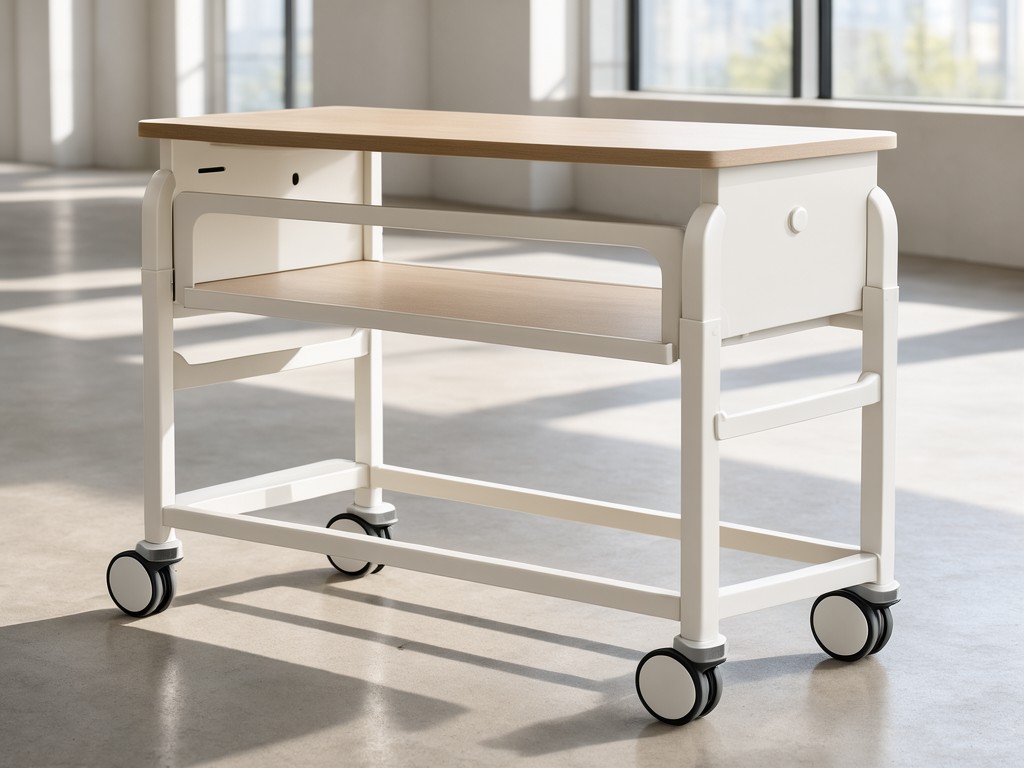
china medical adjustable overbed bedside table with wheels Company - Bulk Supply and Specification Guide
Where Cheaper Alternatives Fall Short
During a private-label launch with a fixed ship date the buyer discovered that tables sourced from low‑cost vendors arrived with misaligned height‑adjustment rails, causing the tabletop to drift 12 mm within the first week of ward use.
The most common failure modes reported by distributors are: wheel‑lock mechanism fatigue after 2 000 cycles, powder‑coat chipping at the edge of the steel frame, and tabletop warping when exposed to routine cleaning agents.
- Wheel‑lock springs lose preload, leading to unintended mobility.
- Adjustment gear teeth strip under repeated 30 kg loads.
- Surface coating fails salt‑spray test after 48 h, indicating poor corrosion resistance.
How It Is Built and What That Changes
Manufacturing note: The frame uses 1.2 mm cold‑rolled steel tube, laser‑cut and robotically welded, then powder‑coated at 180 °C for 20 min. This yields a coating thickness of 70‑90 µm and a salt‑spray rating of 200 h.
The height‑adjustment column incorporates a hardened‑steel rack‑and‑pinion with a 0.05 mm positional tolerance, eliminating drift.
The tabletop is a 18 mm high‑pressure laminate (HPL) bonded to a 12 mm particle‑core, pressed at 1.2 MPa. Edge banding is 2 mm PVC with a 0.3 mm radius, reducing chipping during cart impact.
Casters are 75 mm twin‑wheel polypropylene with a sealed ball bearing and a foot‑operated brake rated for 5 000 lock cycles.
Segment-Specific Requirements
| Parameter | Standard Carton | Palletised Load |
|---|---|---|
| Units per carton | 1 | 4 |
| Carton dimensions (L×W×H, mm) | 950 × 560 × 120 | 1150 × 1150 × 1150 |
| Gross weight per carton (kg) | 18.5 | 78 |
| Pallet configuration | — | 4 cartons per Euro‑pallet, stretch‑wrapped |
Hospital procurement teams typically require the single‑unit carton for sterile‑room delivery, while distributors serving nursing‑home chains prefer the palletised pack to minimise handling steps.
OEM and ODM Programme Structure
OEM – Brand‑label
Buyer supplies logo artwork (vector, 300 dpi) and colour spec (Pantone). Factory applies silk‑screen on tabletop edge and laser‑etches the frame.
MOQ 200 units; lead‑time 35 days from artwork approval.
ODM – Custom geometry
Buyer defines tabletop size (800‑1000 mm), height range (750‑950 mm), and caster type. Engineering validates load‑test at 40 kg static, 20 kg dynamic.
MOQ 500 units; lead‑time 55 days including prototype sign‑off.
Both programmes include a pre‑production sample (PPS) that undergoes dimensional inspection (±1 mm), coating adhesion cross‑cut test, and caster brake torque verification before mass run.
Stock Availability and Reorder Planning
Standard stock
Core SKU (900 mm × 450 mm tabletop, 750‑950 mm height) held at 1 200 units in the Shenzhen warehouse.
Reorder point set at 300 units; replenishment batch 600 units, 14‑day production lead.
Seasonal buffer
Pre‑winter surge (Oct‑Dec) adds 400 units of the same SKU, shipped in two consolidated containers.
Buyers can lock allocation 30 days before ship‑window to avoid spot‑rate premiums.
On a club programme that reorders twice a season the planner aligns the second order with the buffer release, keeping inventory turnover above 6× per year.
Ready to define your specification and lock in pricing?
Discuss your project