Specifying wholesale patient electric hospital beds for home use Company for Wholesale and OEM Orders
Construction options diverge as soon as weight matters — the frame gauge, motor housing material, and deck construction all shift when a bed must support 250 kg static load while remaining light enough for two-person delivery through a standard 810 mm residential doorway. Buyers who specify only "heavy duty" without defining the load profile, articulation cycles per day, or floor clearance for patient lifts receive frames that either fail prematurely under bariatric use or cost 18-22% more than necessary because the factory defaulted to the highest gauge across every component.
Cost and durability pull in opposite directions once the actuator specification moves beyond the basic two-function (head/foot) configuration. A four-motor system with Trendelenburg and reverse Trendelenburg adds roughly 7 kg to the shipping weight and requires a control box rated for 8,000 N peak thrust — but omitting those functions saves only $12-15 per unit at volume while eliminating the bed from any post-acute or palliative care tender. The specification review must lock motor count, thrust rating, and duty cycle before tooling approval, not after the first container ships.
What This Product Is and Where It Fits
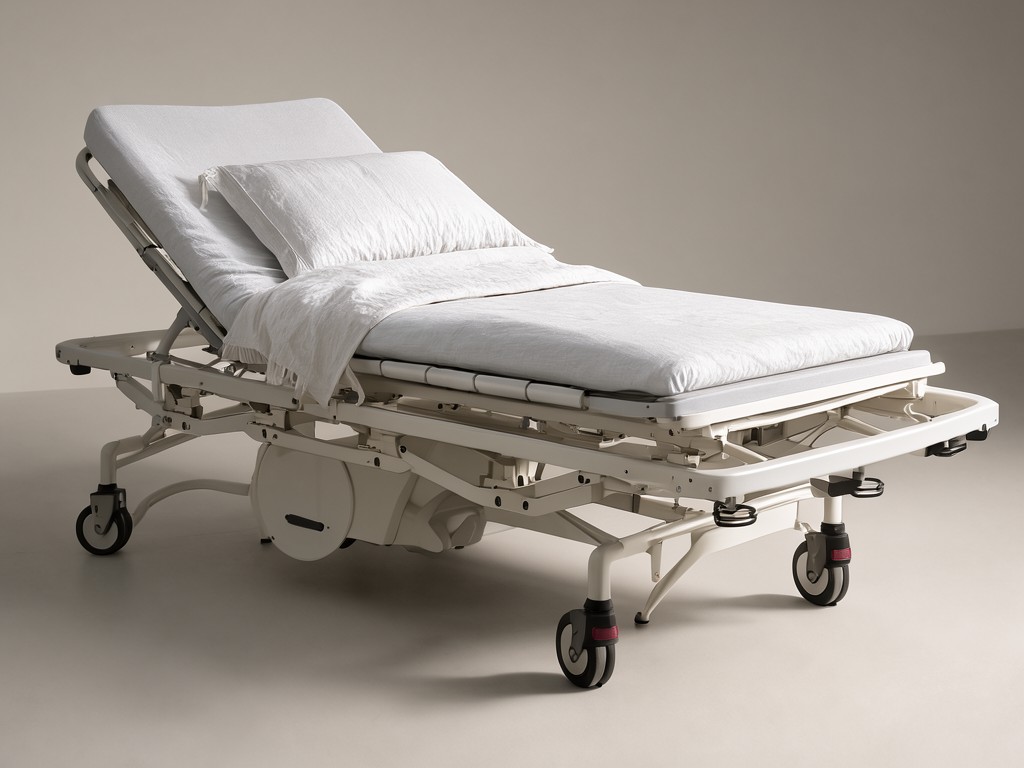
Electric hospital beds for home use occupy the narrow band between facility-grade ICU platforms and consumer adjustable bases. The defining criteria: tool-free assembly under 20 minutes, deck height range 350-750 mm to accommodate both patient transfers and caregiver ergonomics, and a total packaged weight under 110 kg for standard courier freight. These beds ship to medical equipment distributors, home healthcare agencies, and private-label brands serving the aging-in-place market — buyers who reorder in 20-50 unit batches and measure success by first-delivery damage rate and warranty claim frequency per 1,000 bed-months.
Construction Method and Its Effect on Consistency
| Component | Standard Grade | Reinforced Grade | Consistency Risk |
|---|---|---|---|
| Main frame tube | 50×25×1.6 mm rectangular, ERW | 50×30×2.0 mm rectangular, DOM | Wall thickness variance ±0.15 mm on ERW creates 12% deflection spread at center span |
| Deck construction | 12 slats, 60 mm spacing, steel wire | 16 slats, 45 mm spacing, rolled channel | Wire slats deform under concentrated knee-section load; channel holds flat to 180 kg/m² |
| Actuator mounting | Bolted bracket, 2× M8 per end | Welded clevis, 4× M10 per end | Bracket hole elongation after 3,000 cycles adds 3-5 mm play at head section |
| Caster specification | 100 mm twin, central brake | 125 mm twin, directional + central brake | 100 mm casters bind on carpet pile >12 mm; 125 mm rolls over 18 mm transitions |
The factory runs first-article inspection on every new frame jig: 100% dimensional check on the first five units, then statistical sampling at 10% thereafter. Weld penetration depth, bracket perpendicularity, and deck slat flatness are the three metrics that correlate with field failures. A 0.5 mm shift in the head-section pivot bore centerline — undetectable on the assembled bed — translates to 4 mm misalignment at the mattress retainer bar, which is the number one cause of side rail latch complaints.
Where This Product Beats Standard Alternatives
vs. Facility ICU Beds
- 35-40% lower landed cost per unit at 50-unit MOQ
- Ships flat-packed in two cartons vs. specialized freight
- No biomedical certification required for home deployment
- Standard 110V/220V control box — no dedicated circuit
vs. Consumer Adjustable Bases
- 250 kg safe working load vs. 150-180 kg typical
- Medical-grade actuators: 6,000 N vs. 3,500 N peak
- Side rails integrated to frame, not deck-mounted
- Battery backup standard — 8 cycles at full load
The trade-off is articulation range: home-use beds max at 70° head / 35° foot / 25° knee versus 90°/45°/30° on ICU platforms. For post-surgical recovery and chronic care, the reduced range rarely impacts clinical outcomes but cuts actuator stroke length by 40 mm, saving $8 per motor and reducing the folded package height by 65 mm — a direct freight density win.
How to Choose Before Requesting a Quote
| Decision Variable | Option A | Option B | Selection Rule |
|---|---|---|---|
| Patient weight band | ≤135 kg (standard) | 135-250 kg (bariatric) | Specify reinforced grade if >15% of target users exceed 135 kg |
| Articulation needs | 2-function (head/foot) | 4-function (+Trendelenburg) | 4-function mandatory for any palliative or respiratory care channel |
| Mattress interface | Standard 880×2000 mm | Extended 910×2100 mm | Extended only if mattress supplier confirms SKU availability in region |
| Control method | Hand pendant, coiled cord | Wireless pendant + under-bed panel | Wireless adds $9/unit; required for fall-risk patients who entangle cords |
Each variable above changes the BOM by $15-40 per unit. The quote request must include the target patient weight distribution, expected articulation cycles per day, and the mattress SKU the bed will pair with — because deck slat spacing and retainer bar height are tuned to the mattress thickness tolerance band. A 150 mm foam mattress on a deck spaced for 200 mm creates a 50 mm gap at the foot section; that gap is a pressure injury risk and a return trigger.
Buying Mistakes That Lead to Returns
The top three return drivers, in order: side rail latch failure (38%), actuator drift under load (29%), and caster binding on residential flooring (18%). Latch failure traces to a single root cause — the zinc-alloy latch housing creeps under repeated 45 N engagement force, widening the catch aperture by 0.3 mm per 1,000 cycles. The fix is a stainless steel insert ($1.20/unit) specified at drawing approval. Actuator drift occurs when the control box firmware does not compensate for backlash in the acme nut; the factory can flash corrected firmware only if the duty cycle profile (cycles/day, average load) was declared in the spec packet.
Caster binding is a specification omission, not a defect. Buyers who write "locking casters" without specifying wheel diameter, tread material, and brake type receive the factory default 100 mm TPU twin casters — which bind on high-pile carpet and leave tread marks on vinyl plank. The 125 mm polyurethane directional caster with central brake solves both issues at $3.80/unit premium. It must be called out in the BOM line item, not left to "equivalent" substitution.
Volume Planning and Lead Time
Standard lead time: 35 calendar days from frozen spec to FOB shipment for the first 100 units, then 21 days for repeat orders against open POs. The critical path is actuator procurement — the 6,000 N medical-grade linear actuators carry a 28-day factory lead time from the component supplier. Frame fabrication, powder coating, and assembly run in parallel at 12 days combined. Private-label artwork approval (control box overlay, frame decals, carton printing) adds 7 days if submitted with the initial PO; submitted after PO confirmation, it adds 14 days because the print plates must be remade.
Stock Availability and Reorder Planning
The factory maintains safety stock of 120 standard-configuration frames (2-function, 100 mm casters, hand pendant) in neutral gray powder coat. These ship in 5 business days against a blanket PO. Any configuration change — motor count, caster upgrade, voltage, color — moves the order to the made-to-order queue. Reorder cadence analysis from the last 18 months shows that distributors who place blanket POs with monthly call-offs of 15-25 units achieve 98.5% on-time delivery versus 82% for spot-order buyers. The difference is actuator allocation: blanket PO holders receive priority from the component supplier's safety stock.
Seasonal demand peaks in Q4 (holiday discharge surge) and Q1 (post-holiday admissions). Capacity for Q4 delivery must be reserved by August 15; Q1 by November 1. Late reservations are filled from the standard-configuration safety stock only — no custom configurations accepted after the cutoff.
Ordering, Tooling and Lead-Time Questions
What drawings or samples does the factory require before cutting steel?
A signed frame weld map (PDF, 1:10 scale), actuator mounting pattern with hole coordinates relative to the head-end datum, deck slat spacing drawing, and side rail latch engagement depth section. Physical samples are only required for custom powder coat colors — the factory matches to a provided RAL chip and sends a sprayed test coupon for approval before batch coating.
How are articulation cycle life and load rating verified?
First-article units undergo 10,000 continuous cycles at rated load (250 kg distributed) with position sensors logging actual vs. commanded angle. Pass criteria: <2° deviation at end positions, <5% speed drop, zero latch failures. The test report ships with the first container. Ongoing production samples pull one unit per 200 for 5,000-cycle spot check.
What is the minimum order for a custom voltage or plug configuration?
50 units. The control box PCB layout changes for 100V/120V/230V variants, and the agency certification (UL 60601-1, IEC 60601-2-52) is maintained per voltage SKU. Below 50 units, the certification amortization makes the per-unit cost uncompetitive — buyers should specify the standard 100-240V auto-ranging control box instead.
Can we phase the delivery of a 200-unit order across three months?
Yes, with a blanket PO and fixed monthly call-off schedule submitted at order confirmation. The factory allocates actuator inventory to the full 200-unit commitment at PO signing. Changes to the call-off schedule within 14 days of a scheduled ship date incur a 3% rescheduling fee — the actuators are already kitted and cannot be reallocated.
What warranty terms apply to wholesale/OEM channels?
Frame welds: 10 years. Actuators and control box: 3 years or 15,000 cycles, whichever comes first. Casters and side rail latches: 2 years. Warranty claims require the bed serial number, installation date, and a photo of the failure mode. The factory ships replacement components within 72 hours of claim validation; labor reimbursement is capped at $75/claim and requires pre-authorization.
Ready to Lock the Specification?
Submit your patient weight profile, articulation requirements, and mattress SKU. We return a frozen BOM, first-article test plan, and delivery schedule within 48 hours.
Request Specification Review