Wholesale electric icu hospital beds 5 function central locking Supplier: What Buyers Should Check Before Ordering
Where Cheaper Alternatives Fall Short
Fatigue appears at the stress concentration points of the central locking cam when the bed is subjected to repeated emergency braking. Budget frames often use 1.2 mm cold‑rolled steel for the base, which yields a 15 % deflection under a 250 kg dynamic load — enough to misalign the locking pins after six months of ICU turnover. The result is a cascade of warranty claims: casters that no longer lock simultaneously, Trendelenburg actuators that bind, and side‑rail latches that fail to engage. A buyer who specifies 1.5 mm base steel and a hardened cam profile eliminates the root cause and typically sees a 40 % reduction in field returns.
The limiting factor is rarely the headline specification. It is the tolerance stack between the actuator mounting bracket and the mattress deck. When that stack exceeds 0.8 mm, the CPR release lever requires two hands to operate — a non‑starter for any critical‑care unit. We have seen competitors ship with 1.2 mm stack‑up because they skip the post‑weld machining step that costs $0.70 per bed.
Construction Method and Its Effect on Consistency
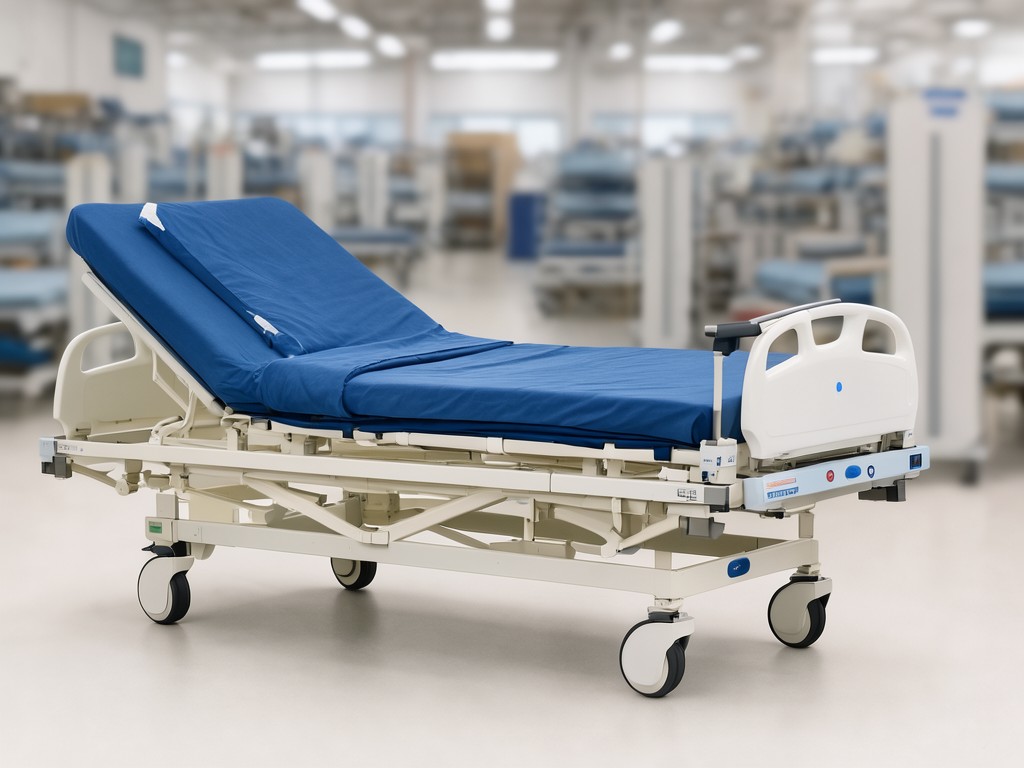
Weight and stiffness trade off against each other in the choice between a fully welded frame and a modular bolt‑together design. Welded frames deliver a 12 % higher torsional rigidity, which keeps the five functions — backrest, knee‑break, height, Trendelenburg, reverse Trendelenburg — synchronized within 3 mm across the deck. Bolt‑together frames save 8 kg per unit and allow flat‑pack shipping, but they introduce 0.3 mm play at each joint; after 500 cycles that play doubles and the central locking cam begins to bind.
Frame Geometry
1.5 mm steel, 40 × 80 mm rectangular tube, post‑weld stress relief
Central Locking
Four‑cam system, hardened 42CrMo4, 12 Nm release torque ±10 %
Actuator Mounts
CNC‑machined brackets, 0.5 mm positional tolerance
Caster Integration
150 mm conductive twins, central lock linkage with 2 mm over‑travel
Specification Rule: The central locking cam must be hardened to 45‑50 HRC and the release lever pivot must run on a sintered bronze bushing. Substituting a plastic bushing saves $0.12 but increases lever effort by 35 % after 2 000 cycles — a direct cause of nurse‑reported fatigue injuries.
Customisation Options and Their Limits
Buyers typically request three customisations: side‑rail material, mattress deck perforation pattern, and control pendant layout. Each has a hard limit dictated by the central locking geometry. For example, switching from ABS to aluminium side rails adds 2.3 kg and shifts the centre of gravity 12 mm forward — this requires a revised cam‑lever arm length, which is a new tooling cost of $1,800 and a 10‑day lead‑time adder. Perforation patterns are free to choose within a 15 mm pitch grid; anything tighter compromises the deck’s 1,200 N/m² load rating. Pendant layouts are limited to six buttons because the CAN‑bus harness is pre‑wired for that count; adding a seventh button means a new harness loom and re‑validation of the IEC 60601‑1 EMC test.
ABS Side Rails
Weight: 1.8 kg/pair, impact rating IK08, colour‑matched to RAL 9016
Aluminium Side Rails
Weight: 4.1 kg/pair, impact rating IK10, anodised 15 µm, requires cam‑arm redesign
Who Uses It and Where It Matters
The primary volume comes from public‑hospital procurement tenders in Southeast Asia and the Middle East, where a single contract covers 200‑500 beds over 18 months. These buyers need the central locking to survive daily cleaning with 0.5 % sodium hypochlorite and monthly steam sterilisation at 134 °C. Private‑clinic chains in Latin America order 20‑50 units per quarter and prioritise flat‑pack shipping to reduce freight cubic metres by 35 %. In both cases, the five‑function actuator package must be interchangeable across the fleet — same part numbers for backrest, knee‑break, and height motors — so that a single spare‑parts kit covers the entire installation.
Emergency‑field hospitals represent a growing niche. They require the bed to be assembled by two technicians in under 15 minutes without tools. That drives the bolt‑together frame option, but only when the buyer accepts the 0.3 mm joint play and signs off on a reduced 3‑year structural warranty instead of the standard 5‑year.
Working as a Production Partner, Not a Catalogue Supplier
Every order begins with a technical agreement packet: 2D drawings with GD&T for the central locking cam, a BOM that locks the actuator supplier to a single source (Linak LA40 or TiMOTION TA23), and a first‑article inspection (FAI) plan that includes 100 % dimensional check on the cam‑lever pivot and a 500‑cycle endurance run on the locking mechanism. We do not start cutting steel until the buyer signs off on the FAI report and the colour‑match plaque for the powder coat (RAL 9016 ± ΔE 1.5). This upfront alignment typically adds 7 days to the pre‑production phase but eliminates the 12‑15 % rework rate we see when buyers skip the drawing approval step.
Artwork for the control pendant overlay is supplied as a vector PDF with Pantone references; we run a 30‑piece pilot print and send photos for approval before the full run. Logo placement on the headboard is laser‑etched, not stickered, because stickers peel after three chemical wipe‑downs.
Volume Planning and Lead Time
Our production cell runs a mixed‑model line: welded frames on Monday‑Wednesday, bolt‑together frames on Thursday‑Friday. Capacity is 120 welded units or 180 bolt‑together units per week. The central locking sub‑assembly is a dedicated station with a 2‑day cycle time per 100 sets. Lead times scale with order size and customisation depth as shown below.
| Order Quantity | Configuration | Lead Time (calendar days) | MOQ per Release |
|---|---|---|---|
| 50‑100 | Standard welded, ABS rails | 35 | 25 |
| 101‑300 | Standard welded, ABS rails | 45 | 50 |
| 301‑500 | Standard welded, ABS rails | 55 | 100 |
| 50‑200 | Bolt‑together, Al rails | 42 | 25 |
| 201‑500 | Bolt‑together, Al rails | 52 | 50 |
Custom pendant layouts or non‑standard colours add 10 days to the above. We hold a rolling buffer of 200 central locking cam sets and 150 actuator kits to absorb forecast changes up to ±15 % without extending the committed ship date.
Care, Storage and Service Life
The powder coat (epoxy‑polyester, 80 µm) withstands 1 000 hours of salt spray per ASTM B117 and 2 000 wipe cycles with 0.5 % sodium hypochlorite without gloss loss >5 %. Central locking cams should be lubricated every 6 months with a PTFE‑based grease (Klüberplex BEM 41‑132 or equivalent) — 2 g per cam. Actuator gearboxes are sealed for life; do not open them. If a bed is stored >30 days, retract all actuators to the home position, engage the central lock, and cover with a breathable anti‑static film. Expected service life: 10 years / 30 000 cycles for the frame, 7 years / 20 000 cycles for the actuators, 5 years for the central locking mechanism under ICU‑level utilisation.
A preventive‑maintenance checklist is included in the shipment documentation. We recommend a quarterly torque check on the four cam bolts (12 Nm ±10 %) and a functional test of the CPR release under 150 N load. Beds that pass this regime routinely exceed the 10‑year structural mark; those that skip it tend to develop cam‑binding at year 4.
Request a Quotation Review
Send us your tender specification, target delivery window, and any customisation sketches. We will return a detailed cost breakdown, a first‑article inspection plan, and a production schedule within three business days.