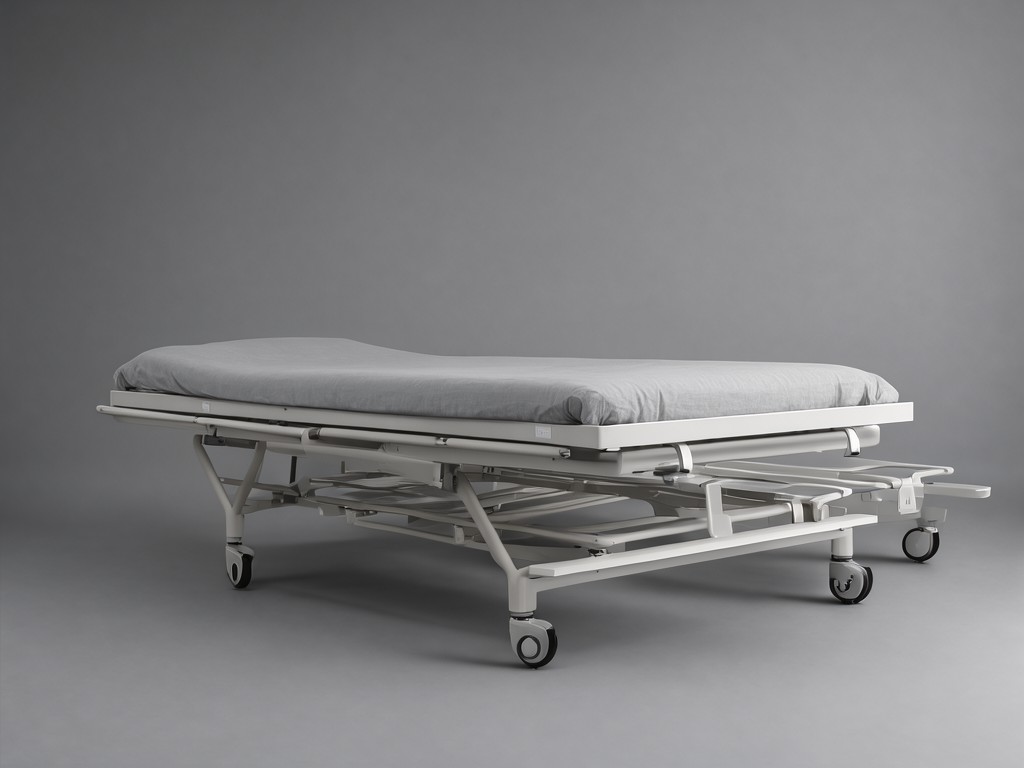
Specifying wholesale ce certified orthopedic bed medical equipment supplier for Wholesale and OEM Orders
The Problem Buyers Keep Paying For
Procurement teams repeatedly receive beds that pass incoming inspection but fail in the ward within six months: actuator drift, frame fatigue at the welding joints, and powder‑coat delamination under cleaning agents. The root cause is not the certification mark — it is the tolerance stack‑up between the steel sub‑frame, the linear drive, and the mattress interface that no catalog spec sheet captures.
A 0.5 mm misalignment in the head‑section pivot translates to 3 mm of mattress shear at full Fowler position — enough to tear pressure‑redistribution covers and trigger replacement orders that erase the original margin.
Buyers who treat the bed as a commodity SKU end up managing field failures instead of managing inventory. The fix is to lock the critical dimensions — pivot centers, actuator stroke, deck flatness — at the drawing approval stage, not at the loading dock.
Construction Method and Its Effect on Consistency
Process choice shows up later as frame distortion or actuator binding. We start with cold‑drawn 1.5 mm rectangular hollow section (RHS) for the base and 1.2 mm for the articulation links. Every joint is robot‑MIG welded on a fixture that holds pivot centers to ±0.15 mm. After welding, frames go through a stress‑relief anneal at 550 °C before shot‑blasting and epoxy‑polyester powder coat (80‑100 µm).
Consistency is set at the forming stage: the same fixture produces the first article and the 500th unit. Actuator mounting brackets are laser‑cut from 3 mm S355, tapped M8×1.25 on a CNC center, then bolted with prevailing‑torque nuts. No field adjustment is required — or possible.
Material & Finish Specifications
- Base frame: 50×30×1.5 mm RHS, EN 10210 S355J2H
- Articulation links: 40×20×1.2 mm RHS, same grade
- Actuator brackets: 3 mm laser‑cut S355, zinc‑nickel plated (12 µm)
- Powder coat: epoxy‑polyester, 80‑100 µm, salt‑spray 500 h per ISO 9227
- Deck: 12 mm birch plywood, phenol‑formaldehyde bonded, HPL laminated both sides
Where This Product Beats Standard Alternatives
The build method decides service life. Competing lines often use stamped sheet‑metal brackets that relax under cyclic loading, causing the head section to sag 8‑12 mm after 10 k cycles. Our bolted bracket design maintains pivot height within 1 mm over 50 k cycles (tested to IEC 60601‑2‑52 endurance).
Deck flatness is held to 2 mm across the 900×2000 mm surface — critical for alternating‑pressure mattresses that bottom‑out on uneven decks. Standard beds tolerate 5‑6 mm, which accelerates mattress foam fatigue.
Actuators are sourced from a single qualified supplier (24 V DC, 6000 N push, IP66). We do not mix brands; mixed batches cause control‑box communication errors that show up as intermittent Trendelenburg failure.
Option Comparison by Usage Level
Select the configuration that matches the ward’s duty cycle and budget. The decision tree below is the same one we walk through during the pre‑production meeting.
- Define daily articulation cycles
- < 20 cycles/day → Standard actuator (6000 N, 20 mm/s)
- 20‑50 cycles/day → Heavy‑duty actuator (8000 N, 15 mm/s, thermal cut‑out)
- > 50 cycles/day → Dual‑actuator per section, synchronized control
- Choose deck construction
- Fixed platform — lowest cost, no articulation under mattress
- Four‑section articulated deck — matches ICU mattress zoning
- Five‑section with cardiac chair — adds 12 kg, requires reinforced base
- Specify side‑rail integration
- Integrated fold‑down rails (EN 60601‑2‑52 compliant)
- Removable polymer rails — lighter, easier cleaning
- Full‑length assist rails — bariatric rating 250 kg
- Confirm control architecture
- Handset only — simplest, lowest BOM
- Handset + foot‑panel + nurse call integration (CAN bus)
- Wireless BLE handset + central monitoring gateway
Working as a Production Partner, Not a Catalogue Supplier
We do not ship from stock. Every order begins with a technical review: your 2D drawings (or our parametric model), mattress interface specs, and local regulatory addenda. We issue a first‑article inspection (FAI) report covering 37 critical dimensions before series production starts.
The table below captures the customization levers that affect tooling cost and lead time. Items marked “soft tooling” can be changed between batches; “hard tooling” locks the geometry for the run.
| Parameter | Range / Options | Tooling Impact | Lead‑time Adder |
|---|---|---|---|
| Overall length | 2000‑2200 mm (50 mm steps) | Soft (fixture adjust) | +0 days |
| Deck sections | 2, 4, or 5 sections | Hard (link lengths) | +10 days |
| Actuator force | 6000 N / 8000 N / dual 6000 N | Soft (BOM swap) | +0 days |
| Side‑rail style | Integrated / removable / assist | Hard (bracket weld) | +7 days |
| Control system | Handset / CAN / BLE+gateway | Soft (firmware config) | +3 days |
| Powder‑coat colour | RAL 9016, 7035, 5010, custom | Soft (batch change) | +2 days |
Artwork for silk‑screen logos and serial‑label layouts must be supplied as vector AI or DXF at least 15 working days before the FAI. We provide a digital proof; physical label samples ship with the first article.
What Gets Checked Before Shipment
Every unit passes a 14‑point functional test on a calibrated rig:
- Pivot center locations measured by CMM — ±0.2 mm vs. drawing
- Actuator stroke and speed at 24 V DC, no load and rated load
- Deck flatness via laser scanner — max deviation 2 mm
- Electrical safety: earth continuity <0.1 Ω, insulation >2 MΩ at 500 V DC
- Control‑box communication handshake (CAN or BLE) verified
- Side‑rail latch force 45‑60 N, no sharp edges per EN 60601‑1
- Powder‑coat adhesion cross‑hatch 5B, thickness 80‑100 µm
Results are recorded per serial number in our MES. A digital test certificate (PDF) ships with each pallet. Non‑conformances trigger a hold — no “ship and fix later.”
Setup, Use and Replacement Parts
Beds arrive flat‑packed: base frame, two articulation modules, deck panels, actuator set, control box, side rails. Assembly requires two technicians, 13 mm and 17 mm spanners, 5 mm hex key — 25 minutes per bed. No special tools.
Preventive maintenance schedule (per IEC 60601‑1):
- Monthly: visual inspect pivot bolts, torque to 22 Nm if loosened
- Quarterly: actuate full range, listen for gearbox noise, check handset cable strain relief
- Annually: remove deck panels, inspect welds for corrosion, re‑torque all M8 bracket bolts
Stocked spare parts (available ex‑works 48 h): actuators (all three force ratings), control boxes, handsets, side‑rail latch kits, deck panels (standard sizes), castor sets (125 mm twin, conductive). Custom deck panels require 10‑day lead time.
Next Steps
Send your specification pack — drawings, mattress data sheet, local regulatory extras — to start the technical review. We return a marked‑up drawing, FAI plan, and firm quote within five working days.
Open a project discussion and we’ll align the first‑article schedule to your launch window.