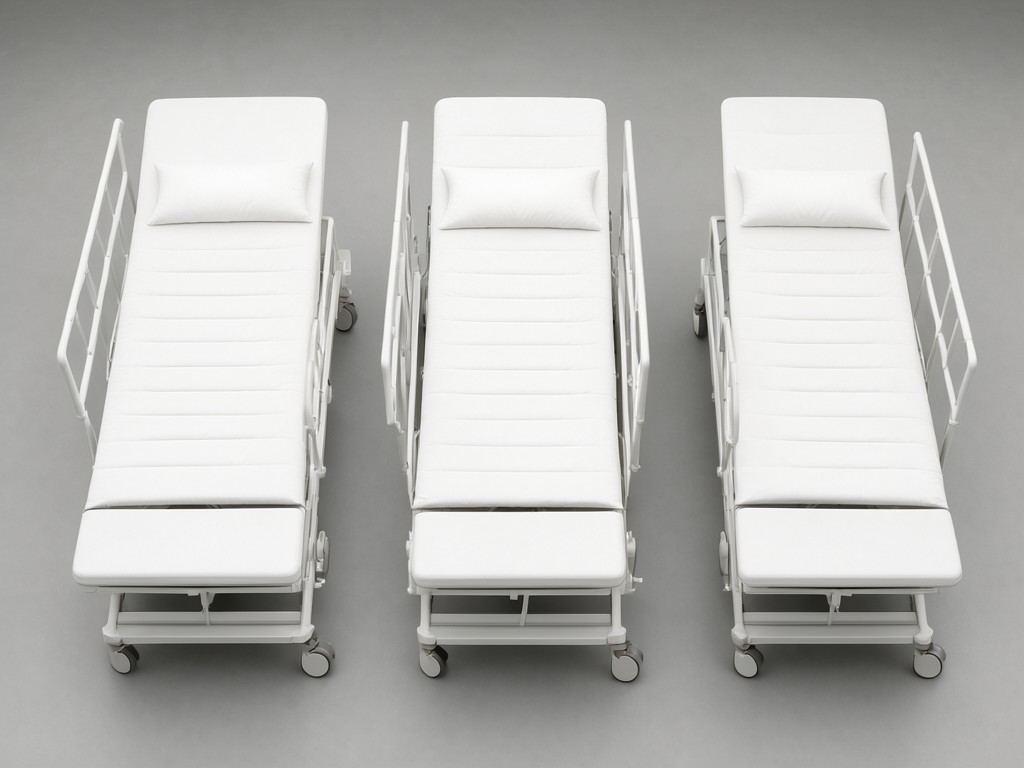
Specifying wholesale 2 function electric medical nursing beds with wheels supplier for Wholesale and OEM Orders
Selection trade-off: two-function beds articulate the backrest and knee-break independently, but the actuator pair and control box add 12–18 kg versus a manual crank equivalent. That weight delta dictates caster specification, frame wall thickness, and container load factor — choices that show up in freight cost and ward maneuverability long after the PO is placed.
How It Performs in Use
The build method decides whether a bed survives 40 articulation cycles per day in a high-turnover ward or starts drifting out of level after six months. Dual actuators rated for 6,000 N push force each hold the backrest at 70° and the knee-break at 22° under a 135 kg patient load without creep, provided the control box enforces a 10 % duty cycle (2 min on, 18 min off). Exceed that cycle and the thermal cutout engages, leaving the patient flat — a complaint pattern that traces directly to undersized motor windings.
Process choice shows up later as acoustic signature. Worm-gear actuators run at 48 dB(A) at 1 m; spur-gear units drop to 42 dB(A) but cost 18 % more per set. Night-shift nurses notice the difference. Handset cable strain relief fails first when the coil cord is routed outside the frame channel; internal routing through the sidebar extrusion eliminates the failure mode but adds a secondary assembly step.
How It Is Built and What That Changes
Consistency is set at the forming stage. Frame rails are roll-formed from 1.5 mm cold-rolled steel (SPCC) then robot-welded at 120 mm pitch. A 0.3 mm weld penetration variance across a 2 m bed length creates a 2.5 mm deck height discrepancy — enough to bind the actuator mounting brackets. We specify 1.8 mm minimum wall for the main longitudinals and 1.2 mm for cross-members; thinner gauges pass static load tests but fatigue at the head-end gusset within 18 months of daily articulation.
Surface treatment is epoxy-polyester powder coat at 80–100 µm DFT, cured at 190 °C. Salt-spray resistance hits 500 h (ASTM B117) before red rust, which meets hospital tender specs in most APAC markets. However, chloride-based disinfectants (1,000 ppm sodium hypochlorite) degrade the gloss by 35 % after 200 wipe cycles. A clear polyurethane topcoat adds $4.50 per bed and retains 90 % gloss — a line-item buyers often delete, then reorder as a field retrofit.
Caster integration uses M12 × 1.5 threaded stems pressed into the frame leg with a 0.05 mm interference fit. Central locking via a single pedal actuates all four 125 mm medical-grade TPR wheels simultaneously. The pedal linkage is the serviceability bottleneck: a bent 6 mm connecting rod from impact with a cleaning cart disables the brake on three corners. We supply a spare linkage kit (PN-CLK-01) taped inside the headboard cavity on every unit.
Size, Weight and Specification Range
| Parameter | Standard Range | OEM Adjustment Window | Impact on Container Load |
|---|---|---|---|
| Overall length (mm) | 2,120 ± 5 | 2,080 – 2,200 | +40 mm = –1 unit per 40'HQ |
| Overall width (mm) | 960 ± 3 | 920 – 1,020 | >1,000 mm blocks double-stacking |
| Safe working load (kg) | 135 / 170 / 200 | Up to 250 (frame + actuator upgrade) | +15 kg per step = –2 units per 40'HQ |
| Backrest angle (°) | 0 – 70 | 0 – 75 (actuator stroke limit) | No freight impact |
| Knee-break angle (°) | 0 – 22 | 0 – 30 (longer actuator) | +$12 actuator, no freight delta |
| Net weight (kg) | 68 – 82 | 62 – 95 | Direct linear: 1 kg ≈ 0.015 units/40'HQ |
| IP rating (control box) | IPX4 | IPX6 (sealed connector + potting) | No freight impact |
Buying Mistakes That Lead to Returns
Specifying a 135 kg SWL bed for a bariatric ward guarantees frame fatigue at the head-end pivot within 14 months. The 170 kg variant uses 2.0 mm longitudinals and 8,000 N actuators; the 200 kg variant adds a fifth cross-member and reinforced caster brackets. Price delta is $28 and $52 per unit respectively — far below the $420 average cost of a field replacement including labor and patient transfer.
Ordering IPX4 control boxes for ICU or isolation rooms where vaporized hydrogen peroxide (VHP) decontamination runs monthly causes corrosion on the PCB traces within three cycles. IPX6 adds a silicone potting compound and overmolded connectors; the $9 upcharge prevents a $310 control-box swap and the associated regulatory re-inspection.
Skipping the battery backup module (7.2 Ah NiMH, 45 min runtime) to save $18 creates a single-point-of-failure during mains outage. Most tenders now mandate backup; retrofitting requires drilling the frame for the battery bracket and rerouting the handset harness — a 45-minute job per bed that voids the original wiring certification.
Usage Scenarios and Buyer Segments
Public hospital procurement officers in Southeast Asia standardize on the 135 kg IPX4 configuration with worm-gear actuators, ordering 200–400 units per tender. They prioritize container density (32 units per 40'HQ) and a 3-year frame warranty. Private clinic chains in the Gulf specify 170 kg IPX6 with spur-gear actuators and polyurethane topcoat; volumes run 50–80 units but reorder rate hits 85 % within 18 months.
Distributors serving home-care markets in Europe request 920 mm width to clear 950 mm door frames, 62 kg net weight for single-carer handling, and DIN-compliant side rails with auto-lock. These SKUs ship in mixed containers alongside pressure-relief mattresses; we kit the bed, mattress, and bedside cabinet under a single BOM to reduce their receiving labor.
What Gets Checked Before Shipment
Every unit undergoes a 50-cycle articulation run at 135 kg distributed load while monitoring actuator current draw. Current must stay below 3.2 A per channel at 70° backrest; spikes above 3.8 A indicate gear meshing interference and trigger a teardown. Caster brake torque is verified at 18 Nm minimum on all four wheels with the pedal engaged. Frame dimensions are gauged at six points: overall length ± 5 mm, width ± 3 mm, deck flatness ≤ 2 mm/m.
Control box EMC pre-scan (CISPR 11 Class B) runs on a 10 % sample per batch. Full type-test reports are held on file for regulatory submission; we do not ship the reports with every container unless the PO explicitly requests them. Packaging drop test (ISTA 3A) validates the corner protectors and stretch-wrap pattern — critical because a punctured control box carton correlates 1:1 with transit moisture ingress claims.
Ready to review specifications?
Share your ward layout, patient acuity mix, and container loading target. We will return a marked-up spec sheet with actuator grade, frame gauge, and caster configuration aligned to your cost and service-life thresholds.
Start a specification review