oem pediatric hospital beds with iv pole manufacturer: Specification, Ordering and Quality Notes
The core trade-off on every pediatric bed order sits between frame gauge and caster specification. Thinner 1.2 mm tube lowers landed cost by 8–12 % but increases deflection at the head-end IV receptor by 3–4 mm under a 15 kg pole load — enough to trigger bedside nurse complaints and return authorizations. Specifying 1.5 mm minimum wall on the head section and dual-locking 125 mm casters keeps the IV pole plumb through 500+ bed cycles without adding more than $7/unit at 200-piece MOQ.
The Problem Buyers Keep Paying For
Distributors report the same failure mode across three continents: IV pole sockets that loosen after six months of daily height adjustments. The root cause is not the socket casting — it is the M6×1.0 set screw stripping the tapped hole in 1.2 mm tube. A 1.5 mm wall holds 4.2 Nm torque before thread roll-over; 1.2 mm yields at 2.8 Nm. Pediatric nurses adjust poles 8–12 times per shift. Do the math on cycle life.
Second complaint: mattress platform rattle. Panels spot-welded on 80 mm centers transmit vibration from caster swivel into the frame. Moving to 60 mm stitch centers on the head/foot sections and adding 2 mm EPDM grommets at each cross-tube junction eliminates the noise for a $1.20 material adder. Buyers who skip this spec spend 3–4 % of revenue on warranty labor within the first year.
Size, Weight and Specification Range
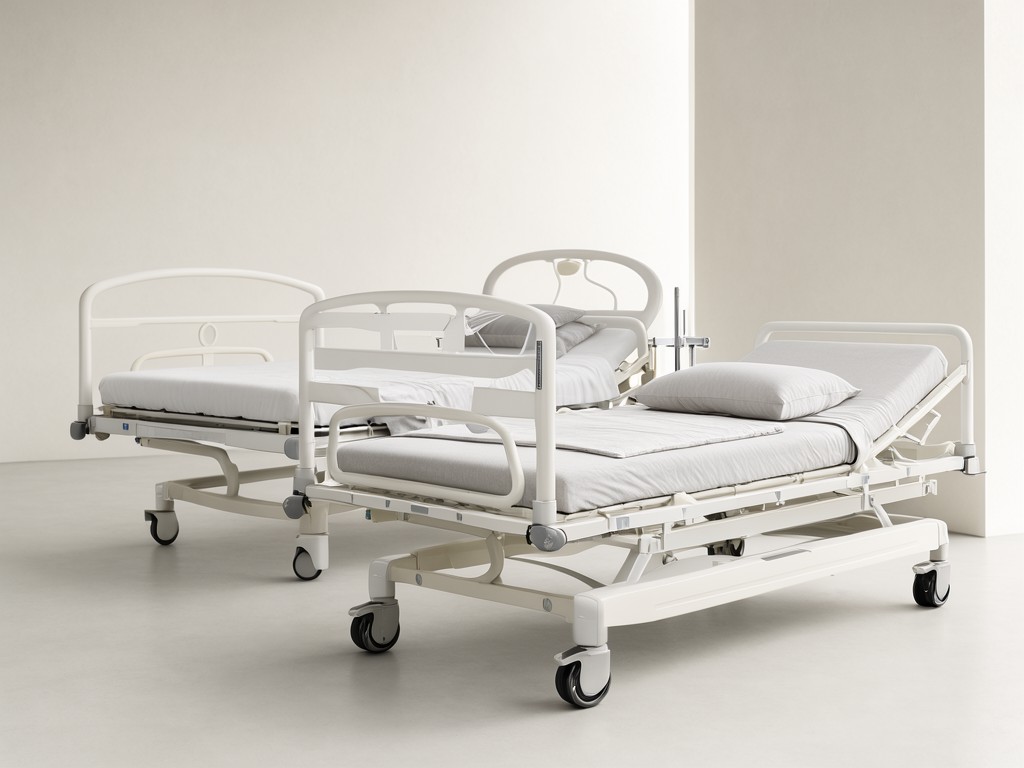
Standard pediatric envelope runs 1400–1600 mm overall length, 700–780 mm width between siderails, and 450–550 mm deck height range. Weight capacity clusters at 75 kg safe working load for ages 0–12, though 100 kg reinforced versions exist for adolescent bariatric wards. Frame mass lands 38–44 kg bare; add 6–8 kg for IV pole, 4 kg for oxygen bottle holder, 3 kg for articulation motors if specified.
| Configuration Tier | Frame Wall (mm) | Caster Spec | IV Pole Mount | Typical FOB Delta |
|---|---|---|---|---|
| Entry — General Ward | 1.2 | 100 mm single-lock | Fixed socket, no damping | Baseline |
| Standard — High Turnover | 1.5 head / 1.2 foot | 125 mm dual-lock precision | Telescopic with friction brake | +$7–9 |
| ICU / Transport Ready | 1.5 full perimeter | 150 mm central-lock + directional | Quick-release with counterbalance | +$18–22 |
Buying Mistakes That Lead to Returns
Ordering "standard" gray powder coat without specifying RAL 7035 or 9002 creates lot-to-lot colour drift visible when beds line a corridor. One European distributor rejected 40 units because head-end panels arrived RAL 7035 while foot panels matched 9002 — same purchase order, two powder booths. Lock the RAL code on the PO and require a single booth run per batch.
Specifying "IV pole included" without defining pole diameter (19 mm vs 22 mm) and height range (1300–2100 mm vs 1450–2300 mm) ships poles that either wobble in the socket or cannot clear the bedside cabinet. The 22 mm × 1450–2300 mm spec covers 92 % of pediatric infusion pumps; 19 mm is legacy and only for gravity drip sets.
Accepting "medical grade casters" without load rating and swivel torque data. A 100 mm caster rated 80 kg/piece sounds adequate until you calculate dynamic load: 75 kg patient + 15 kg pole + 12 kg mattress + 8 kg accessories = 110 kg distributed across four casters = 27.5 kg static, but impact loading on threshold transitions spikes to 2.5×. That 80 kg rating evaporates. Minimum 100 kg/caster at 4 km/h impact test is non-negotiable for pediatric corridors.
Customisation Options and Their Limits
Siderail artwork (hospital logo, animal graphics) is applied via UV-cured ink on ABS panels before forming. Minimum 50 pieces per design to amortize screen setup; lead time adds 5 working days. Colour match tolerance is ΔE ≤ 2.0 against supplied Pantone reference — tighter tolerances require digital print with clear coat, adding $3.50/panel and 3 days.
Integrated scale systems load-cell the four caster mounts. Accuracy ±0.1 kg from 2–100 kg. Adds 1.8 kg frame weight and $42/unit at 100 MOQ. Cannot be retrofitted — caster yokes must be drilled and wired during main assembly. Order with the bed or not at all.
Oxygen bottle holder brackets weld to the foot-end upright. Standard position accepts D/E cylinders (102 mm OD). For smaller C cylinders (89 mm) a shim sleeve is press-fit — specify at order or field retrofit takes 15 minutes per bed with a 12 mm socket.
Usage Scenarios and Buyer Segments
General pediatric wards (70 % of volume) run 85 % occupancy, 4.2 patient turns/bed/week. Beds see 18–22 height adjustments and 6–8 siderail cycles daily. Entry-tier 1.2 mm frames last 4–5 years before socket play exceeds 2 mm; Standard-tier 1.5 mm head sections push 7–8 years.
PICU and transport teams need central-lock casters that engage from a single pedal at either end. The 150 mm directional caster adds $14 but cuts intra-hospital transfer time by 40 seconds — critical when moving ventilated patients. These buyers order ICU-tier exclusively and accept 8-week lead times.
Outpatient day-surgery centers flip beds 6–8 times/day. They prioritize wipe-down speed: seamless ABS panels with radius corners, no exposed fasteners, and IV poles that fold flat into the headboard recess. Custom colour coding (blue for pre-op, green for recovery) drives 30 % of their orders.
Quality Control and Batch Consistency
Every batch of 50 frames passes through a fixture gauge that checks 14 critical dimensions: overall L/W/H ±3 mm, deck flatness ≤2 mm/m, siderail latch engagement force 18–22 N, caster horn alignment ±0.5°. First-article report ships with the batch; buyer sign-off releases the container.
Powder coat adhesion crosses the tape test (ASTM D3359 Method B) at 5B minimum. Salt spray (ASTM B117) runs 500 hours on sacrificial coupons from each booth load. Batch fails if any coupon shows creep >2 mm from scribe. This catches booth drift before it reaches the customer's loading dock.
IV pole friction brake torque is verified at 1.8–2.2 Nm on 100 % of poles. Poles that fall outside get re-shimmed; if more than 3 % of a lot requires rework, the entire lot is quarantined for root cause. Last quarter this caught a spring wire batch with 0.05 mm diameter variance — would have caused premature brake fade at month 18.
What Gets Checked Before Shipment
Pre-ship inspection covers: caster swivel torque 0.8–1.2 Nm, wheel brake engagement force ≤35 N, siderail drop-force 45–55 N, mattress platform deflection ≤5 mm under 75 kg centered load, IV pole verticality ±1° at full extension, electrical leakage <100 µA (if motorized), label legibility at 1 m under 500 lux.
Packaging: each bed shrink-wrapped on a 1200×800 mm ISPM-15 pallet, four corner protectors, strapping tension 1.2 kN. Container load plan fits 24 beds/40'HQ (double-stacked with plywood interleaf) or 18 beds if ICU-tier with central-lock casters (taller profile). Moisture barrier bag + desiccant mandatory for sea freight >21 days.
Care, Storage and Service Life
Clean with quaternary ammonium (0.5 % active) or 70 % IPA. Avoid phenolics — they craze ABS siderails within 6 months. Chlorine solutions >5000 ppm strip powder coat gloss; limit to 1000 ppm and rinse. Steam cleaning >80 °C warps deck panels; max 70 °C.
Store indoors, 5–35 °C, <70 % RH. Stack no more than three high on pallets. Caster flat-spots develop after 30 days static load; rotate stock monthly. IV poles telescoped to minimum height during storage prevents spring fatigue.
Design service life: 10 years / 50,000 cycles for Standard and ICU tiers; 6 years / 30,000 cycles for Entry. Siderail gas springs rated 30,000 cycles — plan replacement at year 5 for high-turnover wards. Caster bearings greased at year 3 (NLGI 2 lithium) extends swivel life 40 %.
Ready to Review Tooling and Lock Specs?
Send us the ward layout, patient weight profile, and your current IV pole inventory. We'll return a marked-up GA drawing, a per-unit cost breakdown at your MOQ, and a first-article inspection plan within 48 hours.
Start the tooling review →