Specifying oem height adjustable electric hospital beds supplier for Wholesale and OEM Orders
What the Design Has to Balance
| Inspection Point | Acceptance Criteria | Test Method |
|---|---|---|
| Frame weld integrity | No visible cracks, penetration ≥ 80% material thickness | Visual + dye penetrant per AWS D1.3 |
| Actuator cycle life | ≥ 20,000 full strokes at rated load | Automated cyclic test, 10 mm/s, 25°C |
| Powder coat adhesion | Cross-hatch 5B after 500 h salt spray | ASTM D3359 / ASTM B117 |
| Caster swivel torque | ≤ 0.8 Nm after 10 km travel | ISO 22883 dynamic endurance |
Every bed frame starts as a weldment of rectangular steel tube, typically 50×25×2 mm, and the inspection table above is the baseline that separates a production run that ships on time from one that stalls at final QC. The buyer who specifies a 20,000-cycle actuator is implicitly asking for a 5-year service interval in a 300-bed facility; dropping to 10,000 cycles saves roughly 12% on the actuator line but doubles the probability of a mid-contract replacement order. Powder coat adhesion is the silent killer — chlorine-based disinfectants attack micro‑porosity at the weld toes, so the 500-hour salt spray threshold is not optional for any market that uses sodium hypochlorite daily.
What Actually Determines Performance
Performance in this category is not a single number. It is the interaction of three subsystems: the lift mechanism, the frame rigidity, and the control electronics. A 4,500 N actuator paired with a frame that deflects 12 mm under a 250 kg patient feels unstable even though the motor meets spec. Conversely, an over‑engineered frame with a 3,000 N actuator will stall on the Trendelenburg position. The control box must handle inrush current without voltage sag that resets the handset — a failure mode that appears only after 200+ consecutive cycles.
DC Linear Actuator (Standard)
- 12/24 V DC, 4,500 N push, 6 mm/s no‑load
- IP66 rated, integrated limit switches
- Typical cost delta: baseline
- Service life: 20k cycles at 80% duty
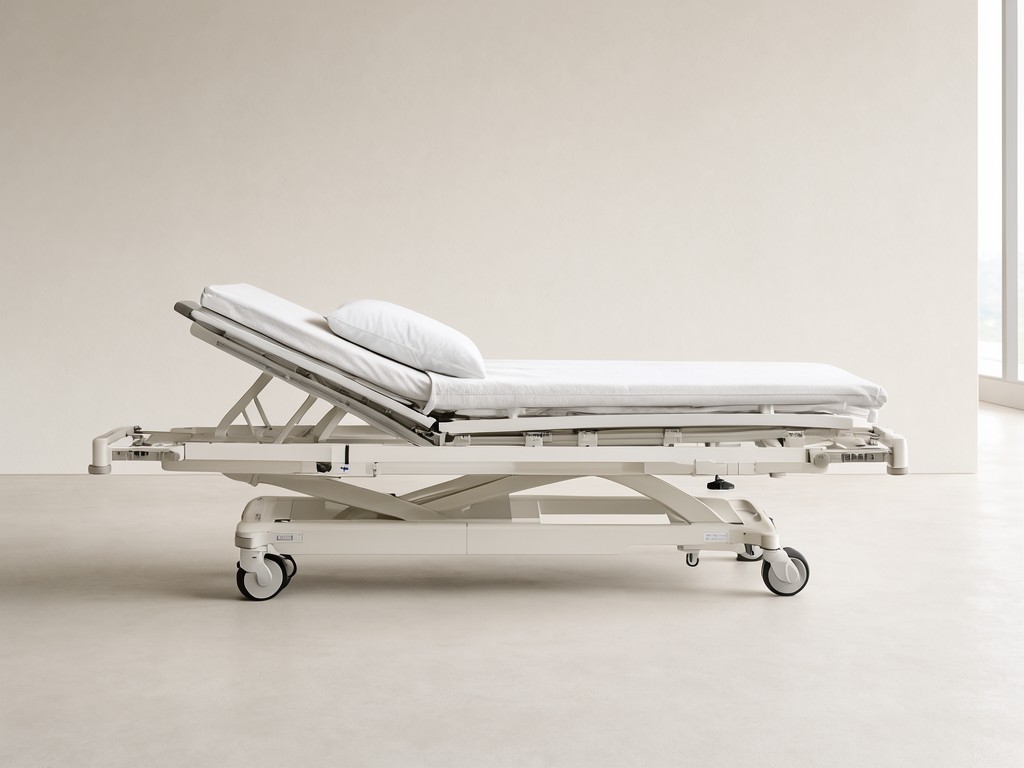
Hydraulic Actuator (Premium)
- Hand‑pump backup, 6,000 N push, 8 mm/s
- No electrical components in patient zone
- Cost delta: +18–22% per unit
- Service life: 30k cycles, fluid change at 15k
The hydraulic option eliminates the control‑box failure mode entirely, which matters for ICU tenders that mandate zero‑single‑point‑of‑failure. For general ward rollouts, the DC actuator keeps the BOM under control and the handset firmware can be updated via USB‑C without opening the enclosure.
Usage Scenarios and Buyer Segments
Acute‑care hospitals order in lots of 50–200 with a 12‑week lead time and require IEC 60601‑1 third‑party test reports. Long‑term‑care chains buy 20–80 units per quarter, prioritize caster durability over maximum lift height, and often request custom colour matching to their facility palette. Home‑care distributors need single‑pallet quantities, foldable side rails, and a 2‑person assembly time under 15 minutes. Bariatric programs demand 350 kg safe working load, reinforced head/foot boards, and a wider mattress platform — typically 1,020 mm vs. the standard 900 mm.
Segment-Specific Requirements
Private‑label buyers usually lock the specification at the first article inspection (FAI). They need a fixed BOM so that repeat orders are identical down to the screw thread locker grade. Brand product managers, on the other hand, may swap the headboard laminate from HPL to antimicrobial acrylic between seasons — this changes the packaging height by 18 mm and forces a new drop‑test validation. Distributors ask for knock‑down packaging that fits 12 beds per 40‑ft HC container; that drives the decision to ship side rails detached and the mattress platform folded flat.
- Acute care: IEC 60601‑1, 250 kg SWL, 4‑section profiling
- Long‑term care: 200 kg SWL, central locking casters, 2‑year warranty
- Home care: 180 kg SWL, foldable, tool‑free assembly, retail carton
- Bariatric: 350 kg SWL, 1,020 mm width, reinforced actuators
Keeping Repeat Orders Supplied
The factory holds safety stock of the top‑three actuator part numbers and the two most common caster assemblies. That covers 85% of repeat configurations without waiting for sub‑supplier lead times. For custom colours or branded headboards, the MOQ is 30 units per SKU — below that, the powder‑coat line changeover eats the margin. Artwork files must be supplied as vector PDFs with Pantone references; raster logos at 300 dpi are acceptable only for non‑critical labels. Lead time from artwork approval to first pallet is 25 working days, assuming no component shortages.
Artwork and branding review is the single most common cause of delayed launch dates. Submit final files before placing the deposit to avoid a 2‑week hold at the print station.
Care, Storage and Service Life
Daily cleaning with 0.5% sodium hypochlorite does not degrade the powder coat if the film thickness stays above 80 µm. Quaternary ammonium compounds are gentler but leave a residue that attracts dust into the actuator seals — wipe with a damp cloth after disinfection. Store beds at 10–35°C, < 75% RH, and cycle the actuators once per month if warehoused longer than 90 days. Caster bearings are sealed for life; do not lubricate. Replace the handset membrane overlay at 3 years or when tactile feedback degrades, whichever comes first.
Next Steps
When the specification is locked and the artwork is ready, the fastest path to a production slot is a quick call with our project engineers. They will confirm the BOM, validate the container loading plan, and issue a firm ship date.