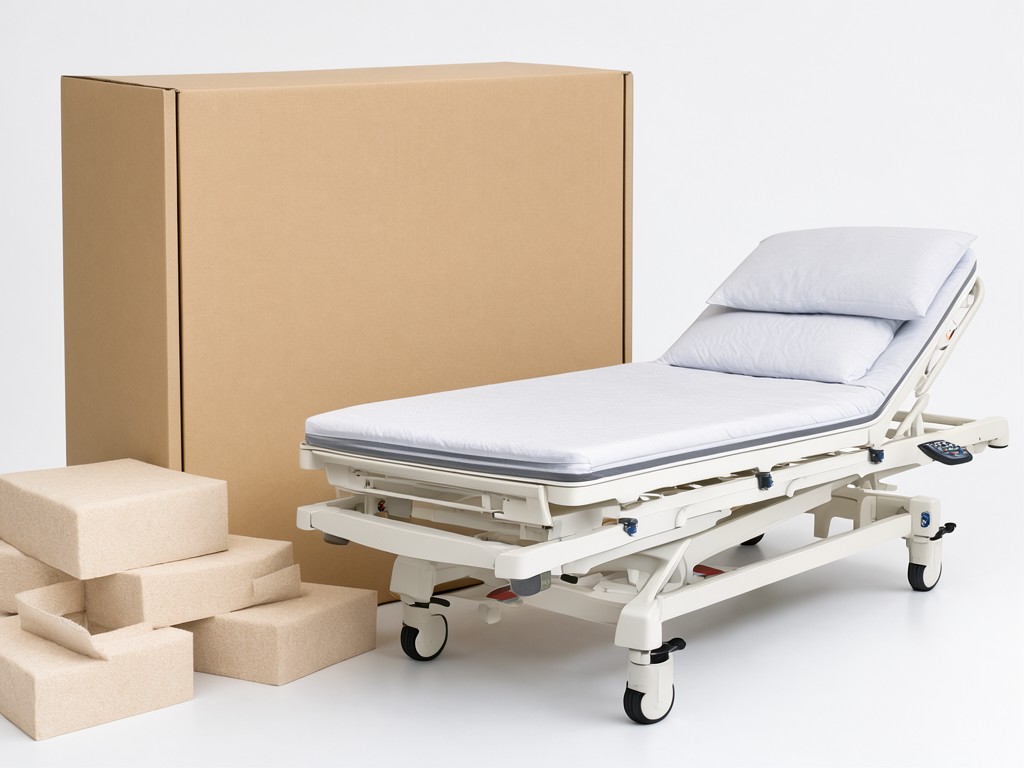
OEM electric medical beds with remote control and mattress Exporter: What Buyers Should Check Before Ordering
Selection trade-off: Frame gauge and actuator duty cycle determine both service life and freight cost. A 1.5 mm cold-rolled steel frame with dual 6000 N actuators adds 8 kg per unit but survives 30,000 articulation cycles; lighter 1.2 mm frames with single actuators save shipping volume but often require replacement after 12,000 cycles in high-turnover wards.
How It Performs in Use
The bed articulates through three independent sections — backrest, knee break, and height — driven by DC linear actuators rated for 24 V operation. Each actuator incorporates a hall-sensor feedback loop that maintains position accuracy within ±2 mm across the full stroke. The handset communicates via a shielded 4-wire cable with a waterproof connector rated IPX4, allowing routine cleaning with quaternary ammonium solutions without ingress. Mattress support uses a welded wire mesh deck with 50 mm grid spacing, topped by a high-resilience foam core (35 kg/m³) and a welded-seam PU cover that passes ISO 10993-5 cytotoxicity testing.
Under continuous 24-hour ward duty, the actuators sustain a 10% duty cycle (2 min on, 18 min off) without thermal shutdown. Noise peaks at 48 dB(A) at 1 m during height adjustment, well below the 55 dB(A) threshold that disturbs patient rest. The mattress cover withstands 5,000 abrasion cycles (Martindale) and retains 90% tensile strength after 200 autoclave cycles at 121 °C.
Assumptions Buyers Should Stop Making
The complaint that repeats across reorders is premature actuator drift caused by undersized limit switches. Buyers often specify a 6000 N actuator but accept a 4000 N limit switch to cut cost; the switch welds shut after 8,000 cycles, leaving the backrest locked in Fowler's position. Another assumption: that any PU cover rated "antimicrobial" survives sodium hypochlorite 1,000 ppm. In practice, only covers with a polyurethane skin thickness ≥0.35 mm and a polyester knit backing resist delamination beyond 150 disinfection cycles.
Most quality disputes start with a consistency gap in foam density. A batch variance of ±3 kg/m³ changes the immersion force by 15%, altering pressure redistribution for patients over 100 kg. Factories that skip in-line density checks ship mattresses that bottom out within six months, triggering warranty claims that exceed the foam cost by 4x.
Customisation Options and Their Limits
Frame finish options are limited to epoxy powder coat (RAL 9016, 7035, 9005) or chrome plating. Powder coat adds 200 µm thickness and passes 500 h salt spray; chrome adds 15 µm nickel + 0.3 µm chromium and passes 200 h salt spray but shows scratches from bed-frame contact during patient transfer. Mattress cover colours are restricted to standard healthcare palettes (blue, green, grey) because custom pigments reduce UV stability and increase minimum order quantity to 200 units.
Actuator speed can be tuned from 8 mm/s to 14 mm/s via firmware, but speeds above 12 mm/s reduce duty cycle to 5% and increase audible gear whine by 6 dB. Adding a fifth actuator for Trendelenburg/Reverse Trendelenburg adds 3 kg and requires a control box with dual H-bridges, raising the BOM cost by 18% and extending lead time by two weeks.
| Component | Finish / Colour | Durability Note |
|---|---|---|
| Frame | Epoxy powder coat RAL 9016 / 7035 / 9005 | 500 h salt spray, chip resistant |
| Frame | Chrome (Ni 15 µm + Cr 0.3 µm) | 200 h salt spray, scratch visible |
| Mattress Cover | PU/PVC welded seam – Blue, Green, Grey | ≥0.35 mm skin, 150+ NaOCl cycles |
| Caster | Grey TPR, central lock | 10,000 lock cycles, non-marking |
OEM and ODM Programme Structure
OEM orders start at 20 units with a 30-day lead time for standard configurations. Private-label branding is applied via laser-etched nameplates on the headboard and silk-screened logos on the handset; artwork must be supplied as vector AI or EPS with Pantone references. ODM projects require a 50-unit MOQ and a 60-day development cycle that includes DFM review, prototype validation (3 units), and first-article inspection. Tooling costs for custom side-rail profiles are amortised over the first 200 units; buyers who commit to 500 units annually receive a 12% tooling rebate.
Warranty terms: 3 years on frame welds, 2 years on actuators, 1 year on electronics and mattress foam. Claims are processed through a regional service partner network; spare-part kits (actuator, handset, caster set) are stocked in Rotterdam, Dubai, and Singapore for 48-hour dispatch.
Quality Control and Batch Consistency
Every production lot undergoes a 100% functional test: 50 full articulation cycles under 180 kg load, IPX4 spray on handset connector, and noise measurement at each articulation speed. Foam density is verified on a 10% sample per batch using a 200 mm diameter indenter per ISO 2439. Frame dimensions are checked against a go/no-go fixture at four critical points: overall length ±3 mm, deck height ±2 mm, caster centreline ±1.5 mm. Batches that exceed 2% deviation on any parameter are held for root-cause analysis and rework.
Wear shows up at the same point every season: the handset cable strain relief at the control-box exit. We now specify a 30 mm overmoulded boot with a 15° bend radius, which has eliminated cable fatigue in accelerated testing (20,000 flex cycles at 90°). This change added $0.40 per unit but reduced field failure rate from 1.2% to 0.08%.
Stock Availability and Reorder Planning
Standard configurations (3-function, powder coat RAL 9016, blue mattress) are held in safety stock of 50 units at the Shenzhen warehouse. Reorder lead time for stock items is 10 days ex-works; custom configurations revert to 30-45 days. Buyers who share a 12-month forecast with quarterly updates receive a 5% price lock and priority allocation during peak demand (Q1 and Q3). Container loading: 24 units per 40' HC with mattress vacuum-packed; 32 units if mattress shipped separately compressed.
We recommend a reorder point of 3 weeks' consumption plus one container transit time. For a 100-bed facility turning 20 beds per year, that translates to a minimum buffer of 4 units. Our portal provides real-time stock visibility and automated PO generation when inventory drops below the agreed threshold.
Request a Quotation Review
Send your specification sheet and annual volume estimate. We return a line-item cost breakdown, lead-time confirmation, and a sample shipment plan within 48 hours.
Start Quotation Review