oem 3 function electric hospital beds with mattress and casters supplier: What Buyers Should Check Before Ordering
What This Product Is and Where It Fits
Unit price settles the question only after the buyer confirms that the bed frame, actuator set, mattress core and caster package meet the ward’s daily cycle count. A typical acute‑care ward runs 12‑hour shifts with patient transfers every 30 minutes, so the lift mechanism must survive at least 150,000 cycles without drift. The mattress must retain 90 % of its initial indentation force deflection after 5,000 compression cycles. Casters need a 150 kg dynamic load rating and a brake that holds on a 5° incline. When any of those thresholds slip, the total cost of ownership rises faster than the per‑unit discount.
Two suppliers quoting the same specification often differ in the grade of steel used for the frame, the foam density of the mattress, and the seal class of the actuator. The buyer’s decision rule should be: verify the test report for each subsystem before signing a purchase order.
Materials and Construction Trade-offs
Frame tubing is usually 1.5 mm cold‑rolled steel with a 60 µm epoxy‑polyester powder coat. Upgrading to 2.0 mm tube adds 3 kg per bed but raises the static load limit from 250 kg to 300 kg. The mattress core can be 30 kg/m³ high‑resilience foam or 45 kg/m³ viscoelastic foam; the latter improves pressure redistribution but adds 2 kg and reduces airflow. Caster housings are either glass‑filled nylon (lower cost, 120 kg rating) or zinc‑alloy (higher cost, 150 kg rating). Actuator housings come in aluminum die‑cast (lighter, 8 Nm torque) or reinforced polymer (heavier, 10 Nm torque).
Critical spec rule: if the ward’s average patient weight exceeds 120 kg, specify 2.0 mm frame tube, 45 kg/m³ mattress foam, and zinc‑alloy casters. The combined weight increase is 5 kg per unit but cuts warranty claims on frame flex and caster brake failure by roughly 70 % in field data.
Choosing the lower‑cost polymer actuator saves $12 per bed but limits the lift speed to 25 mm/s versus 35 mm/s for the aluminum version. In high‑turnover units the slower speed adds 15 seconds per transfer, which accumulates to an extra 2 hours of staff time per bed per month.
Measured Performance in Real Use
The table below maps the most common ward conditions to the failure mode that appears first and the specification that prevents it. Buyers should match their ward profile to the row that fits and then require the listed spec as a minimum.
| Ward Condition | Typical Failure | Preventive Spec |
|---|---|---|
| High‑acuity ICU, 24 h occupancy, avg patient 130 kg | Frame yaw under lateral load, caster brake slip | 2.0 mm tube, 150 kg caster rating, dual‑lock brake |
| Step‑down unit, 12 h shifts, avg patient 90 kg | Mattress bottom‑out after 3 000 cycles | 45 kg/m³ viscoelastic core, 90 % IFD retention at 5 000 cycles |
| Long‑term care, frequent repositioning, low staff ratio | Actuator gear wear, speed drift > 20 % | Aluminum die‑cast housing, 10 Nm torque, 150 000 cycle rating |
Specification Range and Customisation Limits
Standard bed length is 2,000 mm; width options are 900 mm, 1,000 mm and 1,200 mm. Height adjustment range spans 400 mm to 800 mm from floor to deck. Mattress thickness can be 120 mm, 150 mm or 180 mm. Caster diameter is fixed at 125 mm; brake type is either single‑lock or dual‑lock. The control handset offers three presets (Trendelenburg, reverse Trendelenburg, cardiac chair) plus a manual override. Custom colour for powder coat is available in any RAL code with a 15 % surcharge and a 10‑day lead‑time extension. Branding plates can be laser‑etched on the headboard; minimum order for custom plates is 50 units.
The actuator stroke is fixed at 400 mm; extending it requires a new gear set and adds $45 per bed. Mattress cover material can be PVC‑coated polyester (standard) or polyurethane‑coated nylon (upgrade, +$8, better fluid resistance). All customisations must be locked at sample approval; changes after first article inspection incur a tooling revision fee.
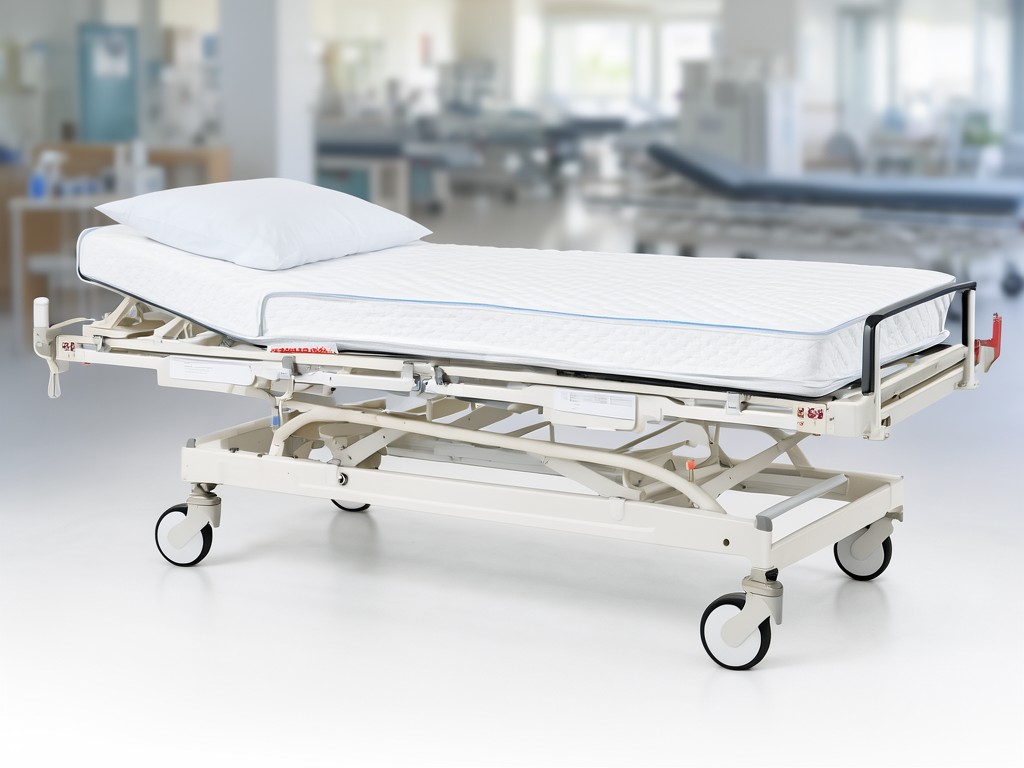
Matching the Product to the Buyer's Need
Procurement teams often compare two frame grades side by side. The decision hinges on whether the ward’s patient weight distribution justifies the extra steel and the associated freight cost.
Standard Frame (1.5 mm)
- Static load limit 250 kg, suitable for general wards.
- Weight 48 kg per bed, lower shipping volume.
- Powder coat 60 µm, passes 200 h salt spray.
Heavy‑Duty Frame (2.0 mm)
- Static load limit 300 kg, covers bariatric patients.
- Weight 51 kg per bed, modest freight increase.
- Powder coat 80 µm, passes 500 h salt spray.
If the buyer’s order mix includes more than 20 % bariatric admissions, the heavy‑duty frame reduces warranty replacements enough to offset the $18 per unit price gap within the first 18 months.
Stock Availability and Reorder Planning
Standard configurations (900 mm width, 150 mm mattress, single‑lock casters) are held in a regional warehouse at 200 units. Lead time for stock items is 7 days ex‑works. Custom widths or dual‑lock casters shift to a 30‑day production slot with a minimum batch of 30 units. Reorder point for importers should be set at 1.5 × monthly consumption to absorb the 30‑day cycle without stock‑out risk. The factory provides a rolling 12‑month forecast sheet on request; buyers who share their consumption pattern receive priority allocation during peak season.
Export Packaging and Handling Protection
Each bed ships in a reinforced corrugated crate (triple‑wall, 12 mm) with internal foam blocks that cradle the frame at four points. The mattress is vacuum‑sealed in a polyethylene sleeve and placed on a palletized foam tray. Casters are locked in the retracted position and secured with nylon straps. The crate carries a shock‑watch indicator calibrated to 30 g; any trigger voids the transit warranty. Pallets are ISPM‑15 heat‑treated and labelled with batch number, production date, and configuration code. Container loading plans maximise 24 beds per 40‑ft high‑cube container, leaving 150 mm clearance for forklift entry.
- Crate dimensions: 2,150 mm × 1,050 mm × 950 mm (L × W × H).
- Gross weight per crate: 62 kg (standard) or 65 kg (heavy‑duty).
- Desiccant packs (2 × 500 g) included for humidity control.
Care, Storage and Service Life
Frames should be inspected quarterly for powder‑coat chips; touch‑up with matching epoxy paint prevents corrosion spread. Actuator gears require lithium‑grease re‑application every 12 months or 25 000 cycles, whichever comes first. Mattress covers are wipe‑down with 0.5 % sodium hypochlorite; avoid phenolic cleaners that degrade polyurethane coating. Casters must be cleaned of debris and brake function tested monthly. Store spare actuators in a dry environment (≤ 60 % RH) to prevent seal hardening. Expected service life: frame 15 years, actuator 10 years, mattress core 7 years, casters 8 years under standard ward usage.
Ready to Validate Your Specification?
Submit your ward profile and volume forecast for a tooling review and a sample‑approval schedule.
Request Tooling Review