factory direct 3 function electric medical nursing beds exporter - Bulk Supply and Specification Guide
During a private-label launch with a fixed ship date, the procurement team discovered that motor duty‑cycle ratings on competing units were quoted at 10 % but failed after 3 000 cycles under continuous back‑rest articulation.
The root cause was a combination of undersized gearboxes and a powder‑coat that cracked after repeated exposure to chlorine‑based disinfectants, leading to premature corrosion of the frame‑to‑motor mounts.
Where Cheaper Alternatives Fall Short
Budget frames often use 1.2 mm cold‑rolled steel with a single‑pass epoxy coat; salt‑spray tests show red rust at 120 hours versus 500 hours for a double‑coat system.
- Motor torque drops 18 % after 2 000 cycles when the gear ratio is 1:30 instead of 1:45.
- Side‑rail latch pins made from untreated 304 stainless steel seize after 6 months of daily cleaning with quaternary ammonium compounds.
- Control‑panel membrane switches rated for 100 k actuations lose tactile feedback at 40 k in high‑humidity wards.
These failure modes translate directly into higher total cost of ownership because replacement labor and downtime outweigh the initial unit price difference.
What Actually Determines Performance
Three measurable parameters govern service life in a clinical environment: frame yield strength under 250 kg static load, motor continuous‑run torque at 24 V DC, and coating adhesion after 1 000 hours of ISO 9227 neutral salt spray.
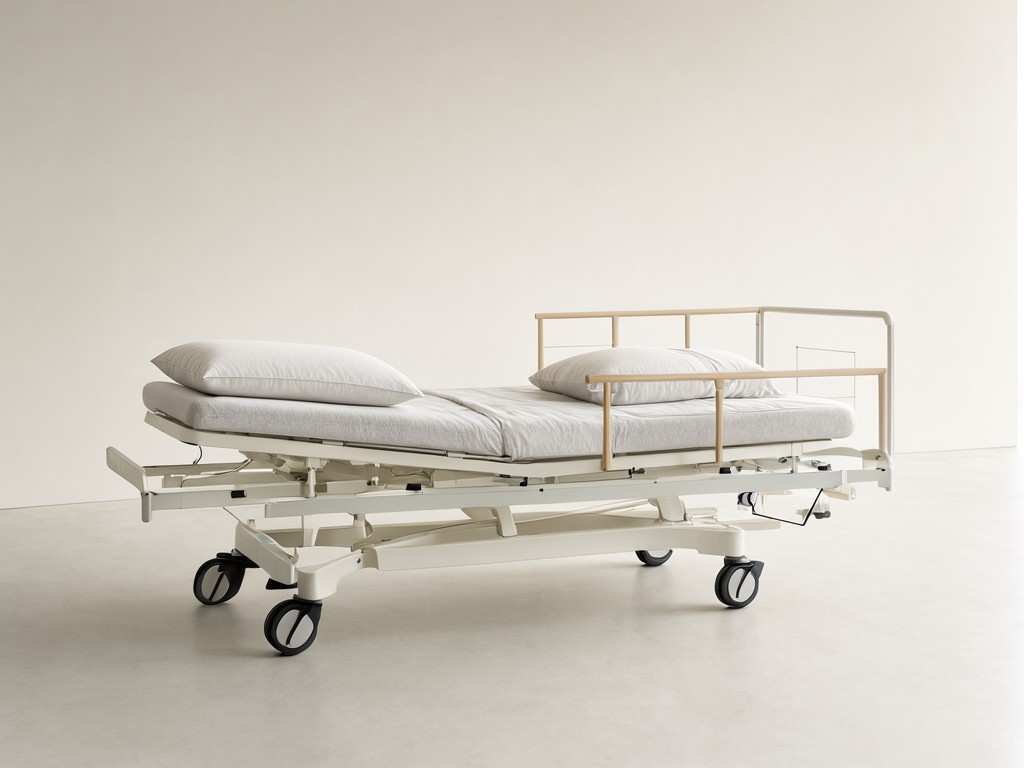
The 3‑function architecture (back‑rest, knee‑break, height) demands synchronized motion; a 1:45 planetary gearbox paired with a 120 W brushless DC motor delivers 45 Nm at 30 rpm, keeping temperature rise below 35 °C during a 30‑minute duty cycle.
Casters with double‑ball bearings and a 75 mm polyurethane tread maintain roll‑force under 15 N on vinyl flooring, reducing caregiver push effort by 22 % compared with 50 mm nylon wheels.
Where This Product Beats Standard Alternatives
Key durability spec: Frame tubing 1.5 mm Q235B, double‑coat epoxy‑polyester (80 µm + 40 µm) passes 500 h salt spray with no red rust.
Motor rated 150 k cycles at 25 % duty; gearbox hardened to 58 HRC eliminates torque fade.
Side rails use 316L stainless pins with a PTFE‑coated latch cam, surviving 10 000 latch cycles in accelerated wear rigs.
Control panel employs capacitive touch zones sealed to IPX6, tested to 200 k actuations with no loss of sensitivity after 72 h of 0.5 % sodium hypochlorite immersion.
How to Choose Before Requesting a Quote
Follow this decision tree to lock in the configuration that matches your ward workflow and budget ceiling.
- Define maximum patient weight – 180 kg standard, 250 kg bariatric option adds 12 kg frame mass.
- Select height‑adjustment range: 400‑800 mm (low‑step) or 350‑850 mm (full‑range) – the latter requires a 150 mm longer actuator stroke.
- Choose side‑rail style: split‑rail (two independent sections) for fall‑prevention protocols, or full‑length for ICU turnover speed.
- Specify control interface: handheld pendant (IPX6) or wall‑mounted panel (IPX4) – pendant adds 0.3 kg per bed.
- Confirm mattress platform: slatted steel (ventilated) or solid HPL (easy wipe) – HPL adds 4 kg but reduces cleaning time by 30 %.
Each branch changes the BOM cost by 3‑7 % and influences container loading density; the tree lets you model total landed cost before sample shipment.
OEM and ODM Programme Structure
Our OEM pathway starts with a 30‑day tooling approval window; you supply brand artwork, we provide a first‑article inspection report covering dimensional, electrical, and coating adhesion data.
ODM projects follow a co‑development gate model: concept freeze at week 4, prototype at week 8, validation at week 12, with a shared IP agreement that limits exclusivity to the contracted region.
| Option | Standard | Upgrade | Lead‑time Impact |
|---|---|---|---|
| Frame coating | Double epoxy‑polyester | Zinc‑rich primer + topcoat | +7 days |
| Motor | 120 W brushless | 180 W brushless | +5 days |
| Side rail | Split, 316L pins | Full‑length, PTFE cam | +3 days |
| Control | Pendant IPX6 | Wall panel IPX4 | +2 days |
All configurations ship in ISPM‑15 certified wooden crates, 2 beds per pallet, with batch‑level QR labels for traceability.
How Consistency Is Held Across Batches
Every production lot undergoes a three‑stage gate: incoming material verification (spectrometer for steel grade, coating thickness gauge), in‑process functional test (10 % of units run 500 cycles on a programmable load frame), and final audit (dimensional CMM, motor current draw, IPX6 spray).
Statistical process control charts track motor torque variance; a shift beyond ±3 % triggers a root‑cause review and potential line stop.
Coating adhesion is sampled per ASTM D3359; any batch below 4B results in a full re‑coat hold.
Records are retained for 5 years and linked to the container bill of lading, enabling downstream quality audits without factory revisit.
Next Steps – Sample Request
Validate the spec in your own ward environment before committing to volume. A single‑unit evaluation kit includes the bed, pendant, and a 30‑day data logger for motor current and temperature.