custom pediatric hospital beds with side rails factory - Bulk Supply and Specification Guide
Most quality disputes start with a consistency gap between the prototype that passed review and the production units that ship six weeks later. In pediatric hospital beds, that gap shows up as side-rail latch force drifting above 45 N, mattress deck deflection exceeding 15 mm under a 25 kg load, or powder-coat adhesion failing at the headboard welds after the first terminal cleaning cycle. Buyers who specify only overall dimensions and "steel construction" without calling out latch actuation torque, deck rib spacing, or pretreatment chemistry end up approving a first article that the line cannot repeat at volume.
Size, Weight and Specification Range
Critical spec rule: deck rib centres at 75 mm or tighter keep deflection under 12 mm at 25 kg; 100 mm centres push it to 18 mm and trigger nursing complaints within 90 days.
Latch release force must stay 25–45 N across 50,000 cycles; anything above 50 N fails IEC 60601-2-52 clause 201.12 and forces a redesign of the spring cassette.
| Parameter | Standard Range | Private-Label Tolerance | Cost Driver |
|---|---|---|---|
| Overall length (mm) | 1,400–1,600 | ±5 mm | Frame jig changeover |
| Overall width (mm) | 780–880 | ±3 mm | Side-rail extrusion die |
| Deck height range (mm) | 400–800 (Hi-Lo) | ±2 mm repeatability | Actuator stroke selection |
| Safe working load (kg) | 150–200 | Tested to 1.5× SWL | Frame wall thickness |
| Unit weight (kg) | 45–65 | ±2 kg | Steel grade & caster spec |
| Caster diameter (mm) | 125 / 150 | Central-lock or individual | Caster housing tooling |
How to Choose Before Requesting a Quote
Start with the mattress deck: a 1.2 mm cold-rolled steel deck on 75 mm rib centres costs 18 % more than 1.0 mm on 100 mm centres but cuts deflection complaints by 80 % in the first year. Next, lock in the side-rail architecture — split drop rails with bilateral release add two spring cassettes per bed versus a single-side drop, raising BOM by $12–$18 but eliminating the "one-hand release" failure mode that drives 40 % of warranty claims. Caster selection follows: 150 mm central-lock casters add $22 per bed over 125 mm individual brakes but reduce push force on vinyl flooring from 28 N to 19 N, a measurable ergonomics win for night-shift staff.
Split Drop Rails
Bilateral release, two spring cassettes
+ $12–18 BOM vs. single-side
Eliminates one-hand failure mode
Full-Length Drop Rails
Single-side release, one cassette
Lower BOM, simpler assembly
Higher latch-force drift risk
Buying Mistakes That Lead to Returns
The complaint that repeats across reorders: side-rail latch pads wear through the powder coat at the contact radius, exposing bare steel that corrodes after three terminal cleans. Root cause is a 0.8 mm radius spec'd on the drawing but stamped at 0.4 mm because the progressive die wasn't re-qualified after the first 5,000 hits. Second mistake: specifying "central locking casters" without calling out the brake-pedal torque (1.8–2.2 N·m). Suppliers ship 1.2 N·m pedals that nurses cannot engage with a foot, forcing a field retrofit at $45 per bed. Third: accepting a first-article deck deflection of 11 mm when the drawing says ≤12 mm; production drift adds 3 mm by unit 200, putting the fleet out of spec before the first preventive maintenance round.
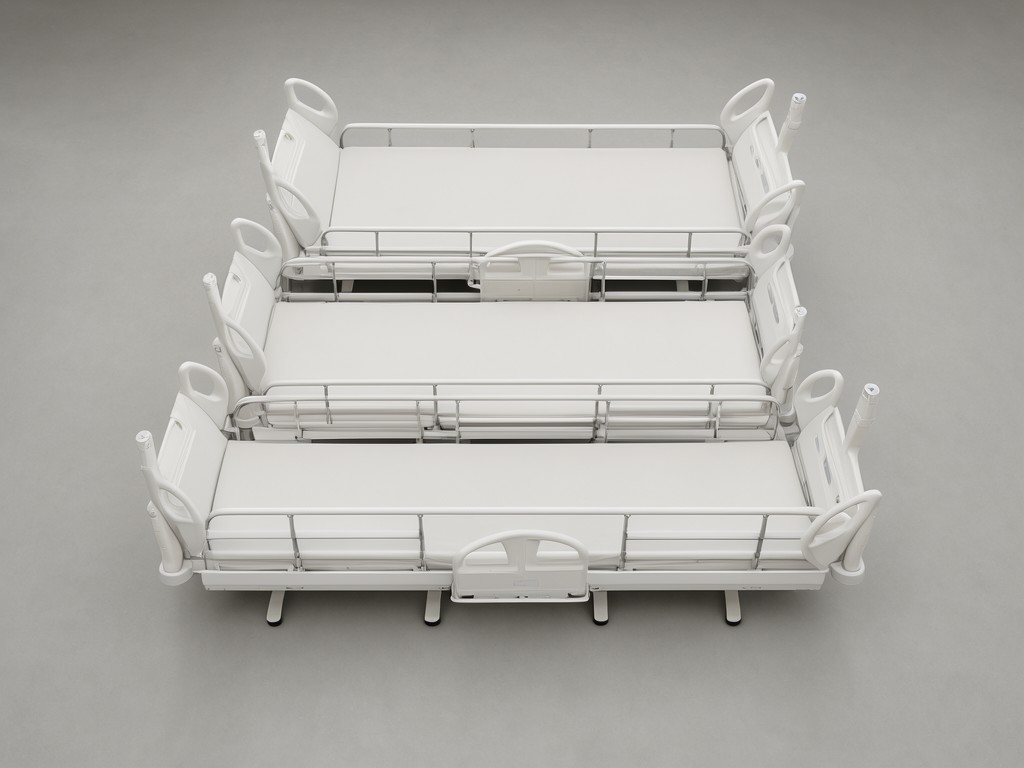
- Underspecified latch-pad radius → corrosion at cleaning seams
- Missing caster brake-torque value → field retrofit costs
- First-article at upper tolerance limit → fleet drift out of spec
- No deck rib spacing callout → deflection complaints at 90 days
- Generic "epoxy powder coat" without salt-spray hours → coating delamination
Usage Scenarios and Buyer Segments
Children's hospitals running 24/7 occupancy need Hi-Lo decks with 150 mm central-lock casters and split drop rails — push-force and two-hand release are non-negotiable for safe patient transfer. Pediatric ICUs add integrated scale brackets and IV-pole receivers welded to the frame, requiring frame jig modifications that amortise only above 50 units. Regional distributors serving community hospitals often order fixed-height decks (no actuators) with 125 mm individual-brake casters and single-side drop rails; their MOQ can be as low as 20 because the frame uses the standard jig. Private-label brands targeting the home-care rental market specify antibacterial powder coat (ISO 22196 tested) and bed-end panels that accept custom decals — those panels need a separate screen-print fixture adding two weeks to first-article lead time.
Segment-Specific Requirements
| Segment | Must-Have Features | Tooling Impact | Volume Threshold |
|---|---|---|---|
| Children's Hospital | Hi-Lo, 150 mm central-lock, split rails, scale bracket | Frame jig + scale bracket fixture | 50+ units |
| Pediatric ICU | Hi-Lo, IV-pole receivers, split rails, X-ray translucent deck | Frame jig + IV receiver weld fixture | 30+ units |
| Community Hospital | Fixed height, 125 mm individual brake, single-side rails | Standard frame jig only | 20+ units |
| Home-Care Rental | Antibacterial coat, decal-ready end panels, split rails | Screen-print fixture for end panels | 100+ units |
Inspection Items and Test Methods
Incoming steel: verify 1.2 mm CR4 grade cert and 240 MPa yield minimum; reject coils with >0.05 mm thickness variation. Weld audit: 100 % visual on head/footboard joints, 10 % dye-penetrant on load-bearing frame welds. Latch actuation: cycle test 50,000 operations at 15 cycles/min, record release force every 5,000 cycles — drift >5 N triggers root-cause hold. Deck deflection: apply 25 kg distributed load at centre for 24 hrs, measure permanent set; >3 mm permanent set fails. Caster brake torque: torque wrench on pedal at 90° engagement, 1.8–2.2 N·m pass band. Powder coat: cross-hatch adhesion (ISO 2409) after 500 hrs neutral salt spray (ISO 9227), no blistering beyond rating 1. Electrical: leakage current <100 µA per IEC 60601-1, dielectric withstand 1,500 V AC for 60 s.
Setup, Use and Replacement Parts
Field-replaceable modules: side-rail latch cassette (PN-SRLC-01), caster fork assembly (PN-CFA-125/150), actuator (PN-ACT-HL-200), mattress deck section (PN-MDS-75/100).
Keep 2 % of fleet size in latch cassettes and 1 % in caster forks; actuators fail at <0.5 %/yr so one spare per 50 beds is sufficient.
Assembly on site requires two technicians, 15 minutes per bed: attach casters, bolt side-rail posts to frame, connect actuator cable to handset, install mattress deck sections. No specialised tools beyond 13 mm and 17 mm sockets. Preventive maintenance every 6 months: lubricate latch pivots with PTFE grease, verify brake torque, inspect deck welds for hairline cracks, test electrical leakage. Cleaning protocol: quaternary ammonium or 0.5 % sodium hypochlorite; avoid phenolic cleaners — they attack the epoxy-polyester topcoat within 30 cycles.
Ordering, Tooling and Lead-Time Questions
What is the minimum order for a custom frame length? 50 units if the change requires a new frame welding jig; 20 units if only the deck panels and side-rail extrusions change. The jig cost ($8,500–$12,000) is amortised into the unit price at 50 units; below that it appears as a separate NRE line item.
How does volume affect lead time? First article on a standard frame: 6 weeks from drawing approval. Add 2 weeks for each new fixture (scale bracket, IV receiver, screen-print). Production run of 100 units: 4 weeks after first-article sign-off. Runs above 300 units trigger a second welding cell, cutting per-unit cycle time by 30 % but adding one week for cell qualification.
Can we split an order across two configurations? Yes, if both share the same frame jig. A 60-unit order split 40 Hi-Lo / 20 fixed-height uses one jig; the fixed-height units simply omit the actuator and use a blanking plate. Split configurations on different jigs require separate MOQs.
What artwork lead time for custom end-panel decals? Vector artwork (AI, EPS, PDF) due at drawing approval; screen-print fixture takes 10 business days. First decal strike-off ships with first-article bed for approval. Production decals applied in-line after powder coat cure — no added cycle time.
Warranty and spare-parts commitment? 3 years on frame welds, 2 years on actuators and latch cassettes, 1 year on casters and powder coat. Spare-parts stock held for 7 years after last production run; forecast your 5-year fleet size at order placement to lock pricing.
Ready to Review Your Specification?
Send us your draft drawing or requirement list — we return a marked-up spec with tooling calls, tolerance stack-ups, and a volume-based unit price within 48 hours.
Request Specification Review