Custom 7 Function Electric Hospital Beds With Mattress And Casters Factory: What Buyers Should Check Before Ordering
Specification Range and Customisation Limits
Consistency depends on the actuator stroke tolerance and the frame welding fixture repeatability. A 0.5 mm deviation in the backrest pivot shifts the Trendelenburg angle by 1.2°, which changes patient positioning and mattress pressure mapping.
Critical spec: the height‑adjustment column must maintain ±2 mm over the full 400 mm travel. Exceeding this range forces a redesign of the mattress retainer clips and adds a secondary inspection station.
Powder‑coated carbon steel frame – 2 mm wall, 250 kg static load, 30 000 cycle actuator rating. Lower tooling cost, shorter lead time for volumes under 200 units.
Stainless‑steel 304 frame – 2 mm wall, 250 kg static load, 30 000 cycle actuator rating. Higher corrosion resistance for humid wards, adds 12 % unit cost and 2 weeks tooling amortisation.
| Test Item | Standard / Protocol | Acceptance Criteria |
|---|---|---|
| Static Load Test | IEC 60601‑2‑52 | 250 kg held 5 min, no permanent deformation |
| Dynamic Cycle Life | Internal protocol (actuator 30 000 cycles) | No loss of stroke >1 mm, no abnormal noise |
| IP Rating | IEC 60529 | IPX4 splash protection on control box |
| Mattress Compression Set | ASTM D3574 | ≤5 % after 22 h at 70 °C |
| Caster Lock Torque | EN 12530 | 1.2 Nm minimum holding torque |
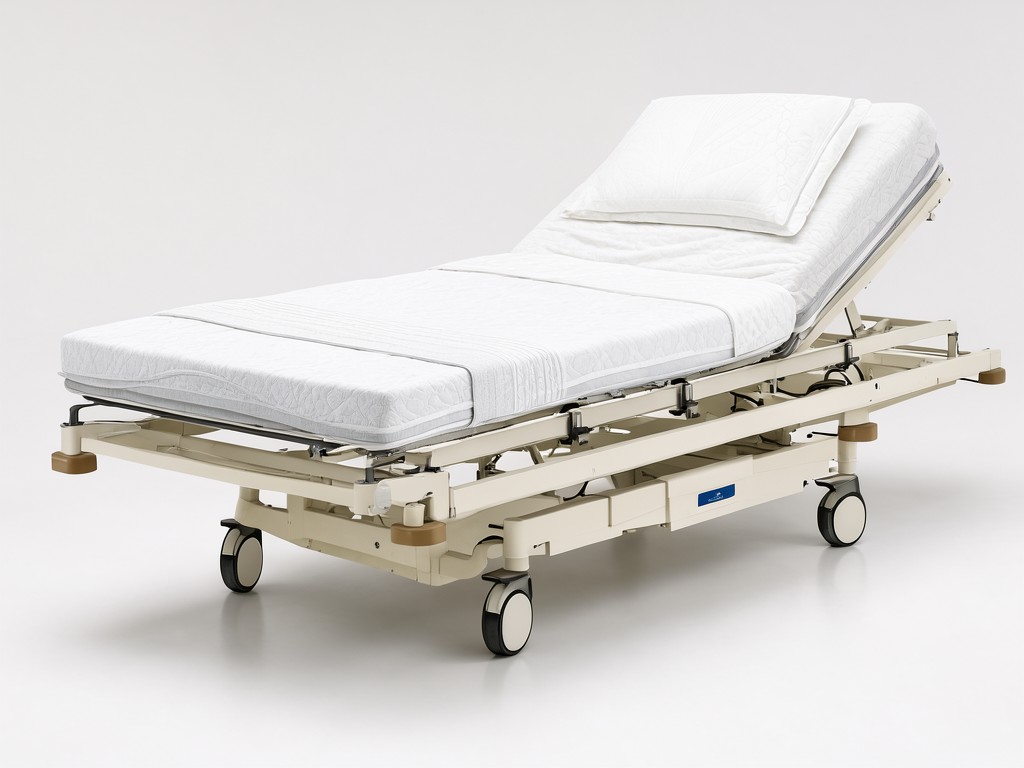
What Can Be Customised and What Cannot
Deflection under load governs the choice of actuator count and mattress core. Each additional actuator pair adds two functions (e.g., lateral tilt, cardiac chair) but increases the control‑box wiring harness length and the required cable‑track clearance.
- Select actuator configuration – 2, 4, or 6 actuators (each pair adds two functions; 6‑actuator version enables full lateral tilt and cardiac chair).
- Choose mattress core – high‑resilience foam (≤120 kg/m³), alternating‑pressure air cells, or hybrid foam/air (affects weight by ±8 kg and pressure‑redistribution profile).
- Define caster specification – central‑lock 125 mm, individual‑lock 100 mm, or antistatic 125 mm (impacts maneuverability, cleaning clearance, and floor‑type compatibility).
- Confirm side‑rail integration – fixed, fold‑down, or removable (changes frame welding jig and powder‑coat masking steps).
Foam core – 150 mm thick, 45 kg/m³ density, 5 yr compression‑set warranty. Best for general wards, lower cost, lighter for frequent repositioning.
Alternating‑pressure air – 8‑cell cycle, 12 min period, 30 kg/m³ base foam. Required for high‑risk pressure‑injury patients, adds 12 kg and a dedicated pump module.
Usage Scenarios and Buyer Segments
Balance and load analysis shows that acute‑care hospitals prioritise rapid height adjustment and central‑lock casters for emergency transfers, while long‑term care facilities value low‑noise actuators and antimicrobial mattress covers for extended occupancy.
- Emergency departments – 7‑function beds with cardiac chair and Trendelenburg, central‑lock 125 mm casters, IPX4 control box.
- ICU step‑down units – 6‑actuator configuration, alternating‑pressure mattress, removable side rails for procedural access.
- Rehabilitation centres – 4‑actuator beds, lateral tilt, foam core, fold‑down rails, antistatic casters for therapy gym floors.
- Home‑care distributors – 2‑actuator basic profile, foam mattress, individual‑lock casters, compact packaging for last‑mile delivery.
Requirements by Buyer Segment
Distributors need batch traceability labels and a 30‑day warranty claim window. Private‑label buyers require custom colour‑matched powder coat and branded mattress ticking. Procurement officers demand a documented first‑article inspection report and a spare‑parts list priced per unit.
- Distributor – barcode label on each bed, master carton label with PO number, 30‑day claim window.
- Private‑label – Pantone‑matched frame colour, logo‑embossed mattress cover, custom user‑manual language pack.
- Procurement – FAIR (First Article Inspection Report) per IEC 60601‑1, spare‑actuator kit (2 pcs) and caster set (4 pcs) priced ex‑works.
Working as a Production Partner, Not a Catalogue Supplier
Tooling amortisation shifts with order volume: a 50‑unit run absorbs the frame welding fixture cost over 50 beds, while a 500‑unit run spreads it across ten times the volume, reducing per‑unit overhead by roughly 18 %. We align the production schedule to your launch date, run a pre‑production sample at your facility, and lock the BOM once the sample passes the FAIR. Changes after lock‑in incur a change‑order fee and a two‑week lead‑time extension.
Export Packaging and Handling Protection
Each bed ships in a reinforced corrugated crate (ECT‑48) with internal foam corners protecting the actuator rods and control box. Casters are locked in the retracted position and wrapped in VCI film to prevent corrosion during sea freight. Mattress is vacuum‑compressed, sealed in PE bag, and placed on a palletised layer to avoid deformation. Gross weight per crate averages 85 kg; stackability limited to two high to protect the mattress seal.
Setup, Use and Replacement Parts
On‑site assembly requires two technicians, a 13 mm socket for the frame bolts, and a torque wrench set to 12 Nm for the caster stems. Actuator replacement is tool‑less: release the quick‑connect cable, slide the actuator out of the mounting bracket, and insert the spare. Mattress cover zippers are rated for 50 cycles; replacement covers ship flat‑packed with a barcode for inventory tracking. Preventive maintenance schedule: inspect actuator stroke and caster lock torque every 6 months, clean control‑box vents quarterly.
Ready to align a custom 7‑function bed program with your launch timeline? Start a project discussion and we’ll share the first‑article inspection template and a volume‑based cost model.