Specifying China fully electric hospital beds for sale for Wholesale and OEM Orders
Material choice starts with the conditions the product will meet: a bed frame cycles through 40–60 height adjustments per day in a busy ward, endures lateral loads from patient egress, and withstands chemical disinfection three times per shift. Steel grade, wall thickness, and surface treatment are not interchangeable line items — they determine whether the frame yields at 18 months or holds tolerance at 60.
Construction options diverge as soon as weight matters. A 5-function ICU bed with integrated scale and X-ray cassette tunnel pushes 145 kg before mattress; a 3-function general ward unit sits near 95 kg. That 50 kg gap changes caster spec, motor torque, packaging cube, and freight class. The buyer who ignores it pays twice — once in container utilization, again in floor-loading complaints from the receiving dock.
Scope of Supply and Physical Form
A standard export configuration ships as a knocked-down kit: frame assembly, four motor units, control box, handset, siderail pair, and caster set. Mattress, IV pole, and drainage hooks are separate line items unless the purchase order specifies a turnkey bundle. Frame dimensions follow IEC 60601-2-52 envelope — 2150 mm × 980 mm overall, mattress platform 1980 mm × 900 mm — but deck segmentation varies by function count.
| Parameter | 3-Function Ward | 5-Function ICU | 5-Function Bariatric |
|---|---|---|---|
| Backrest angle | 0–75° | 0–80° | 0–80° |
| Knee-break angle | 0–40° | 0–45° | 0–45° |
| Height range | 400–720 mm | 380–820 mm | 420–800 mm |
| Trendelenburg | — | 12° / 12° | 10° / 10° |
| Safe working load | 170 kg | 200 kg | 300 kg |
| Frame weight (approx.) | 95 kg | 135 kg | 165 kg |
| Caster diameter | 125 mm | 150 mm | 150 mm reinforced |
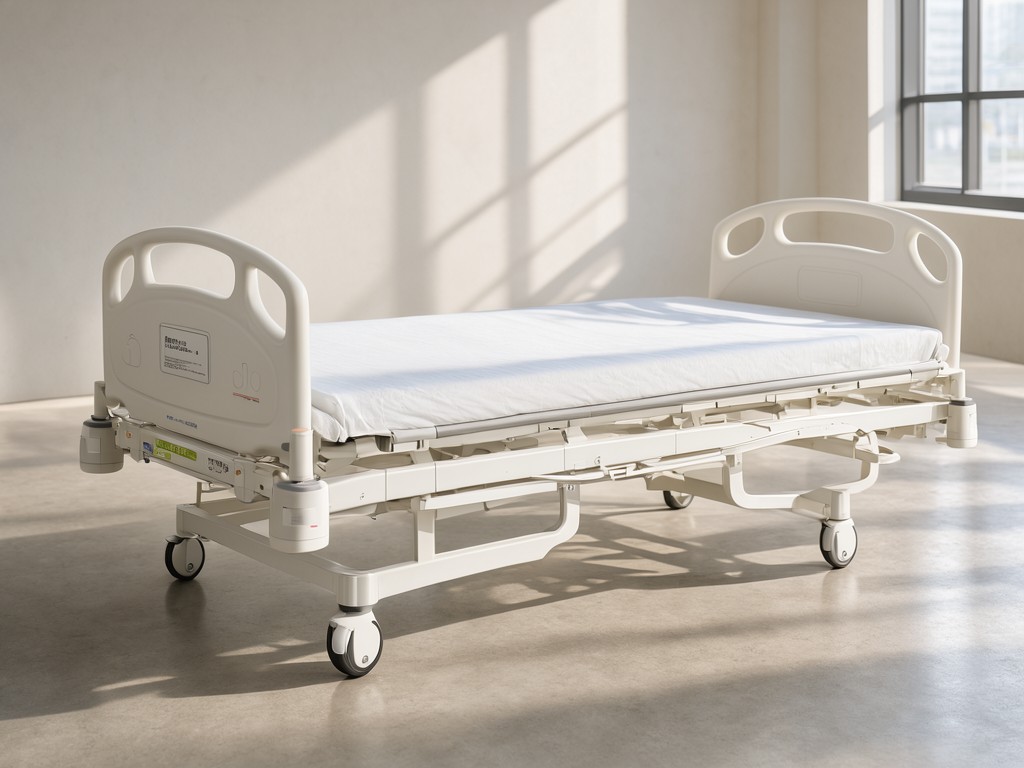
Design Constraints Behind the Specification
Critical Specification Rule
Motor duty cycle is rated at 10% (2 min on / 18 min off) per IEC 60601-1. Continuous operation beyond this — common in bariatric repositioning — triggers thermal cutout. Specify dual-motor lift columns with 6000 N thrust each for bariatric; 4000 N suffices for standard ICU. Undersizing saves $18–22 per unit but generates warranty claims within 90 days at high-occupancy facilities.
Side rail latch mechanism is the single highest failure point in post-market data. Injection-molded ABS latches fracture at the stress concentrator where the return spring anchors. Aluminum die-cast latches with radiused roots add $3.50 per rail but eliminate the failure mode. The trade-off appears in the 18-month reorder rate: facilities that specified aluminum reorder 3.2× less frequently for rail hardware.
How It Is Built and What That Changes
Frame welding uses robotic MIG cells with 1.2 mm ER70S-6 wire on 1.5–2.0 mm Q235B tube. Heat input is locked at 1.1 kJ/mm to prevent grain growth in the heat-affected zone — excess heat input reduces fatigue life at the head-end lift bracket by 40%. Post-weld shot peening (Almen intensity 0.12–0.18 mmA) is standard on ICU and bariatric frames; ward frames receive it only when the PO specifies "extended service" configuration.
Powder coat line runs epoxy-polyester hybrid at 80–100 μm DFT. Salt spray resistance passes 500 h neutral per ASTM B117, but chlorine-based disinfectants attack the coating at scratch sites. An optional zirconium conversion layer under the powder adds 200 h salt spray and doubles resistance to sodium hypochlorite — cost impact is $4.20 per frame. Buyers serving long-term care facilities with aggressive cleaning protocols should specify it; acute care with quaternary ammonium cleaners see no benefit.
Option Comparison by Usage Level
General Ward — Cost-Optimized
- 3-function: backrest, knee-break, height
- Single-motor lift columns, 4000 N
- ABS side rails, central-lock 125 mm casters
- Standard epoxy-polyester powder coat
- Handset only; nurse control optional
- Tooling amortised at 500 units — unit cost drops 14% at 1,000
ICU / High-Acuity — Serviceability-First
- 5-function: adds Trendelenburg, reverse Trendelenburg
- Dual-motor lift, 6000 N each, quick-release motor mounts
- Aluminum siderails, 150 mm casters with directional lock
- Zirconium conversion coat standard
- Nurse control panel, foot control, bed-exit alarm integration
- Modular deck sections — replace mattress platform without frame removal
What Can Be Customised and What Cannot
Customisable: siderail length (full, half, three-quarter), caster brand and brake topology, handset button layout and cable length, control box firmware (language, lockout functions), powder coat colour from RAL palette, mattress platform deck material (HPL, perforated steel, X-ray translucent composite), battery backup capacity (1.2 Ah to 7 Ah).
Fixed: overall envelope dimensions (IEC 60601-2-52 compliance), motor mounting pattern (standardised across suppliers for service parts), lift column stroke length (tied to height range certification), control box safety architecture (dual-channel monitoring, IEC 60601-1 third edition). Changing these requires full re-certification — 14–18 weeks and $45k–65k in test lab fees. The tooling for frame jigs is single-cavity per size; a 20 mm width change means new fixture, new weld program, new first-article inspection.
Questions Buyers Ask Before Ordering
What motor brand comes standard, and can we specify Linak? Default is TiMOTION TA23 series — 4000 N or 6000 N depending on configuration. Linak LA40 is a drop-in mechanical replacement but requires control box reprogramming; add $28 per motor and 10 days lead time for firmware validation. Linak LA27 (compact) fits ward beds only; it lacks the stroke for ICU height range.
How is the integrated scale calibrated, and does it hold certification after shipping? Load cells are calibrated at final assembly with NIST-traceable weights. The calibration survives transport if the bed ships upright on its casters with deck locked flat. Horizontal stacking in a 40HQ container shifts zero by 0.8–1.2 kg — requires field recalibration. Specify "upright-only" container loading if scale accuracy is contractual; it reduces container yield by 18%.
What is the realistic lead time for a 200-unit mixed order? Frame fabrication runs in 50-unit batches on the robotic cell. Powder coat line runs colour changes in 4-hour windows. Motor and control box sub-assemblies are stocked at 30-day coverage. A 200-unit order (120 ward, 50 ICU, 30 bariatric) ships in 38–42 days from PO confirmation if all colours are standard RAL 9016/7035. Custom colour adds 7 days for powder qualification panels.
Can we order spare motor modules and control boxes separately for regional service stock? Yes. Service kits are packed 10 per carton with anti-static bags and desiccant. Minimum order 20 units per SKU. Shelf life on control box electrolytic capacitors is 5 years at 25°C; rotate stock annually. We provide serialised BOM mapping so your service team matches firmware revision to hardware revision — prevents the "version mismatch" fault code that accounts for 22% of field service calls.
Ready to Review Specifications?
Send us your ward layout, patient acuity profile, and target unit cost. We return a marked-up spec sheet with motor sizing, coating option, and container loading plan within 48 hours.
Request specification review