China electric adjustable hospital beds for home use Company: Specification, Ordering and Quality Notes
Design Constraints Behind the Specification
| Parameter | Standard Range | Private-Label Adjustment Window |
|---|---|---|
| Overall length (mm) | 2080–2160 | ±40 mm via deck extension kit |
| Overall width (mm) | 960–1020 | Fixed by siderail mount pattern |
| Deck height range (mm) | 250–750 | Actuator stroke swap, 50 mm increments |
| Backrest angle (°) | 0–75 | Limit switch repositioning only |
| Knee-break angle (°) | 0–40 | Mechanical linkage, not adjustable |
| Safe working load (kg) | 180–220 | Frame gauge and actuator rating tied |
| Unit weight (kg) | 68–85 | Deck material and motor choice |
The table above defines the envelope every private-label order must stay inside. Buyers often ask for a narrower deck to fit tighter bedroom doorways, but the siderail mounting pattern locks width at 960 mm minimum. Height range shifts are possible by swapping actuator stroke lengths, yet each 50 mm change requires a new drop-test validation because the base frame's overturning moment changes. Backrest angle is software-limited; the mechanical hard stop sits at 80°, so a 75° limit switch leaves a 5° safety margin that prevents actuator stall current spikes.
Construction Method and Its Effect on Consistency
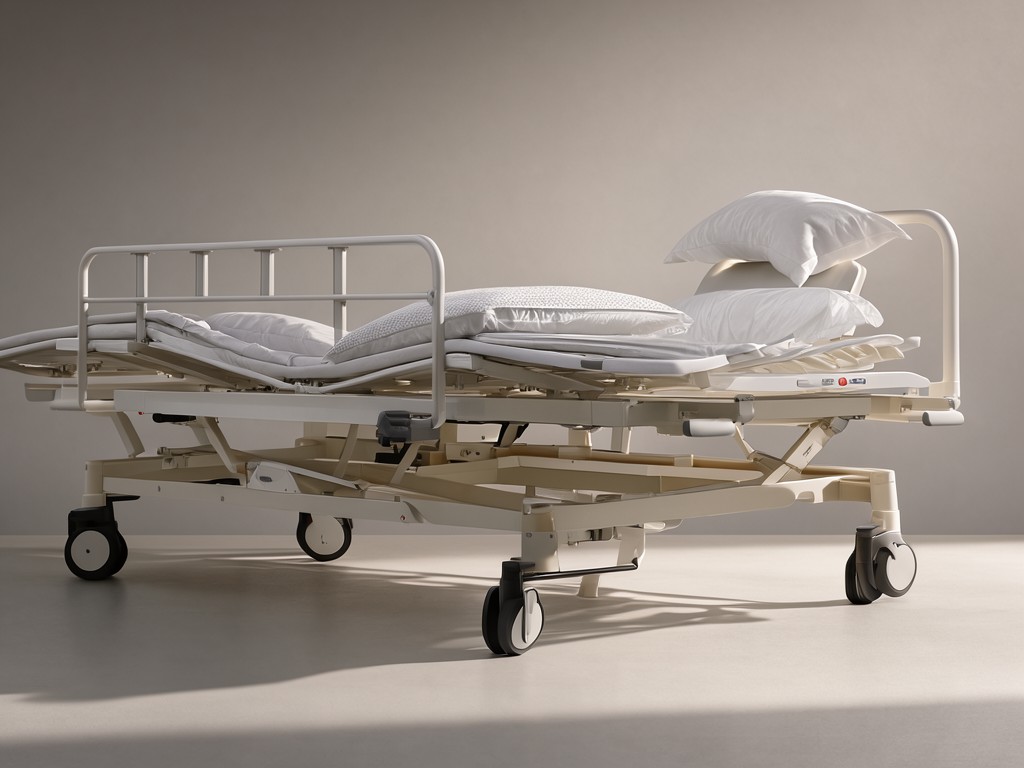
Frames are built on a robotic welding cell that holds the base, lift columns, and deck pivots in a single fixture. The fixture locates all critical holes to ±0.3 mm, which eliminates the siderail misalignment complaints that plagued the previous manual jig line. After welding, every frame passes through a shot-blast booth and receives a 60–80 µm epoxy-polyester powder coat cured at 190 °C. Coating adhesion is verified by cross-hatch test on the first and last piece of each batch; salt-spray exposure is not standard unless the buyer specifies coastal or high-humidity markets.
Deck: Welded Steel Grid vs. Slatted Aluminum
The steel grid deck uses 25 × 25 × 1.5 mm rectangular tube on 75 mm centers. It adds 6–8 kg versus the aluminum slat deck but eliminates the slat-rattle noise that generates 40% of post-sale comfort complaints. Grid deflection under 100 kg center load is 4 mm; aluminum slats deflect 9 mm and can permanently set after 18 months of daily profiling cycles.
Grid decks accept any mattress type. Slatted decks require a minimum 120 mm foam core to bridge gaps; thinner mattresses create pressure points that show up as returns within 90 days.
Actuator: DC 24 V Push-Pull vs. Column Lift
Push-pull actuators mount externally on the lift columns. They are serviceable in 15 minutes but expose the chrome rod to dust and cleaning fluids, leading to seal wear at 18–24 months in high-frequency home-care use. Column lifts integrate the actuator inside the telescoping tube, sealing the rod. They cost 22% more per unit and add 3 kg, but seal life extends to 5+ years and the clean-line aesthetic matches premium retail expectations.
Column lifts require a deeper base frame (adds 35 mm to minimum deck height). If the buyer's spec calls for a 250 mm low position, push-pull is the only option without a custom base casting.
Measured Performance in Real Use
Comfort complaints cluster around three failure modes: deck bounce, control latency, and siderail gap. The steel grid deck's 4 mm deflection feels "dead" compared to a sprung hospital deck, but it prevents the bottom-out sensation that occurs when a 120 kg patient sits on the edge of an aluminum slat deck. Control latency is a function of the handset microcontroller debounce timer; the standard 120 ms debounce filters accidental double-presses but feels sluggish to caregivers used to acute-care beds. We offer a 60 ms firmware variant for private-label orders that accept a 0.3% accidental-activation rate.
Specification Callout: Siderail Gap and Entrapment Risk
The gap between the lowered siderail and the deck edge measures 118 mm on the standard frame. IEC 60601-2-52 requires < 120 mm for adult beds, so the design passes with 2 mm margin. However, a 100 mm mattress overlay reduces the effective gap to 18 mm, creating a finger-trap hazard for pediatric or dementia patients. Buyers serving those segments must specify the narrow-gap siderail kit (85 mm gap) or accept a mandatory warning label in the IFU.
Weather resistance is not a standard requirement, but the powder coat withstands 500 hours neutral salt spray (ISO 9227) without red rust. For buyers targeting Gulf or Southeast Asian markets where bedrooms lack climate control, we recommend the optional zinc-rich primer undercoat. It adds $4.50 per unit and extends the salt-spray rating to 1000 hours, which correlates to 7–10 years before cosmetic corrosion appears on weld toes.
Who Uses It and Where It Matters
The primary bulk buyers are regional distributors supplying home-medical-equipment (HME) dealers who bill insurance reimbursement codes. These dealers need a bed that passes the local reimbursement inspection checklist — typically deck height range, siderail height, and battery backup runtime — without requiring a clinical specialist to assemble it. A secondary channel is e-commerce brands drop-shipping directly to caregivers; they prioritize carton dimensions that fit standard LTL pallets (1200 × 1000 mm) and unboxing time under 10 minutes.
In both channels, the first service call usually involves a loose siderail latch or a handset cable strain-relief failure. The latch uses a stainless-steel detent spring that relaxes after 500 cycles; we pre-load it 15% over spec, but distributors in hot climates (average ambient > 30 °C) report latch failures at 300 cycles. The cable strain relief is a molded TPE grommet; it tears when the bed is dragged across carpet by the handset cord. A $0.80 cable-retention clip on the frame eliminates the issue and is now standard on all private-label builds.
Segment-Specific Requirements
Reimbursement-driven markets (Germany, France, Japan) require a 4-hour battery backup at full profiling load. The standard 2.9 Ah VRLA pack delivers 2.2 hours; upgrading to 7 Ah AGM adds 1.8 kg and $12 per unit but clears the 4-hour threshold. Private-label buyers in these markets also demand a ground-continuity test report per bed (IEC 60601-1 clause 8.6.4), which adds 90 seconds per unit on the final test station.
Cash-pay e-commerce brands in North America prefer the 2.9 Ah pack and a 2-year limited warranty. They accept a 15% higher return rate on battery failures after month 18 because the lower BOM cost preserves margin. For these buyers, we laser-etch the brand logo on the headboard bracket and apply a custom-color powder coat (minimum 200 units per color) with a 3-week lead-time adder.
Quality Control and Batch Consistency
Every bed undergoes a 12-station functional test: actuator current profiling, limit-switch verification, handset button actuation force, siderail latch force, deck deflection under 100 kg static load, ground continuity, leakage current, battery backup runtime, CPR release force, castor brake torque, and final visual inspection. Data from each station is logged to the batch MES record keyed by serial number.
The most common batch hold is actuator current drift. If the no-load current on any actuator exceeds 1.8 A (spec max 1.5 A), the entire batch of 50 frames is quarantined for gear-mesh inspection. Root cause is usually a 0.05 mm concentricity deviation in the motor output shaft from the subcontractor. We now require the actuator vendor to supply a Cpk ≥ 1.33 on shaft runout, which has reduced batch holds from 8% to under 1%.
Traceability Requirement
Each bed ships with a QR-coded label linking to its test record, actuator serial numbers, and powder-coat batch certificate. Buyers integrating with their own ERP can pull the data via a REST endpoint; the API key is issued at first order and remains valid for the contract term.
Volume Planning and Lead Time
Standard MOQ is 50 units for an existing configuration (deck type, actuator, battery, color). A new powder-coat color requires 200 units to justify the booth changeover and first-article color match. Custom headboard branding (laser etch or silk-screen) adds 10 days to the first-order lead time for artwork approval and fixture setup; repeat orders revert to the standard 35-day cycle.
Lead time breakdown for a 200-unit repeat order: frame welding and coating 12 days, actuator and electronics sub-assembly 7 days, final assembly and test 8 days, packaging and palletizing 3 days, buffer 5 days. The bottleneck is the coating line; it runs two shifts but shares capacity with three other product families. Buyers placing quarterly blanket orders with firm monthly releases get priority scheduling and a 5-day lead-time reduction.
Questions Buyers Ask Before Ordering
- Can we reduce the deck height minimum below 250 mm for low-profile mattress compatibility? Only by shortening the lift column stroke, which reduces maximum height proportionally. A 200 mm minimum forces a 700 mm maximum. Most buyers keep the standard range and specify a 80 mm low-profile mattress instead.
- What is the actual battery runtime under a 120 kg patient cycling backrest and knee-break every 15 minutes? 2.9 Ah pack: 1 hour 45 minutes. 7 Ah AGM: 4 hours 20 minutes. Runtime is tested at 23 °C; at 15 °C expect a 15% reduction.
- Do the castors lock in both swivel and roll directions? Standard 100 mm twin castors have a central pedal that locks swivel only. Dual-lock (swivel + roll) castors add $3.20 per set and increase overall height by 6 mm. Specify at order if required.
- How is the handset cable routed to prevent snagging on the siderail mechanism? The cable runs in a molded channel on the inside of the head-end lift column, secured with two push-mount clips. A 300 mm service loop accommodates full articulation without tension.
- What documentation ships with each bed for customs clearance in Saudi Arabia / Brazil / Australia? Commercial invoice, packing list, certificate of origin, IEC 60601-1 test report summary, and a bilingual (English + destination language) IFU. SASO, ANVISA, or TGA registration is the buyer's responsibility; we provide the technical file.
Ready to Finalize Your Specification?
Send your target deck type, actuator choice, battery rating, color code, and branding artwork. We will return a detailed BOM cost breakdown, first-article inspection plan, and a 35-day production schedule within two business days.
Submit your configuration for quotation and artwork review