china automatic electric patient hospital beds supplier: Specification, Ordering and Quality Notes
Tooling amortisation decides the real cost per bed when volumes exceed 200 units per quarter. A single stamping die for the frame side rail costs $12,000–$18,000 and spreads across the production run; below that threshold the per-unit overhead adds $40–$60 to the landed price. Buyers who negotiate a shared tooling arrangement with the factory can reduce that burden, but the trade-off is a longer first-article approval cycle.
Replacement rate, not unit price, drives total cost of ownership in high-turnover wards. An actuator that drifts 5 mm after 8,000 cycles forces a bed out of service for recalibration, costing the facility an estimated $350 per event in labor and lost bed-days. Specifying a motor with a 15,000-cycle rated life and a sealed IP66 enclosure cuts that failure mode by roughly 70%, even if the upfront price is 12% higher.
Specification Range and Customisation Limits
The standard platform covers three frame widths (900, 1000, 1050 mm) and two length configurations (2000, 2100 mm) to match regional mattress sizes. Height adjustment ranges from 400 mm to 800 mm, driven by dual 6000 N linear actuators on the hi-lo function and single 4000 N units for backrest and knee break. Control options include a 4-button handset, a 12-function nurse panel, and an optional Wi‑Fi module for central monitoring. All electrics comply with IEC 60601‑1 and IEC 60601‑2‑52; the factory runs 100% functional test at 110% of rated load before shipment.
| Finish Type | Colour Code | Chemical Resistance | Typical Lead Time (days) | MOQ (units) |
|---|---|---|---|---|
| Epoxy‑polyester powder coat (standard) | RAL 9016, 7035, 5015 | Quaternary ammonium, 0.5% chlorine, alcohol wipes | 15 | 50 |
| Anti‑microbial topcoat (add‑on) | RAL 9016 only | Phenolic resistance up to 1%, enhanced UV stability | 20 | 100 |
| Stainless steel 304 (brushed) – frame accents | Natural | Full chemical spectrum, no coating degradation | 30 | 200 |
Specification Callout: The powder-coat system uses a two‑coat epoxy‑polyester process (80–100 µm total) that passes 500‑hour salt spray per ASTM B117. If the facility uses chlorine‑based cleaners daily, specify the optional anti‑microbial topcoat; it adds 5 days to curing but reduces surface colonisation by 99% in ISO 22196 testing.
Comparing Two Standard Configurations
Two baseline builds cover 90% of tender requirements. The table below is replaced by a side‑by‑side block so buyers can match specs to ward type without scrolling.
Configuration A – Standard Ward
- Frame: 900 mm width, 2000 mm length, cold‑rolled steel 1.5 mm
- Actuators: 2×6000 N hi‑lo, 1×4000 N backrest, 1×4000 N knee break
- Control: 4‑button handset + nurse panel (wired)
- Mattress platform: ABS panels, 4‑section
- Safe working load: 135 kg
- Packaging: 12 units / 40‑ft HC, wooden crate
Configuration B – ICU/High‑Dependency
- Frame: 1050 mm width, 2100 mm length, steel 2.0 mm with reinforced corners
- Actuators: 2×8000 N hi‑lo, 1×6000 N backrest, 1×6000 N knee break, 1×3000 N Trendelenburg
- Control: 12‑function nurse panel, Wi‑Fi module, backup battery
- Mattress platform: X‑ray translucent grid, 5‑section
- Safe working load: 250 kg
- Packaging: 8 units / 40‑ft HC, reinforced crate with shock indicators
Buying Mistakes That Lead to Returns
The majority of post‑delivery disputes trace back to four avoidable specification gaps.
- Ordering a single voltage (110 V) for a 220 V market without confirming the transformer rating – the factory ships with a 110 V motor by default unless the PO explicitly states 220 V / 50 Hz.
- Skipping the mattress‑platform compatibility check – ABS panels flex differently under a 30 cm foam mattress versus a 15 cm hybrid; the result is premature panel cracking at the hinge line.
- Ignoring the handset cable routing – a 2.5 m coiled cable snags on IV poles and fails at the strain relief within 6 months; specify the 1.8 m straight cable with magnetic quick‑release for high‑traffic bays.
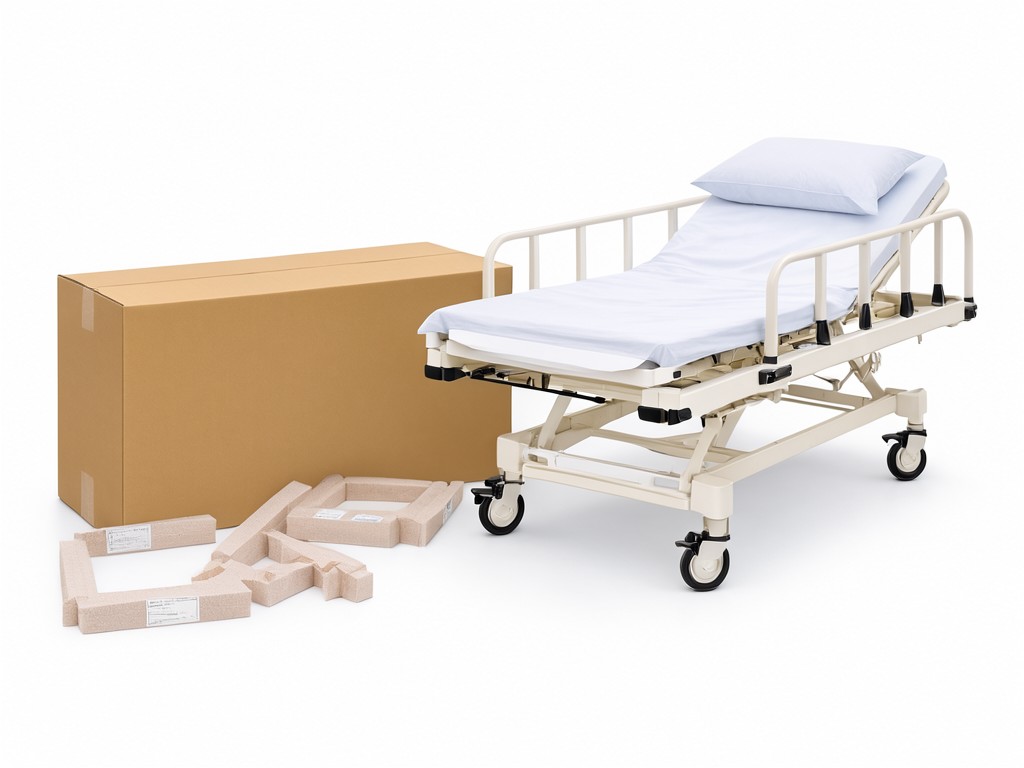
- Assuming the factory’s standard corrugated sleeve survives trans‑shipment – palletised wooden crates with corner protectors are mandatory for LCL loads; the cost delta is $18 per bed but eliminates freight damage claims.
Who Uses It and Where It Matters
Public‑health procurement agencies in Southeast Asia and the Middle East order 500–1,000 units per tender, requiring UDI‑compliant labelling and a 24‑month warranty on the frame. Private‑clinic chains in Europe prefer the 1050 mm width with integrated scale and nurse‑call interface; they reorder in batches of 50–100 and need 4‑week lead times. Distributors serving the Latin American private‑insurance segment stock the 900 mm model with a 110 V motor and a Spanish‑language handset; their turnover is 8–10 turns per year, so packaging density (12 beds per 40‑ft HC container) is a key spec.
Stock Availability and Reorder Planning
The factory holds safety stock of the three most common frame weldments (900/1000/1050 mm) and the two actuator families (6000 N and 4000 N). That covers 80% of repeat orders without additional tooling. For a new private‑label SKU, the first run requires 45 days for tooling validation and first‑article inspection; subsequent runs drop to 25 days if the BOM is frozen. Buyers should place blanket orders with quarterly releases to lock capacity; the factory allocates 30% of monthly output to blanket partners.
Care, Storage and Service Life
Daily cleaning with quaternary ammonium compounds (0.5% concentration) does not degrade the powder coat if rinsed within 10 minutes. Avoid phenolic cleaners – they attack the epoxy binder and cause chalking after 300 cycles. Store frames upright on padded racks; stacking more than two high risks permanent deformation of the mattress platform side rails. Actuator rods should be cycled once per month during long‑term storage to prevent seal set. Expected service life: frame 15 years, actuators 8–10 years, handset 5 years under 24/7 ward use.
| Component | Standard Grade | Upgrade Option | Service Life Delta | Cost Impact |
|---|---|---|---|---|
| Frame tubing | Cold‑rolled steel 1.5 mm, epoxy‑polyester coat | 2.0 mm with internal ribbing, zinc‑phosphate pretreatment | +3–5 years corrosion resistance | +$22/unit |
| Actuator motor | DC 24 V, 4000/6000 N, IP54, 10k cycles | DC 24 V, 6000/8000 N, IP66, 20k cycles | +5–7 years in high‑cycle wards | +$35/actuator |
| Mattress platform | ABS panels, 4‑section | Radiolucent carbon‑fiber grid, 5‑section | Eliminates panel cracking; +2 years | +$120/bed |
| Handset cable | PVC coiled 2.5 m, strain relief | TPU straight 1.8 m, magnetic quick‑release | Reduces cable fatigue failures by 85% | +$8/unit |
| Powder coat | Two‑coat epoxy‑polyester, 80–100 µm | Anti‑microbial topcoat + UV stabiliser | Maintains gloss >90% after 1000 clean cycles | +$15/bed |
Ordering, Tooling and Lead-Time Questions
What is the minimum order quantity for a custom colour?
100 units for a non‑standard RAL; 200 units if the colour requires a new powder batch. The factory can match a physical swatch within ±1.5 ΔE.
Can we supply our own actuators?
Yes, provided they meet the mounting interface (M12×1.75, 120 mm stroke) and carry IEC 60601‑1 certification. The factory will run incoming inspection (dimensional, current draw, noise) at no extra charge.
How is first‑article inspection documented?
A FAIR pack includes dimensional report (CMM), load test curves, actuator cycle logs (500 cycles), hi‑pot test records, and coating thickness maps. Digital copy delivered before mass production release.
What are the payment terms for a new private‑label account?
30% deposit with PO, 60% at final inspection, 10% net 30 after delivery. Letters of credit accepted for orders above $150,000.
How do you handle warranty claims after installation?
Frame defects: replacement part shipped within 10 working days, labour reimbursed at $45/hour up to 2 hours. Actuator or electronics: module swap via regional service partner (currently 12 countries covered). Claims require serial number, installation date, and photo evidence.
Ready to lock in specifications and lead times for your next tender?
Request a tooling review and sample schedule