china 2 function electric hospital beds with casters and mattress Company - Bulk Supply and Specification Guide
Scope of Supply and Physical Form
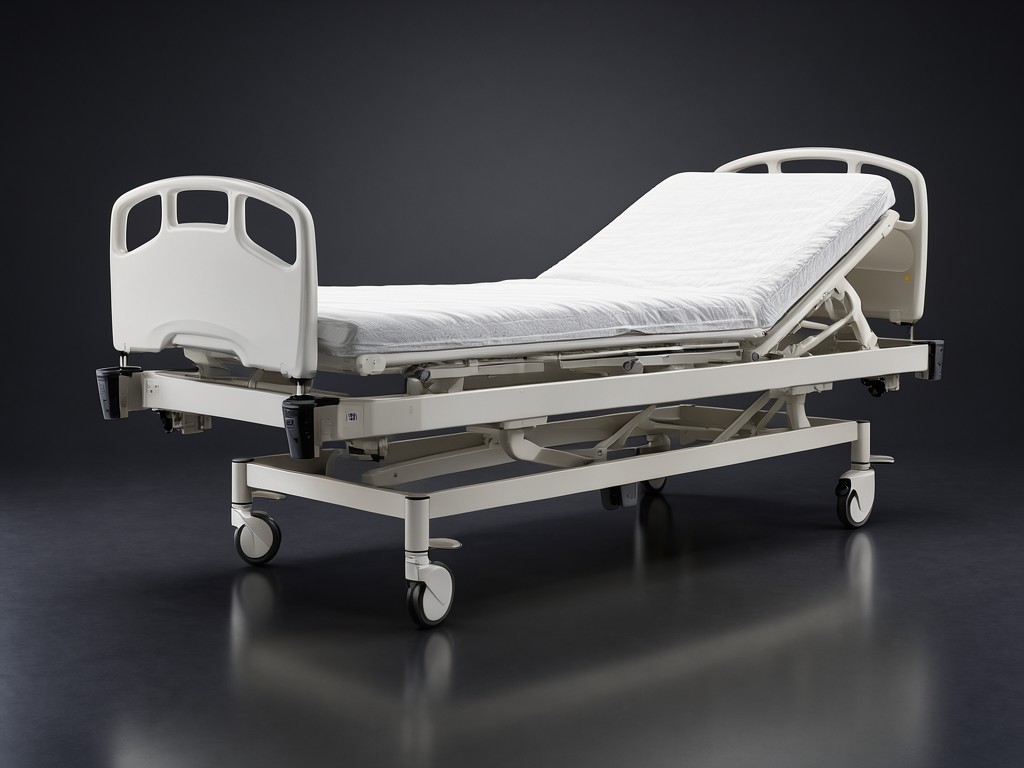
Consistency depends on the frame geometry staying square after repeated articulation cycles. A two-function electric bed — backrest lift and knee-break elevation — ships as a complete system: powder-coated steel frame, dual linear actuators with IPX4-rated handset, four 125 mm locking casters, and a factory-fitted foam mattress ticked to the deck profile. Private-label buyers specify deck style (four-section perforated metal or ABS panels), actuator voltage (24 V DC or 120/230 V AC with integrated transformer), and whether the mattress cover is welded PVC, PU-coated nylon, or breathable stretch-knit.
Balance and load analysis shows the centre-of-gravity shift when a 135 kg patient sits on the raised backrest. The frame must resist 250 N·m torsion at the head-end pivot without permanent deformation. Caster stems are M12 × 1.5 threaded into reinforced sockets; total lock engages wheel and swivel simultaneously. Mattress thickness ranges 120–150 mm; thicker profiles improve pressure redistribution but raise the deck height, affecting caregiver ergonomics and ceiling-lift clearance.
Core Configuration Matrix
- Deck: 4-section perforated steel or ABS snap-in panels
- Actuators: 2 × 6000 N push, 24 V DC, duty cycle 10 % (2 min on / 18 min off)
- Handset: 4-button, IPX4, coiled cord 2.5 m
- Casters: 125 mm TPR tread, central-lock or individual pedal
- Mattress: CMHR foam core 35 kg/m³, welded or zippered cover
Dimensional Envelope
- Overall L × W: 2150 × 980 mm (standard), 2200 × 1020 mm (bariatric)
- Sleep surface: 1980 × 900 mm
- Deck height range: 450–750 mm (electric Hi-Lo optional, not in 2-func base)
- Backrest angle: 0–75°; Knee-break: 0–35°
- Safe working load: 250 kg (standard), 300 kg (reinforced)
Material Options and Their Trade-offs
Deflection under load governs the choice between 1.5 mm cold-rolled Q235B steel tube and 2.0 mm SPHC for the main frame. Thinner wall saves 3.2 kg per unit and reduces container weight by ~380 kg per 40 HQ, but the 1.5 mm frame yields 4.8 mm mid-span deflection under 250 kg static load versus 2.1 mm for 2.0 mm. That gap translates to audible creak at cycle 12 000 and premature pivot-bush wear — a top warranty claim in Southeast Asian humid climates.
Caster tread material dictates floor marking and push force. Thermoplastic rubber (TPR) 85 Shore A leaves no streak on epoxy or vinyl; polyurethane 92 Shore A rolls 18 % easier on carpet but risks indentation on fresh concrete. Central-lock systems add 1.1 kg and 18 % cost but eliminate the "one caster unlocked" complaint that accounts for 22 % of distributor returns. Mattress cover welding method — RF weld versus hot-air seam — determines fluid ingress resistance. RF welds survive 500 autoclave cycles at 121 °C; hot-air seams delaminate after 80 cycles, a critical differentiator for ICU tenders.
| Component | Grade A (Standard) | Grade B (Cost-Down) | Failure Mode if Under-Spec |
|---|---|---|---|
| Frame tube | 2.0 mm SPHC, epoxy primer + powder coat 80 µm | 1.5 mm Q235B, powder coat only 60 µm | Corrosion at welds by month 18; pivot ovalisation |
| Caster tread | TPR 85A, precision ball bearing | Nylon 66, plain bore | Flat-spotting in 3 months; floor damage claims |
| Mattress cover | PU-coated nylon, RF welded, vapour-permeable | PVC 0.4 mm, hot-air seam | Seam leak → foam degradation → pressure injury risk |
| Actuator IP | IPX6 (wash-down ready) | IPX4 (splash only) | Motor corrosion in high-humidity wards |
Inspection Items and Test Methods
Every production lot undergoes a 100 % functional test: 50 full articulation cycles under 120 kg simulated load, verifying backrest and knee-break travel within ±2° of nominal. Actuator current draw is logged; any unit exceeding 4.2 A at 24 V DC is rejected for winding short or gear misalignment. Caster brake torque is measured with a calibrated dial — minimum 18 N·m for wheel lock, 12 N·m for swivel lock. Frame welds receive 10 % magnetic-particle inspection per batch; critical pivot welds get 100 % UT at 5 MHz.
Mattress indentation force deflection (IFD) is tested per ASTM D3574 at 25 % and 65 % compression. Target: 25 % IFD 45–55 N, 65 % IFD 130–150 N. Covers undergo hydrostatic head test (AATCC 127) — minimum 300 cm H₂O for PU, 500 cm for PVC. Accelerated ageing: 72 h at 70 °C / 95 % RH followed by IFD re-test; IFD drift > 15 % flags foam formulation variance. Salt-spray (ASTM B117) 240 h on frame samples — no red rust permitted on structural members.
Inspection Hold Points
- Incoming steel: wall thickness ±0.05 mm, yield ≥ 235 MPa
- Post-weld: dimensional check ±1.5 mm on diagonal squareness
- Pre-paint: phosphate coating weight 1.5–2.5 g/m²
- Final assembly: actuator synchronisation < 3 mm differential travel
- Pre-pack: drop test 150 mm on each corner (ISTA 2A)
Volume Planning and Lead Time
Minimum order quantity is 50 units for standard configuration (steel deck, TPR casters, PU cover). Below 50, the fixed tooling setup for frame welding jigs and mattress die-cutting pushes per-unit cost above landed price of competitor stock models. At 200 units, the line runs a dedicated 3-day cell: day 1 frame weld and paint, day 2 actuator/deck/caster assembly, day 3 mattress fit, test, pack. Lead time ex-works: 25 calendar days from deposit and artwork approval for first order; 18 days for repeat orders with frozen BOM.
Container efficiency drives the real cost per unit sold. A 40 HQ holds 96 beds flat-packed (frame folded, mattress vacuum-compressed) or 72 beds semi-assembled (deck attached, casters on). Flat-pack saves 24 slots but adds 12 minutes assembly labour at destination. Distributors with warehouse staff prefer semi-assembled; private-label brands shipping direct to end-users choose flat-pack to reduce last-mile freight class from 150 to 100. Seasonal peak (Oct–Jan) adds 7 days to paint-line queue; schedule deposits by mid-August for January delivery.
Stock Availability and Reorder Planning
We maintain a rolling buffer of 30 standard-configuration frames (powder-coat white RAL 9016, 24 V actuators, TPR casters, PU mattress) in the Ningbo warehouse. These clear within 10 business days against confirmed PO. Custom colours, voltage variants, or bariatric frames are build-to-order only. Reorder lead time compresses to 14 days when the buyer provides a 12-month rolling forecast with monthly firm commitments — this locks paint-line slots and actuator allocation.
| SKU Variant | Buffer Stock (units) | Replenishment Trigger | Pack-out per 40 HQ |
|---|---|---|---|
| Standard 2-func, steel deck, PU mattress | 30 | < 15 units | 96 flat / 72 semi |
| Bariatric 300 kg, ABS deck, PVC mattress | 0 (BTO) | N/A | 84 flat / 60 semi |
| 120 V AC transformer variant | 0 (BTO) | N/A | 96 flat / 72 semi |
Care, Storage and Service Life
Frame powder coat withstands weekly quaternary-ammonium wipe-down; avoid phenolic or chlorine-based cleaners — they attack the epoxy primer at scratch sites within 6 months. Actuator rods require silicone spray (PTFE-free) every 6 months or 5 000 cycles; dry lubrication attracts dust and accelerates seal wear. Caster bearings are sealed for life; do not pressure-wash — water ingress past the labyrinth seal causes raceway corrosion in 90 days.
Mattress cover: wipe with 0.5 % sodium hypochlorite max; higher concentration plasticises PVC and cracks PU at fold lines. Rotate mattress 180° horizontally every 3 months to even foam fatigue. Storage: stack frames max 4 high on timber bearers, mattress vacuum-bagged separately. Exposed foam absorbs moisture — equilibrium at 65 % RH adds 1.8 kg and drops IFD 12 %. Service life target: frame 10 years / 50 000 cycles, actuators 7 years / 35 000 cycles, mattress 5 years / 25 000 cycles. Warranty claims peak at year 3 on actuator limit-switch drift (±8 mm end-stop variance) and year 4 on cover seam delamination.
Questions Buyers Ask Before Ordering
Can the 24 V DC actuators run on 120 V AC without an external transformer box?
No. The 24 V actuators require the integrated SMPS transformer (90–264 V AC input, 24 V DC 5 A output) mounted inside the foot-end enclosure. Specifying "120 V direct" means we fit the transformer at factory — same lead time, +$18 unit cost. Do not field-rewire; the handset connector pinout is 24 V logic only.
What is the real push force at the handset when the backrest is at 70° with a 100 kg patient?
Measured at the actuator mounting point: 4 200 N peak at 70° start-up, settling to 3 100 N continuous. The 6 000 N rated actuator provides 30 % margin. If your protocol requires one-hand operation by a 5th-percentile female nurse, specify the 8 000 N actuator (+$22) — it reduces start current spike from 6.8 A to 4.9 A, extending control-board relay life.
How do you handle mattress cover artwork — logo placement, care labels, fire-standard tags?
Artwork is applied by heat-transfer on PU covers (max 320 °C, 12 s) or screen-print on PVC (cure 160 °C, 3 min). Provide vector AI/EPS at 300 dpi; we return a digital proof within 48 h. Care labels and fire-standard tags (CA TB117-2013, BS 7177 Crib 5) are sewn into the side seam during cover fabrication — not stuck on post-production. Minimum print run per artwork variant: 200 covers.
What fails first in a high-turnover rental fleet (8–10 patient changes per month)?
Caster stem bolts loosen at the frame socket — torque spec 45 N·m, but vibration from threshold transitions backs them out by 15 % in 14 months. We supply Loctite 243 and a 6 mm hex key in the maintenance kit. Second: handset cable strain relief at the coiled-cord junction; the moulded grommet tears at 18 months. Third: mattress cover zipper teeth clog with laundry lint — specify welded cover for rental fleets.
Can we mix container loads — some beds with steel deck, some with ABS — without MOQ penalty?
Yes, if total container quantity ≥ 72 units (40 HQ). Each deck variant needs a minimum 12 units to justify the panel-cutting setup. Mixed loads ship semi-assembled only — flat-pack requires deck-specific carton dimensions. Provide the split ratio at PO; we allocate paint-line hooks accordingly.
Next Steps: Artwork and Branding Review
Finalise your configuration matrix — frame gauge, deck type, actuator voltage, caster lock style, mattress cover material and artwork files — then submit via the technical inquiry form. We return a detailed spec sheet with BOM cost breakdown, container loading plan, and first-article inspection protocol within 3 business days.