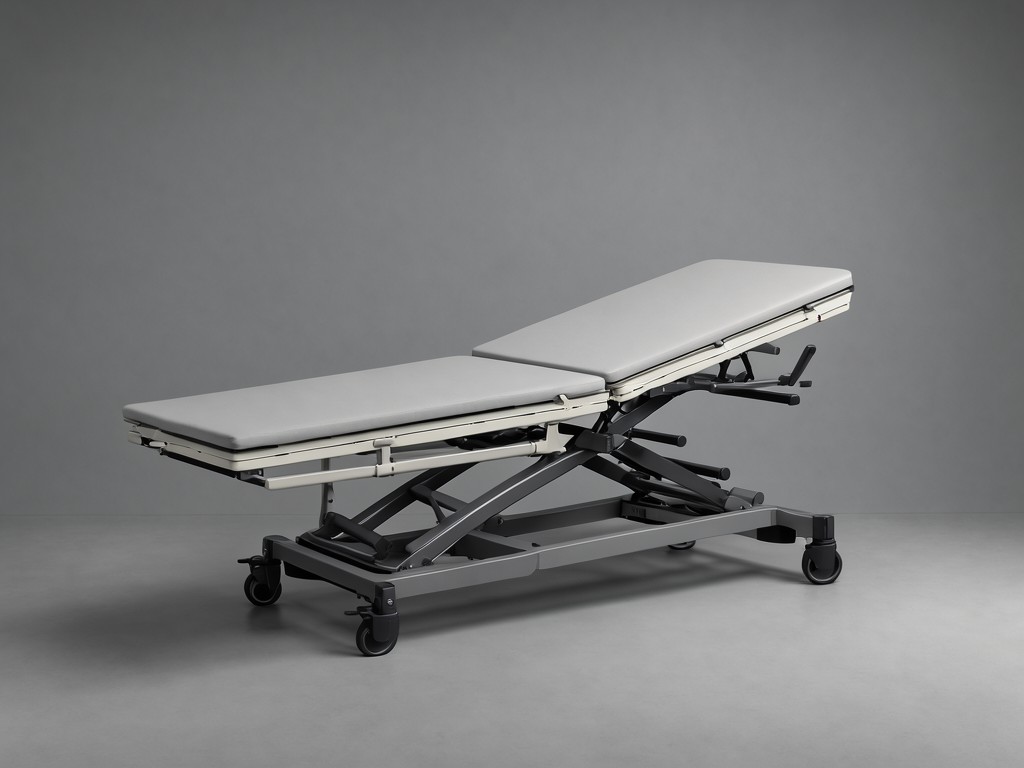
CE Certified electric tilt table standing beds for rehabilitation Factory: Specification, Ordering and Quality Notes
Before comparing quotations on electric tilt tables, confirm which parts of the CE marking actually apply to the frame, the actuator and the hand controller. Rehabilitation buyers often discover too late that a CE declaration covers the electrical assembly but not the weld integrity of the tilt mechanism. As a result, the frame sits outside the certification scope. Tilt tables for standing rehabilitation are judged on safe working load, tilt-cycle endurance and frame stiffness under off-centre patient weight, not on appearance alone.
Materials and Construction Trade-offs
Welded cold-rolled steel tube is the default frame material because it carries a static load rating without flexing under patient transfer. Increasing wall thickness from 1.5 mm to 2.0 mm adds roughly 4 kg to the frame mass but reduces torsional flex at the tilt pivot. A 230 V linear actuator with a 10 % duty cycle suits intermittent clinic use; continuous-duty motors cost more and are rarely necessary unless the table runs multiple patient sessions back to back.
Upholstery choice drives cleaning chemistry compatibility. Medical-grade vinyl resists alcohol and chlorine-based disinfectants but cracks after extended UV exposure. Polyurethane leather feels softer but degrades faster under daily wipe-down. High-density foam padding around 45-55 kg/m³ resists bottoming out under full patient weight, while lower-density foam compresses permanently within months.
CE scope warning
Electrical CE marking does not automatically extend to the structural frame. Ask for the declaration of conformity per component and verify whether the actuator, control box and handset are covered separately.
Assumptions Buyers Should Stop Making
Buyers frequently assume that a 150 kg safe working load implies a matching cycle life. Load rating is a static or near-static figure; cycle life depends on actuator duty rating, pivot bearing quality and how often the table reaches full tilt. A table rated for 150 kg may fail at the weld joint after 2,000 tilt cycles if the pivot plate is undersized.
Another common error is treating the hand controller as interchangeable. Wired pendants and wireless handsets use different receiver housings and plug pinouts, so swapping them after production voids the electrical conformity file. Buyers also assume tilt speed is adjustable; most rehabilitation actuators run at a fixed linear speed, and variable speed requires a different control board.
What Can Be Customised and What Cannot
Frame colour and tabletop width are usually open to negotiation; tilt geometry and actuator mounting points are not. Changing the pivot position alters the centre of gravity during tilt and requires new stability calculations, so factories treat it as a fixed engineering parameter. Before production, agree on drawings, sample units, tolerance bands and artwork placement; without an approved pre-production sample, reorders often arrive with dimensional drift. Request specification drawings
| Specification | Standard Build | Custom Option | Lead-Time Effect |
|---|---|---|---|
| Frame finish | Powder-coated grey | RAL colour match | +7-10 working days for sample approval |
| Tabletop width | 600 mm | 500-700 mm in 50 mm steps | New cutting fixture required |
| Tilt range | 0° to 85° | 0° to 90° | Actuator stroke and limit switch recalibration |
| Hand controller | Wired pendant | Wireless handset | Receiver housing and battery compliance |
| Castors | 100 mm fixed | 125 mm braked swivel | Base plate reinforcement |
| Voltage / plug | 230 V EU | 110 V or UK plug | Regional electrical testing |
Who Uses It and Where It Matters
Rehabilitation clinics use standing beds for progressive weight-bearing after stroke, spinal injury or orthopaedic surgery. A typical session moves the patient from horizontal to 60-75 degrees over 30 to 60 seconds, then holds the angle while a physiotherapist assesses blood pressure and balance. The table must survive daily patient transfers, repeated disinfection and occasional sideways loading when a patient shifts weight unexpectedly.
Long-term care facilities add a different usage pattern: residents may remain tilted for extended periods, so upholstery breathability and pressure distribution matter more than rapid cycle throughput. Sports injury clinics prioritise quick height changes between athletes and often request braked castors for repositioning within a treatment room.
Segment-Specific Requirements
Private-label buyers targeting physiotherapy distributors usually prioritise upholstery that survives daily alcohol-wipe disinfection without surface peeling. If the end customer is a hospital procurement department, therefore the handset cable should be strain-relieved and the control box should sit inside a sealed housing.
Distributors selling to private clinics often care more about frame colour matching clinic branding and castor diameter for doorway clearance.
Export buyers need batch traceability on the electrical nameplate and a sample approval step before the first production run. Tolerance on tabletop width is typically ±2 mm; tilt angle repeatability is usually within 1-2 degrees between cycles. Agreeing these figures in writing prevents rejection at incoming quality control.
Ready to verify specifications before tooling? Request a production sample and review the tilt-table drawings, sample protocol and tolerance schedule.
Submit a sample request