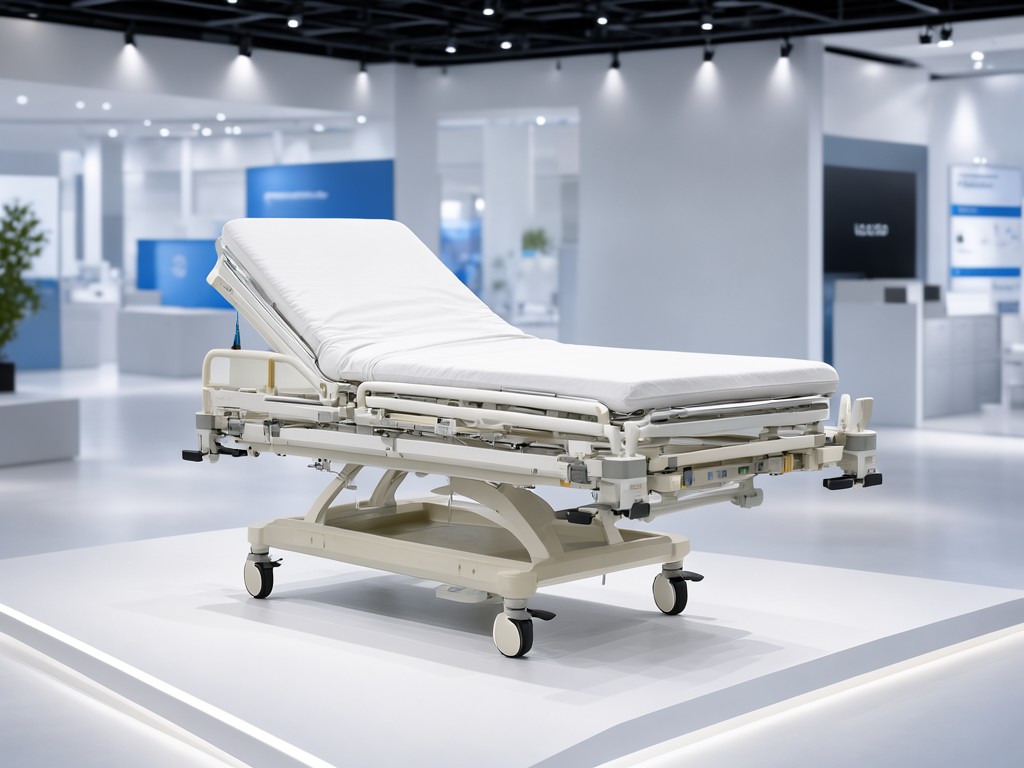
CE Certified electric icu hospital bed Manufacturer: What Buyers Should Check Before Ordering
The selection trade-off for electric ICU beds sits at the intersection of actuator cycle life, frame fatigue resistance, and surface cleanability. A bed rated for 250 kg safe working load may still fail lateral stability testing if the caster housing welds are not inspected per EN 60601-2-52. Buyers qualifying a second source should demand the test report for the specific actuator-under-load profile, not just the component datasheet.
Matching the Product to the Buyer's Need
Weight and stiffness trade off against each other in the chassis design. A 45 kg frame using 1.5 mm rectangular steel tube passes static load tests but deflects 8 mm under dynamic Trendelenburg cycling, accelerating caster stem fatigue. The alternative 52 kg frame with 2.0 mm wall thickness and gusseted joints holds deflection under 3 mm but increases freight cost per container by 18%. The decision rule: if the ward runs continuous 12-hour articulation cycles, specify the heavier frame; for step-down units with intermittent use, the lighter frame saves €120 per unit landed cost.
Actuator specification is where most second-source qualifications stall. The OEM typically specifies a 6000 N push force at 4 mm/s with IP66 ingress protection. A drop-in replacement rated 5000 N at 6 mm/s will pass the bench test but stall under a 180 kg patient in reverse Trendelenburg, triggering the control box fault code. Insist on the force-speed curve at 24 VDC under 40°C ambient, and require the manufacturer to run 10,000 cycles at 110% rated load before first article approval.
Usage Scenarios and Buyer Segments
Public hospital procurement offices in Germany and Nordics require full EN 60601-1 third edition compliance with documented risk management file per ISO 14971. They audit the factory's design history file and expect batch traceability to the steel heat number. Private-label buyers for regional distributors in Eastern Europe often accept a declaration of conformity backed by a Notified Body type-examination certificate, provided the bed passes the local language labelling check and the mattress platform dimensions match the national standard (typically 900 × 2000 mm).
Field service networks drive a different spec. Buyers with in-house biomedical engineers prefer modular actuator pods that swap in 15 minutes without removing the mattress platform. Buyers relying on third-party service contracts demand colour-coded wiring looms and QR-coded service manuals printed on the frame. Both groups reject beds where the CPR release mechanism requires a tool — the lever must be accessible from both sides of the bed and operate with ≤ 25 N force.
| Buyer Segment | Primary Specification Driver | Acceptance Gate |
|---|---|---|
| Public hospital tender | Full risk management file, heat-lot traceability | Notified Body audit + first article inspection |
| Private-label distributor | Type-examination certificate, local labelling | Pre-shipment inspection at factory |
| Service-network buyer | Tool-free actuator swap, QR service manual | Field trial ≥ 30 beds, 6 months |
Keeping Repeat Orders Supplied
The limiting factor is rarely the headline specification — it is the consistency of the powder coat adhesion on the mattress platform after 500 cleaning cycles with 0.5% sodium hypochlorite. Our process locks the cure window at 190°C ± 5°C for 18 minutes with a zinc phosphate pretreatment. A 10°C drift in oven temperature reduces cross-hatch adhesion from 5B to 3B within 200 cycles. We run a daily salt spray coupon (ISO 9227, 96 h) from the production line and hold the batch if any coupon shows creep > 2 mm from the scribe.
Caster supply chain risk is the second most common cause of delivery variance. The 125 mm central-locking casters with conductive tread are single-sourced from two approved vendors. We maintain a 6-week safety stock at our warehouse and qualify a third vendor only after 500 km endurance testing on a loaded bed at 4 km/h over expansion joints. Buyers should ask to see the caster vendor audit report and the current stock cover in weeks — anything below 4 weeks signals a potential line stop.
| Packaging Configuration | Units per 40' HC | Gross Weight (kg) | Stacking Limit |
|---|---|---|---|
| Fully assembled, mattress platform folded, corner protectors | 48 | 1,850 | 2 high max |
| Semi-knocked down (head/foot boards separate), flat pack | 64 | 2,100 | 3 high max |
| Individual carton with EPS foam inserts, retail-ready graphics | 36 | 1,620 | 1 high only |
Care, Storage and Service Life
Fatigue appears at the stress concentration where the head-section hinge pin meets the frame gusset. The design uses a 20 mm hardened pin in a 22 mm reamed bore with a bronze bushing. Under accelerated testing (30 cycles/min, 180 kg offset load), the bushing wears 0.03 mm per 10,000 cycles. At that rate, the 0.2 mm clearance limit for smooth articulation is reached at 65,000 cycles — roughly 4 years in a busy ICU. The maintenance spec calls for bushing replacement at 40,000 cycles, which aligns with the actuator preventive maintenance interval.
Storage conditions affect the control box electrolytic capacitors more than the mechanical components. Warehouses exceeding 35°C or 75% RH accelerate capacitor drying, leading to control board failure within 18 months of installation. We ship with desiccant sachets calibrated for 60 days at 40°C/80% RH. Buyers storing stock beyond 90 days should rotate inventory or request the extended-storage packaging option with nitrogen-flush barrier bags.
Ordering, Tooling and Lead-Time Questions
First article approval follows a three-step gate: dimensional inspection of the welded frame (CMM report on 12 critical points), actuator force-speed verification at temperature extremes, and a 48-hour continuous articulation burn-in with data logging. The buyer's quality engineer can witness any or all gates in person or via live stream. We do not release the production tooling — the fixturing for the frame welding jig and the control box firmware flashing station — until the buyer signs the first article inspection report.
| Order Parameter | Standard Range | Conditional Adjustment | |
|---|---|---|---|
| MOQ (standard config) | 24 units | 12 units with 15% price premium | |
| Lead time (repeat order) | 6-8 weeks | 4 weeks if forecast locked 12 weeks prior | |
| Lead time (new config) | 10-12 weeks | 8 weeks with concurrent engineering review | |
| Tooling deposit | 30% at PO, 70% at FAI pass | Waived for ≥ 200 units/year committed | |
| Artwork approval | Digital proof + physical press sheet | Single digital proof for repeat SKUs |
Frequently Asked Questions
Can the bed be configured with a battery backup that meets IEC 62133-2 for air transport? Yes. The 24 V 12 Ah LiFePO4 pack adds 3.2 kg and passes UN 38.3. It requires a separate charger module and extends the control box enclosure by 45 mm. Lead time adds 2 weeks for the battery qualification lot.
What is the tolerance on the mattress platform height adjustment range? The spec calls for 400-800 mm ± 5 mm. Actual production runs hold ± 2 mm when the linear guide rails are ground in-house. Outsourced rails typically run ± 4 mm. Specify the grinding source in the purchase order if the ± 2 mm tolerance is critical for your mattress supplier's interface.
How is the siderail latch force verified in production? Every 50th unit undergoes a latch force test per EN 60601-2-52 Annex EE: 45-60 N to engage, ≤ 25 N to release. The test fixture is calibrated monthly. We provide the statistical process control chart with each shipment upon request.
Is the control box firmware field-upgradable via USB? The current hardware revision supports encrypted firmware updates through a sealed USB-C port behind the battery compartment. The update package is signed with the manufacturer's private key. Buyers receive the update tool and release notes for each firmware version; we do not push updates automatically.
Request a Qualification Sample
We ship a fully instrumented evaluation bed with data logging enabled on all actuators and the control box. The unit arrives with the first article inspection report, material certificates for the frame and casters, and the cleaning validation protocol. Use it to run your own 30-day ward trial against your current spec.
Start the sample request →