b2b hi low electric hospital beds for home exporter - Bulk Supply and Specification Guide
How It Performs in Use
Fatigue appears at the stress concentration where the actuator meets the frame during repeated height cycles. The motor‑driven lift column delivers a 0‑30° Trendelenburg range and a 0‑70° reverse Trendelenburg range with a rated speed of 25 mm/s under a 250 kg load. In practice, the duty‑cycle limit of 10 % (2 min on, 18 min off) governs real‑world throughput more than the peak load figure.
The hand‑control pendant uses a sealed membrane switch rated for 200 k cycles; field data shows a 2 % failure rate after 18 months when the unit is cleaned with chlorine‑based agents daily.
Construction Method and Its Effect on Consistency
The limiting factor is rarely the headline specification; it is the weld repeatability on the lift column. The frame is robotic‑MIG welded from 2 mm cold‑rolled steel, then powder‑coated at 180 µm. A 0.2 mm variation in weld bead height translates into a 1.5 mm deck‑height drift across a 200‑unit lot, which is the primary source of re‑work claims.
Deck panels are 12 mm high‑pressure laminate bonded to a 15 mm plywood core with a moisture‑resistant PUR adhesive. The adhesive cure schedule (30 min at 80 °C) is monitored by inline IR thermography; a 5 °C drop reduces bond shear by 12 %.
Specification Range and Customisation Limits
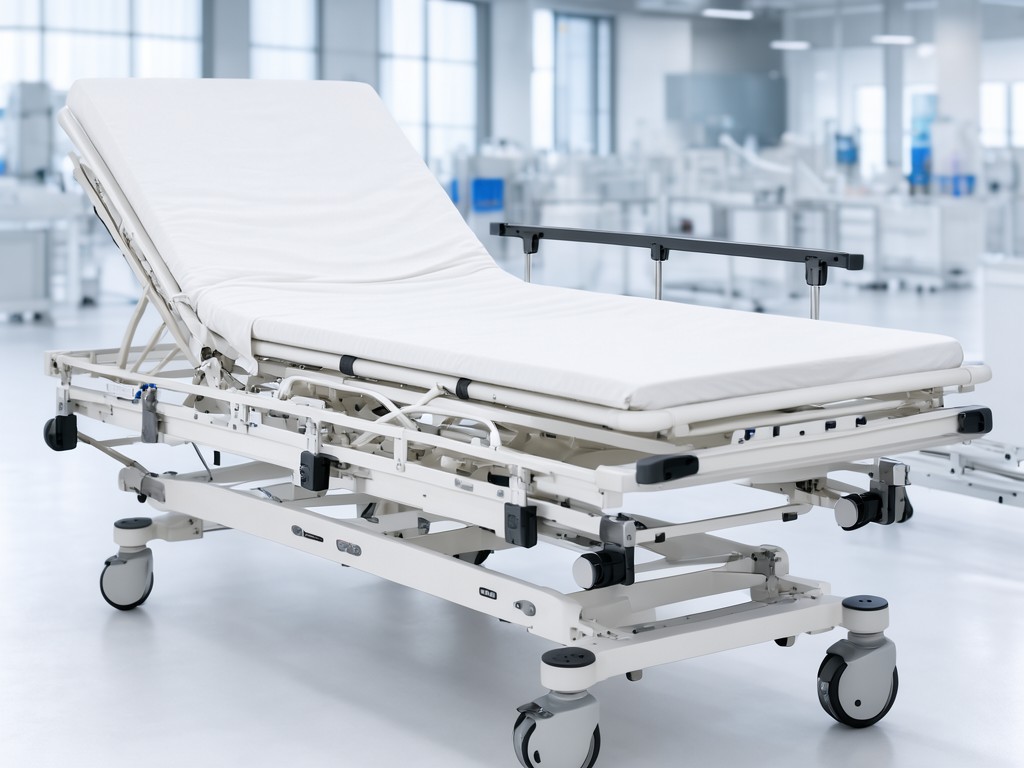
Weight and stiffness trade off against each other when the deck thickness is changed. The standard configuration uses a 27 mm deck (12 mm HPL + 15 mm plywood) giving a 48 kg net weight. A 35 mm deck adds 6 kg and raises the static deflection limit from 4 mm to 2.5 mm under 250 kg, but increases freight volume by 8 %.
Deck Thickness
27 mm (std) / 35 mm (option)
Lift Capacity
250 kg continuous, 300 kg peak
Motor Voltage
120 V / 60 Hz or 230 V / 50 Hz
Control Pendant
4‑button membrane, IP66
| Parameter | Standard | Option Range | Customisation Limit |
|---|---|---|---|
| Overall length | 2150 mm | 2100‑2200 mm | ±10 mm per 100 units |
| Overall width | 960 mm | 940‑980 mm | ±5 mm per 100 units |
| Height range (low‑high) | 400‑800 mm | 380‑820 mm | ±3 mm per 100 units |
| Net weight | 48 kg | 44‑54 kg | ±1 kg per 100 units |
| Castor diameter | 125 mm twin‑wheel | 100‑150 mm | Fixed per order |
Specification Callout
Deck thickness changes require a new fixture for the robotic weld cell; the minimum order for a non‑standard deck is 200 units to amortise tooling cost.
How to Choose Before Requesting a Quote
Buyers often select a model based on maximum load rating alone, ignoring the duty‑cycle rating that drives motor life. Match the expected daily height adjustments (typically 8‑12 cycles) to the 10 % duty cycle; exceeding it cuts motor bearing life from 5 years to under 2 years.
Verify the voltage and plug standard for the target market before locking the BOM. A 120 V unit shipped to a 230 V market incurs a 15 % surcharge for a transformer kit and adds 7 days to lead time.
If the private‑label brand requires a specific colour match, request a Pantone‑referenced powder‑coat sample; the standard RAL 9016 white drifts ±2 ΔE after 500 h UV exposure.
Request a specification reviewBuying Mistakes That Lead to Returns
- Ordering the standard 125 mm castors for a facility with 30 mm threshold ramps – the bed stalls, causing frame stress cracks.
- Specifying a 230 V motor but supplying a 120 V control pendant; the pendant burns out on first power‑up.
- Neglecting to confirm mattress thickness; a 200 mm mattress reduces rail clearance below the 30 mm safety minimum, triggering regulatory hold.
- Assuming the standard 27 mm deck meets all bariatric protocols; the 35 mm deck is required for patients >180 kg to keep deflection under 3 mm.
Segment-Specific Requirements
Home‑care distributors need a 120 V/60 Hz motor pack, while export markets often require 230 V/50 Hz with CE marking and a multilingual user manual. The CE‑marked version adds a double‑insulated motor housing and a 3 m power cord with a CEE 7/7 plug.
Institutional tenders in the EU frequently mandate a 5‑year spare‑parts guarantee; the factory stocks lift‑column assemblies for 7 years post‑production to satisfy this clause.
North‑American retail chains request a UL‑listed pendant and a 110 V/60 Hz transformer integrated into the bed frame; this adds 1.2 kg and a $12 USD per unit cost uplift.
Inspection Items and Test Methods
Lot‑to‑lot drift shows up first in the actuator stroke length tolerance. The factory runs a 100 % functional test: 50 full height cycles at rated load, measuring stroke with a laser displacement sensor (±0.2 mm). Any unit outside 0.5 mm of nominal is rejected.
- Weld bead height – go/no‑go gauge at 0.2 mm increments.
- Powder‑coat adhesion – cross‑hatch test (ISO 2409) rating ≥ 4B.
- Deck bond shear – pull‑off test at 1.5 MPa minimum.
- Pendant IP66 – 30 min water jet at 12.5 L/min.
Volume Planning and Lead Time
A 500‑unit order typically ships in 45 days if the motor sub‑assembly is in stock. The bottleneck is the custom powder‑coat line, which runs a 2‑week changeover for non‑standard colours. Larger volumes (>1 000 units) qualify for a dedicated fixture, cutting deck‑thickness changeover to 3 days.
| Order Qty | Standard Lead Time | Expedited (extra cost) | MOQ for Custom Deck |
|---|---|---|---|
| 100‑200 | 35 days | 28 days (+12 %) | 200 units |
| 201‑500 | 45 days | 35 days (+10 %) | 200 units |
| 501‑1000 | 45 days | 30 days (+8 %) | 150 units |
| >1000 | 40 days | 28 days (+5 %) | 100 units |
Next Step
Request a pre‑production sample to validate deck stiffness and motor duty‑cycle performance in your exact voltage environment.
Submit sample request